

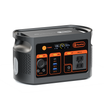
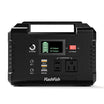

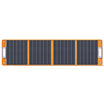
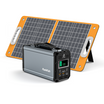
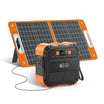
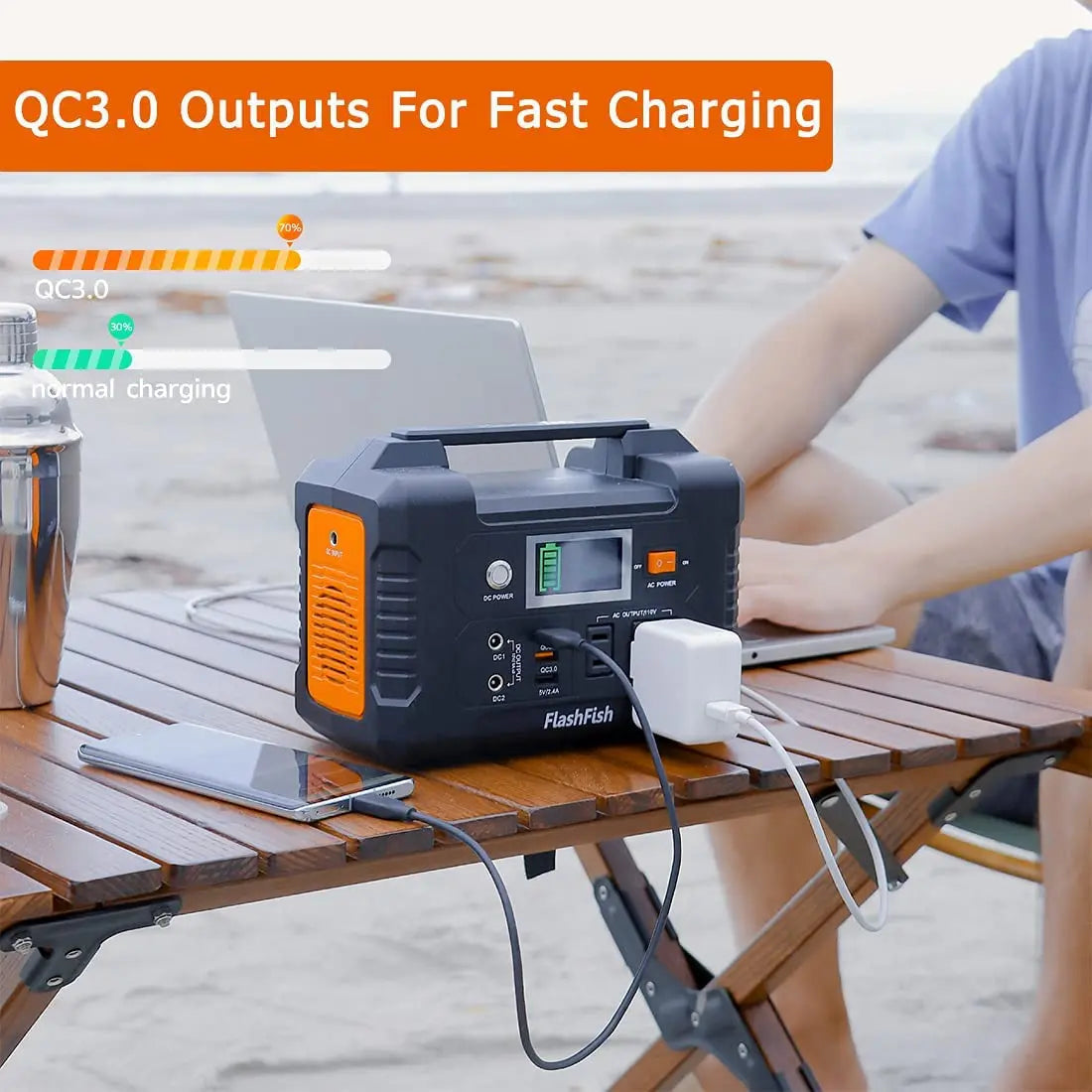
A 300W portable power station is usually the compact choice for phones, laptops, routers, LED lights, cameras, and light camping gear. A 1200W-class station is the step-up tier when your device labels show higher running watts, larger startup surge, longer outage planning, or a need for more solar input headroom. Before choosing either tier, check the device watt label, startup surge, watt-hours, and the station manual instead of assuming an exact runtime. In the FlashFish lineup, the E103 and T300PRO sit in the 300W class, while the T1200S gives buyers a larger 1200W / 768Wh step-up option.
300W vs 1200W: the practical difference
The number on the front of a power station usually points to AC output, not total stored energy. AC watts tell you how much load the station can support at one time. Watt-hours tell you how much stored energy is available before losses, device variation, and user behavior reduce the practical result.
That is why a 300W station can be a good match for a light kit even when it is not the right match for a larger outage plan. It may handle small electronics cleanly, but it should not be treated as a shortcut for heaters, kitchen appliances, HVAC equipment, whole-home circuits, or medical backup. A 1200W-class station expands the load boundary, but it still requires the same device-label check.
Decision table: when each tier makes sense
| Use case | 300W class | 1200W class |
|---|---|---|
| Phone, tablet, camera, small LED light | Usually the simpler fit when ports and output match. | More capacity than many users need for a light kit. |
| Laptop, router, monitor, small fan | Can fit after checking the device label and startup behavior. | Better if several devices run together or the outage window is longer. |
| High-surge motor loads | Often a poor fit unless the surge requirement is clearly within the station limit. | Still requires startup-surge verification before use. |
| Heat-producing appliances | Generally not a good target for a compact station. | Do not assume compatibility; many heat loads are still inefficient or unsuitable. |
| Camping portability | Best when weight and pack size matter. | Better when the campsite load list is larger and vehicle transport is available. |
| Apartment or home-office outage planning | Useful for selected small essentials. | Better for a broader essential-load list after wattage checks. |
| Solar top-up headroom | Limited by the station's input capability. | More headroom when the station supports higher solar input. |
FlashFish 300W-class options
The FlashFish E103 is a 179.2Wh portable power station with 300W pure sine AC output, 90W max DC charging input, and a 3.0kg weight. Its available specifications do not state a separate solar input value or battery chemistry, so compare only the documented values when choosing it.
The FlashFish T300PRO is the stronger 300W-class FlashFish fit when a buyer wants more battery capacity and documented LFP and pure sine specifications. It provides 230Wh capacity, 300W continuous AC output, 600W peak output, LiFePO4 battery chemistry, pure sine AC output, 120W max solar input, and a 4.5kg weight.
For shoppers comparing compact models, the key question is not simply "Can it turn on?" It is whether the device's running watts, startup behavior, expected hours, and charging path all fit inside a compact station's limits.
FlashFish 1200W-class step-up option
The FlashFish T1200S is the main step-up option: a 768Wh LiFePO4 portable power station with 1200W continuous AC output, 2400W peak output, pure sine AC output, 400W max solar input, and a 12.45kg weight.
That larger output and capacity can make sense when the load list moves beyond one or two small electronics. It can also make sense when the buyer wants a more flexible apartment or home-office outage plan. The tradeoff is weight, size, and buying complexity. A T1200S-class station is not the same thing as a hardwired home backup system, and it should not be described as a whole-home solution.
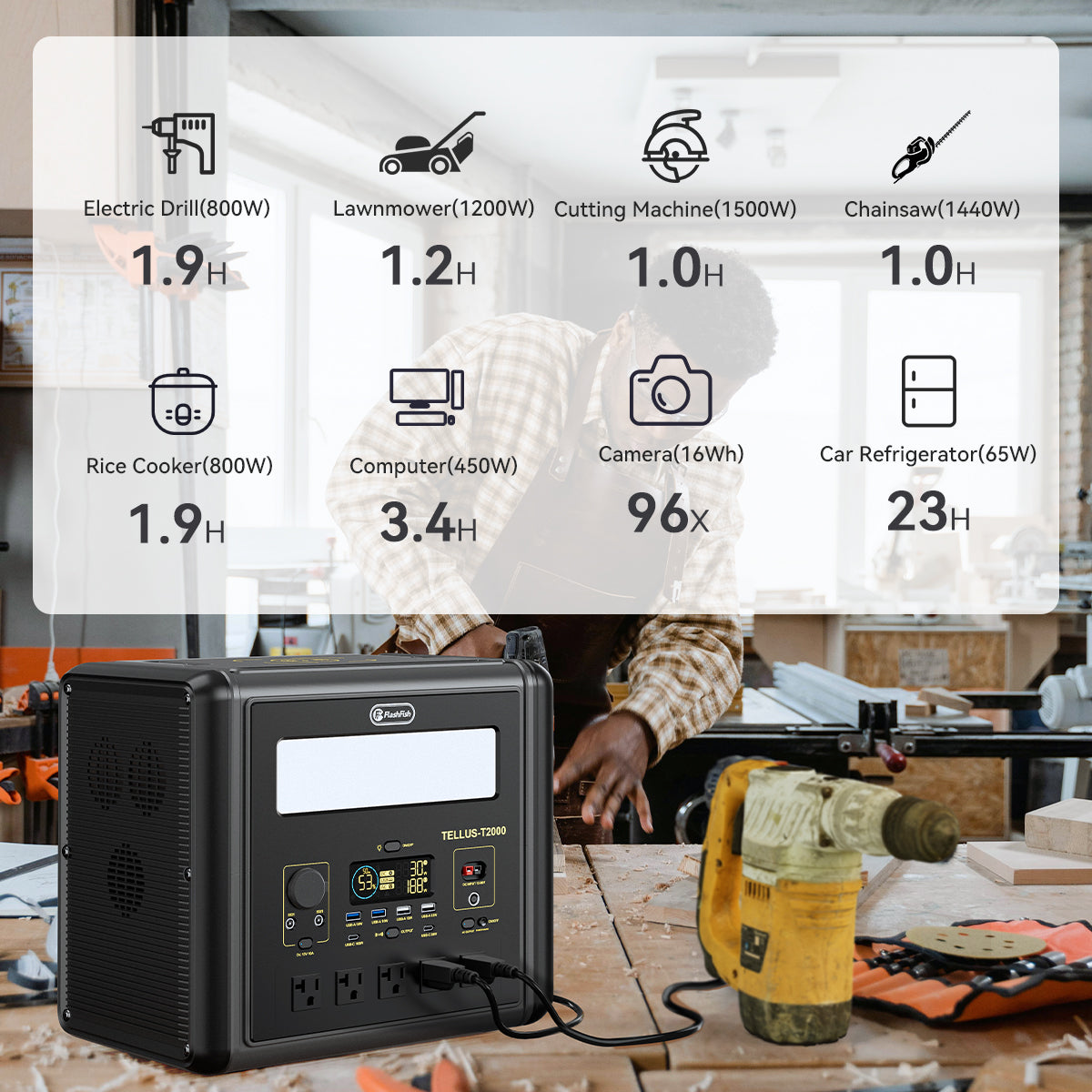
The FlashFish T2000 is the higher tier for users whose verified load list clearly exceeds the T1200S class. It provides 1536Wh capacity, 2000W continuous AC output, 4000W peak output, LiFePO4 battery chemistry, 600W max solar input, and a 19.2kg weight. Consider it only when the additional output and capacity solve a documented need.
When 300W is enough
Choose the 300W class when your list is mostly personal electronics and small campsite or apartment essentials. Good candidates include phones, tablets, cameras, laptop charging, small LED lights, a router, or a small fan after the watt label is checked. This tier also makes sense when you care more about easy carrying than maximum output.
For buyers who want a simple starting point, the FlashFish portable power stations collection gives a clean way to compare compact and larger models without turning the article into a price claim.
When to step up to T1200S
Step up when the load list is no longer just small electronics. A higher-output station can be the better fit when you need to run multiple essential devices at once, when startup surge is part of the decision, when the outage plan is longer, or when solar input headroom matters. The T1200S also fits buyers who want one station to cover camping plus selected home-office outage loads.
Use a simple rule: if the device label, expected usage time, or surge requirement makes the 300W class feel tight, do not force the smaller tier. Move up to a larger class or remove that load from the plan.
When neither tier should be promised
Do not promise compatibility for electric heaters, hot plates, kettles, HVAC systems, large pumps, whole-home wiring, medical devices, or refrigerator food-safety planning from this article. Some of these loads may have high running watts, high startup surge, safety requirements, or manufacturer restrictions that a general blog post cannot verify.
For outage planning, focus on selected essential loads and manual checks. A portable power station can be useful, but it is still a portable battery and inverter system with limits.
FAQ
Is a 300W portable power station enough for camping?
It can be enough for light camping loads such as phones, cameras, laptops, lights, and small fans when the device labels fit the station's output limits. It is not the right assumption for cooking, heating, cooling, or large motor loads.
When should I choose a 1200W portable power station?
Choose a 1200W-class station when your planned devices need more running watts, more surge headroom, more battery capacity, or more solar input headroom than a compact station can comfortably provide.
Does watt-hours matter more than AC watts?
Both matter. AC watts describe the load the station can support at one time, while watt-hours describe stored energy. A buyer should check both before assuming how useful a station will be.
Can a 300W station run a fan or router during an outage?
It may fit if the fan or router label stays within the station's continuous output and any startup behavior is acceptable. Exact runtime varies with device draw, conversion losses, settings, and real-world use.
Is T1200S a whole-home backup battery?
No. T1200S is a portable power station for selected loads. It should not be described as a whole-home backup system, a transfer-switch solution, or medical backup equipment.

Hinterlasse einen Kommentar
Diese Website ist durch hCaptcha geschützt und es gelten die allgemeinen Geschäftsbedingungen und Datenschutzbestimmungen von hCaptcha.