


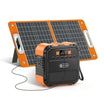

No. The T300Pro EPS switching record alone does not establish that your non-critical device and application will continue uninterrupted. Match the exact station mode and electrical version, obtain the device manufacturer's applicable interruption requirements, and check what the application does when power or a connection changes. If any requirement is missing, record the task as unresolved rather than assume continuity.
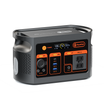
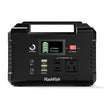
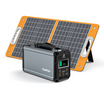
FlashFish T300Pro is also named TELLUS-T300Pro in its manual. The available product specification describes EPS emergency backup, a non-professional UPS function, and approximately 20ms switching. That description is a starting point for a document comparison, not evidence that a particular task survives a transition.
Read the EPS statement in its operating context
The U.S. manual directory links the TELLUS-T300Pro manual; section 3.8 on printed page 8 describes EPS. It concerns the AC-input and AC-output arrangement described there: grid power normally supplies the connected appliance, and the station changes to battery power when grid power fails. Do not extend that description to every input, USB port, or charging arrangement.
The original page uses “within 20mS” wording; the product specification summarizes switching as approximately 20ms. Keep those source descriptions distinct. Neither this article nor a calculation using that figure is an independent measurement or a guarantee for your device. The manual also says the function does not provide zero-millisecond switching and is a non-professional UPS function.
The same section cautions about devices requiring uninterrupted supply and recommends using one device rather than multiple devices in that arrangement. Read the full matching instructions before considering use. This article does not give a connection procedure or authorize a deliberate power-cut test.
Build a station, device, and application matrix
Start by naming the task precisely. “Keep my desk running” hides several separate requirements. “Preserve an editable local note while using one documented device” identifies an outcome you can ask the device and software documentation to address.
| Evidence layer | Record to obtain | What it establishes | What remains unresolved |
|---|---|---|---|
| Exact EPS mode and source | Matching station label, electrical version, manual revision, section 3.8 | The arrangement the manufacturer describes | Whether another port or configuration is covered |
| Switching record | Original manual wording and product specification | A manufacturer-described transition characteristic | Actual task behavior and independently verified timing |
| Device tolerance | OEM documentation for the exact device, adapter, load, and operating conditions | Any documented interruption boundary | Missing tolerance, unmatched conditions, or power-quality requirements |
| Application outcome | Software documentation for saving, reconnecting, and restarting | Documented recovery behavior under stated conditions | Unsaved work, session state, or dependencies not covered |
| Permission and qualification | Applicable manufacturer instructions and unresolved questions | Whether the proposed assessment is permitted and adequately documented | Any missing approval or compatibility evidence |
Do not substitute an input wattage label for interruption tolerance. The label may help with an electrical-load check, but it does not tell you whether a device can ride through a loss of supply. Similarly, a software autosave interval does not establish the hardware's power tolerance.
Compare quantities that describe the same condition
Milliseconds can be compared numerically only after the records' meanings and conditions match. An approximate switching summary and an OEM minimum tolerance under a different load do not establish a verified margin. Even a favorable document comparison would leave the exact application outcome to address.
Ask what would happen to the task if the display stayed on but a connection restarted. Does the application preserve the working file? Does it reconnect automatically? Is an external dependency part of the task? Mark missing answers unknown. No exact device or application documentation was supplied here, so this article approves no actual combination.
Three hypothetical evidence outcomes
These are fictional document-review cases. No transfer test or device behavior was observed.
Hypothetical example 1: the tolerance is absent
A device sheet lists watts and voltage but says nothing about power interruption. Record electrical information in the fit worksheet and mark interruption tolerance unknown. The station's switching description cannot fill that missing OEM field.
Hypothetical example 2: the application requirement is missing
A fictional device has applicable OEM continuity documentation, but the note-taking application's recovery behavior is undocumented. The hardware evidence addresses only one layer. Record preservation of the editing session as unresolved; do not change the overall task to “uninterrupted.”
Hypothetical example 3: a dependency falls outside the proposed arrangement
A fictional desk task needs a separate network device as well as the main device. The proposed one-device EPS arrangement leaves that dependency outside its scope. Record the gap. Do not add another device by inference or treat a powered screen as proof of a continuous session.
Where T300Pro specifications help, and where they stop
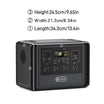
The documented product specification and the linked manual's printed page 2 identify 230Wh capacity and a total 300W continuous, 120V/60Hz pure-sine AC output. Those ratings support a separate exact-load assessment. They do not supply the receiving device's interruption tolerance, a runtime for your task, or assurance that saved work remains intact.
This worksheet is limited to non-critical tasks. It does not qualify medical equipment, essential services, servers, hardwired loads, or professional UPS applications. A compatibility assessment must retain the matching manual's restrictions and all applicable device instructions.
FAQ
Does EPS mean there is no interruption?
No. The matching manual expressly excludes zero-millisecond switching. Device and application requirements still need their own evidence.
Does a load below 300W prove continuity?
No. Load rating and interruption tolerance answer different questions. The full electrical assessment and application behavior also matter.
Should I pull the power cable to find out?
This article does not authorize that test. Obtain the applicable instructions and any required approval first. A missing document should remain an evidence gap.
Finish with a documented task decision
Collect the exact T300Pro manual, the device OEM requirements, and the application recovery documentation. Fill in the matrix for one non-critical task. Use the model's documented details to resolve the station side, and leave the task unresolved whenever tolerance, operating conditions, or application evidence is missing.
Next step: View the current FlashFish T300Pro product details.


Hinterlasse einen Kommentar
Diese Website ist durch hCaptcha geschützt und es gelten die allgemeinen Geschäftsbedingungen und Datenschutzbestimmungen von hCaptcha.