

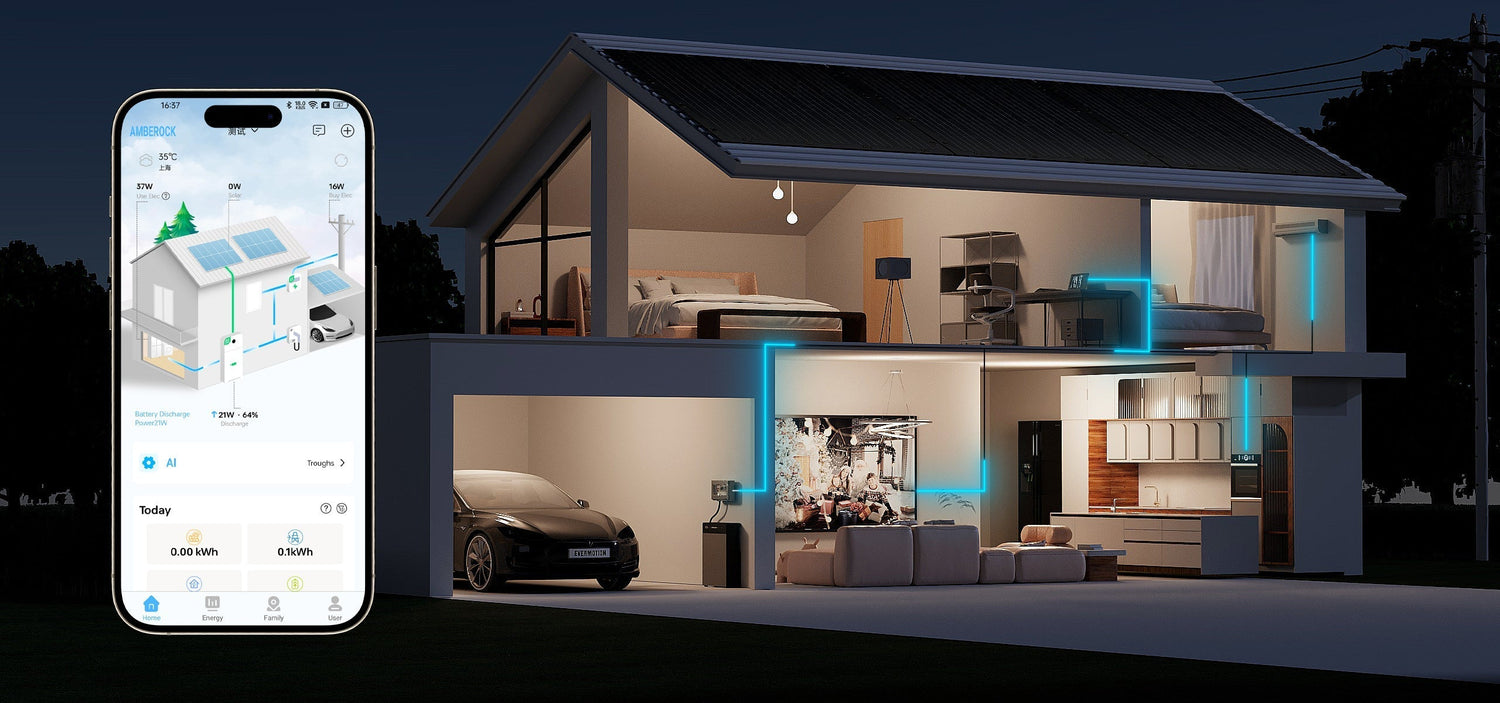
Quick answer: FlashFish SR5000 can be evaluated for time-of-use or variable-tariff load shifting in a compatible 230V, 50Hz installation, but the product database does not provide a fixed bill-saving percentage, predefined payback period, or named electricity-supplier integration. A qualified installer must confirm the electrical design, grid process, PV limits, controls, and regional eligibility before purchase or installation.
U.S. market note: The local product database does not provide U.S. availability or U.S. electrical compatibility for FlashFish SR5000. Its documented 230V, 50Hz record should not be treated as a U.S. residential installation claim.
Verified FlashFish SR5000 specifications
| Stored energy | 5120Wh; 51.2V, 100Ah |
|---|---|
| Battery | LiFePO4; more than 6,000 cycles at 25 degrees C |
| Documented AC context | 230V, 50Hz |
| Rated off-grid output | 2400W |
| Maximum output record | 3600W for 10 seconds |
| PV input | Two inputs, up to 1000W each; maximum 100V DC |
| Communications | WiFi, Bluetooth, and RS-485 |
| Ingress record | IP65 |
| Size and weight | 520 x 181 x 715mm; 59 +/- 2kg |
These values come from the local FlashFish product database extracted from the SR5000 manual. The original installation documents still need to be checked before a listing-critical or installation-critical decision.
What variable-tariff load shifting means
Load shifting means charging storage during a selected period and using stored energy during another period. Whether that reduces a bill depends on the actual import prices, export terms, household load profile, solar generation, conversion losses, reserve settings, installed configuration, and how often the price spread is large enough to matter.
The product database documents communications and monitoring features, but it does not identify a supported tariff provider, automatic price feed, utility API, or universal scheduling workflow. Ask the installer to demonstrate the exact control path included with the proposed system.
Calculate a scenario before discussing savings
| Input | Evidence to collect |
|---|---|
| Import price by period | The customer's current tariff document |
| Export payment and conditions | The supplier's current export terms |
| Household demand by time | Interval meter data, not a monthly total alone |
| Solar production | Site-specific generation records or an installer model |
| System losses and reserve | The proposed configuration and commissioning settings |
| Installed cost | A written quotation including required electrical work |
A simple gross spread is the avoided import price minus the cost of the energy used to charge the battery. It is not net savings until losses, export opportunity, standby use, equipment cost, tariff changes, and maintenance assumptions are included.
Installation and grid checks come first
The SR5000 source requires grounding, qualified-technician installation and maintenance, and at least 150mm clearance around the top and rear for heat dissipation. It is not a plug-in balcony appliance.
For UK installations, GOV.UK battery-storage guidance says the installer must determine the applicable Distribution Network Operator notification or application process. Ofgem's Smart Export Guarantee information should be checked for current supplier and eligibility details.
Questions to give the installer
- Is this exact SR5000 variant compatible with the property voltage, frequency, grid connection, and installation location?
- Which DNO, building, isolation, grounding, and protective-device requirements apply?
- How will each PV string remain within the documented voltage and input limits?
- Which monitoring, scheduling, and remote-control functions are included in this configuration?
- Which tariff data is entered manually, and which data can be imported automatically?
- What commissioning records, owner documents, warranty terms, and maintenance plan will be supplied?
Related FlashFish SR5000 planning articles
Use these current FlashFish pages and guides to continue your comparison:
- Read the German FlashFish SR5000 cost-planning article
- Review FlashFish SR5000 UK installation checks
- Compare home backup batteries and portable power stations
Frequently asked questions
Does FlashFish promise a 30% or 40% bill reduction?
No. The product database does not provide a verified savings percentage. Results depend on the tariff, property, solar generation, installed configuration, losses, and usage.
Can SR5000 connect automatically to every variable tariff?
The product database does not provide a list of tariff-provider integrations or a universal automatic tariff workflow. Confirm the exact controls with the installer.
Can a homeowner install SR5000 without an electrician?
No. The product source requires installation and maintenance by qualified technicians, along with grounding and clearance requirements.

Laisser un commentaire
Ce site est protégé par hCaptcha, et la Politique de confidentialité et les Conditions de service de hCaptcha s’appliquent.