

A phone light-meter number alone does not establish the solar energy available to a portable panel or the electrical power entering a station. Keep the reported quantity and units attached to each reading. Without a documented measurement chain for the exact phone, app, sensor, and panel, a lux reading provides no verified conversion to panel watts.
The practical decision is whether your evidence measures the quantity you need. A screen showing a precise number can still leave that question unanswered. This guide provides a measurement worksheet; it does not calibrate a phone or estimate solar yield.
Follow the quantity through the chain
Begin with the app documentation: what does the displayed value claim to measure, which sensor provides it, and what limitations are stated for the exact device? Record whether the unit is lux, watts per square meter, watts, or something else. If the app does not document the quantity, write unknown instead of relabeling the number.
Lux is a unit of illuminance, while irradiance is expressed in watts per square meter and electrical power in watts. NIST's SI tables distinguish those quantities and units. NIST's photometry guidance explains that photometric measurement accounts for human visual sensitivity; it is not simply a measurement of all incoming radiant power. A number labeled lux therefore answers a different question from panel input watts.
The Solar Resource Glossary likewise describes irradiance using power per area. Before accepting a conversion, require the method to explain how it relates the sensor's response and measurement plane to the intended solar quantity, then to the panel's electrical output. These definitions support the distinction; they do not validate any phone, app, or conversion factor. A calculator asking only for an app number and panel rating leaves that relationship undocumented.
Use a measurement evidence table
| Instrument or record | Reported quantity and unit | Boundary to document | What it can support | What remains unsupported |
|---|---|---|---|---|
| Exact phone and app | Copy the app's stated quantity; retain lux if shown | Sensor identity, documented response, calibration, position, and app method | A record of what that setup reported | Verified irradiance or panel watts without the missing conversion evidence |
| Documented irradiance instrument | Its specified irradiance quantity, typically W/m² | Calibration, measurement plane, response, and conditions | The quantity within that instrument's documented scope | Electrical charging output without the panel and system evidence |
| Panel specification | Nameplate power in W | Exact model and applicable rating conditions | The documented product rating | Actual output for the present session |
| Receiving-station display or appropriate meter | Documented electrical input reading in W, if provided | Measurement location, accuracy, and what the display includes | The documented electrical reading at that point | Solar irradiance or phone calibration |
Add a document title, revision, and page beside each row. No exact phone, app, irradiance instrument, or receiving-station meter is evaluated in this guide, so the table grants none of them a capability. Use the documentation for your actual instrument; the mere presence of a sensor or display does not establish the proposed measurement.
Product fit: two panel ratings, no predicted yield
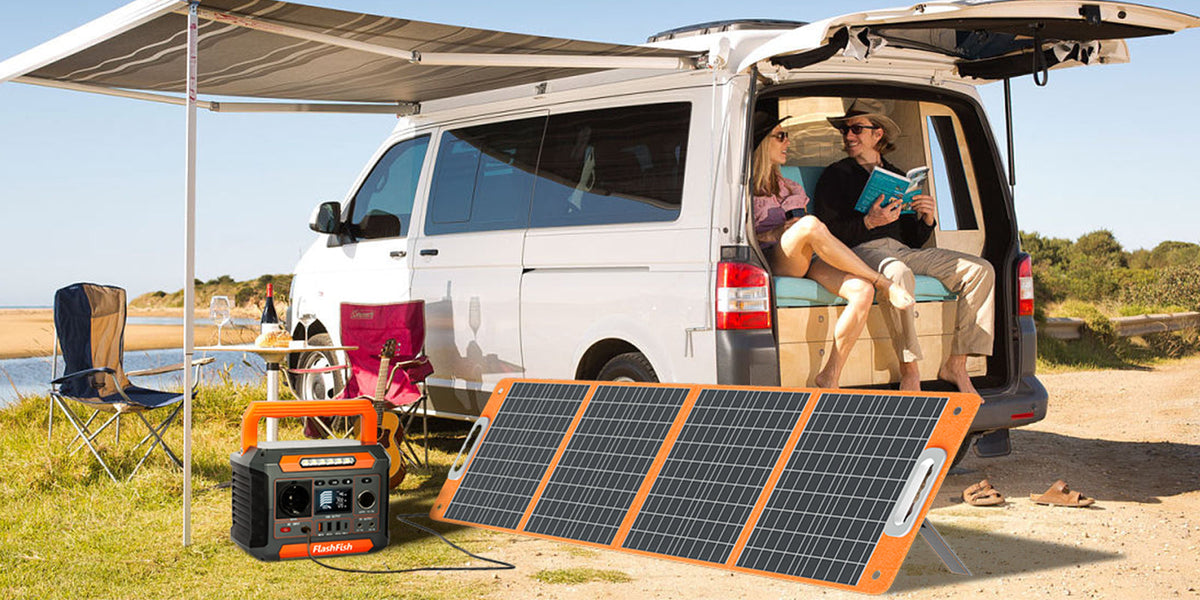
FlashFish TSP18V60W is specified at 60W and TSP18V100W at 100W; both have an 18V DC output specification. See specification page 1 in the TSP18V60W manual and TSP18V100W manual. Those are product ratings, not readings taken beside a phone or observed output from your charging session.
The panel manuals note that charging conversion depends on sunlight angle, temperature, weather, and charging time. They provide no conversion from a phone's lux reading to panel output. No exact phone, app, or sensor has been evaluated here. A larger panel rating cannot fill that missing measurement evidence.
Compare these models only after identifying your receiving equipment, input limits, exact connector and polarity, and intended use. Do not infer compatibility from the shared 18V description. Matching original manuals remain necessary for connection instructions and any listing-critical technical claim.
Why a simple percentage can mislead
Suppose an app number rises. Without its documented measurement method, that change does not establish a proportional rise in charging power. Multiplying the number by 60W or 100W merely combines an app result with a panel rating; it does not create the missing physical relationship.
Even a separately documented irradiance reading would leave additional questions: which area is relevant, which operating conditions apply, and what evidence describes conversion and accepted input? This article assigns no values to those unknowns. It also makes no calculation from phone lux to W/m², panel output, charge time, or runtime.
Three hypothetical evidence decisions
Example 1: An app shows a lux value
A beginner records the number and unit but has no app or sensor specification. The worksheet preserves it as an app-reported light reading. The irradiance and electrical-output cells stay unknown.
Example 2: Two phones disagree
Two devices report different numbers near the same panel. The reader records each phone, app, and measurement position. Averaging them would not establish a calibrated solar reading, so no panel-power estimate follows.
Example 3: A station shows input power
A reader has documentation describing an input-power display. The reader labels that observation as an electrical reading at the documented point. It does not retroactively turn a nearby phone's lux value into an irradiance measurement. This is a fictional case, not a FlashFish display test.
FAQ
Is there a universal lux-to-panel-watts formula here?
No. No validated conversion for an exact phone, app, sensor, and panel is supplied. Keep the quantities separate rather than invent a factor.
Does a higher phone number prove that a 100W panel is producing more than a 60W panel?
It does not establish either panel's electrical output. The model ratings and the app observation need separate evidence.
Should I buy an instrument before choosing a panel?
First identify the decision you need to make. If you only need to check documented equipment fit, a new instrument may not resolve that task. If you need a defensible measurement, establish the required quantity and instrument documentation before choosing a method.
Choose the next document before the next conversion
Write your desired quantity at the top of the worksheet, gather the exact device and panel documents, and mark each unsupported step unknown. Use the verified FlashFish specifications to compare equipment fit; keep any yield estimate pending until its measurement evidence exists.
Next step: Compare FlashFish TSP18V60W specifications with your requirements.

Laisser un commentaire
Ce site est protégé par hCaptcha, et la Politique de confidentialité et les Conditions de service de hCaptcha s’appliquent.