

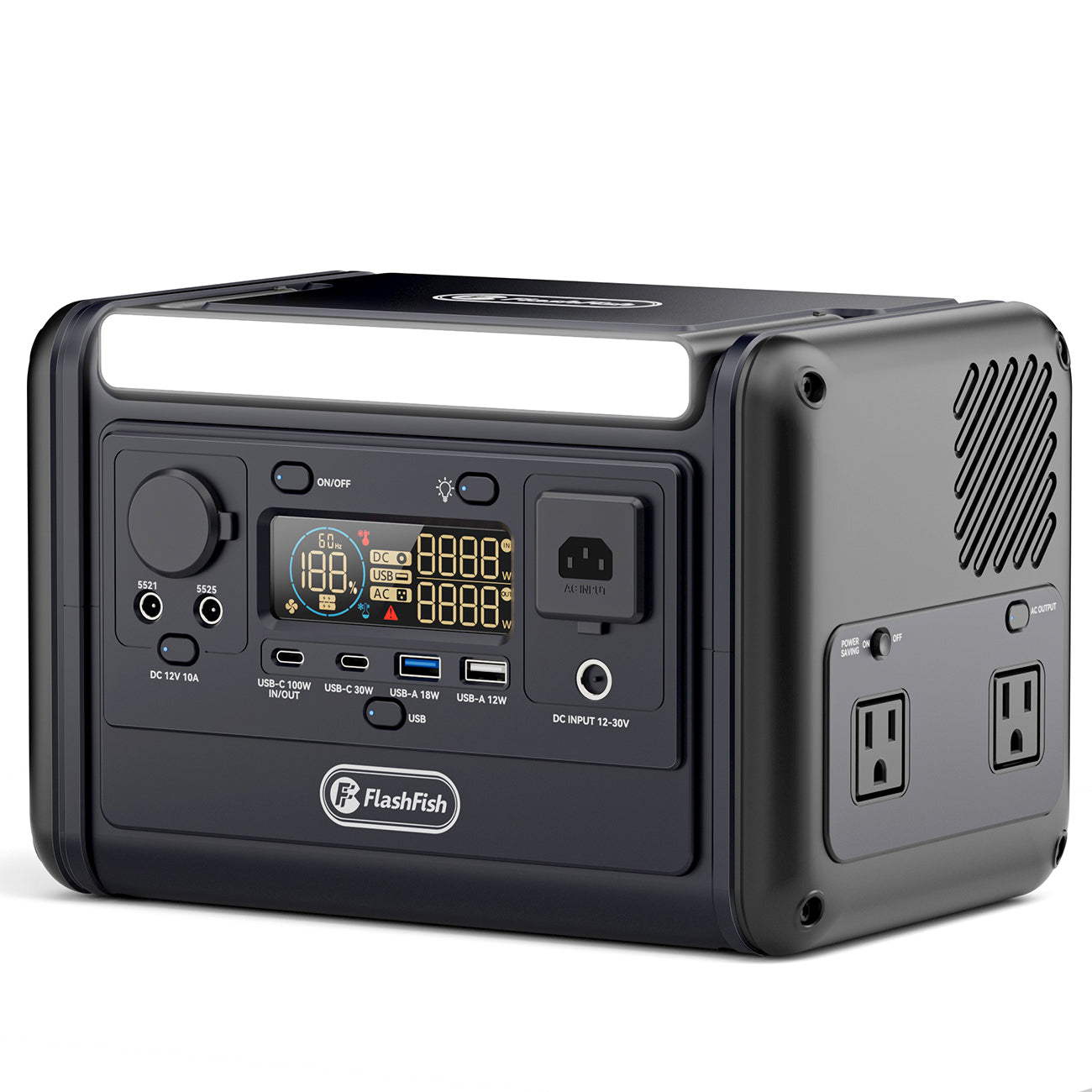
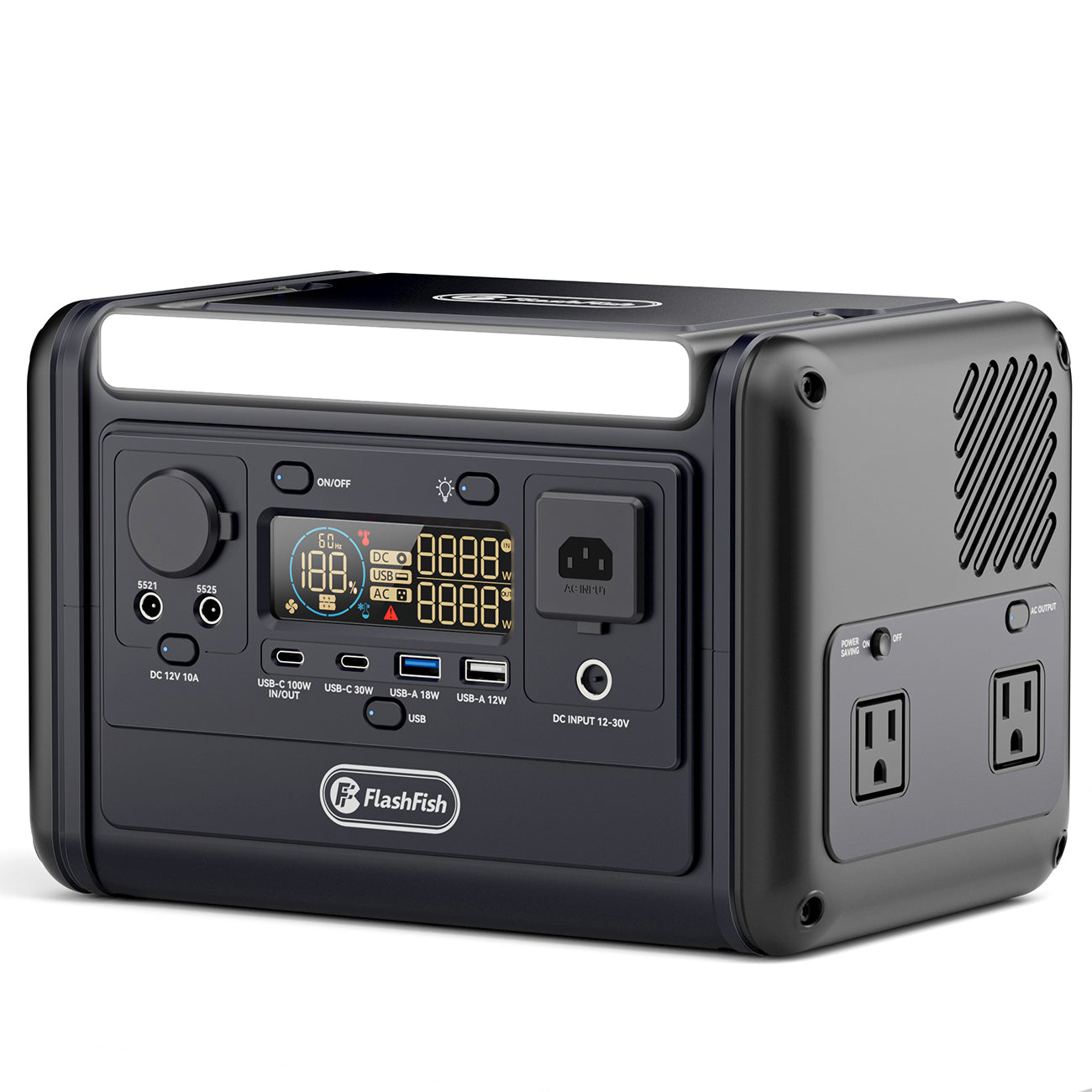
Quick answer: A portable power station combines a battery pack, battery management system, inverter, charging controller, output ports, controls, display, wiring, cooling path, and enclosure. Each part has a different job, and no single component proves that a station fits every device or environment.
Core components at a glance
| Component | Main job | What shoppers should verify |
|---|---|---|
| Battery cells | Store electrical energy in chemical form | Chemistry, watt-hours, cycle wording, and manual care instructions |
| Battery management system (BMS) | Monitors selected pack conditions and controls protective responses | The exact protection list for the model |
| Inverter | Converts battery DC into AC output | Continuous watts, peak watts, voltage, frequency, and waveform |
| Charging controller | Manages supported charging inputs | Input voltage, current, wattage, connector, and allowed combinations |
| DC and USB circuits | Provide non-AC output paths | Port type, per-port maximum, and shared limits |
| Display and controls | Show status and switch output groups | Indicator meaning, shutdown behavior, and power-saving settings |
| Cooling and enclosure | Manage heat and physical protection | Vent clearance, temperature range, moisture limits, and placement |
Battery cells store energy
Watt-hours describe stored energy. Chemistry and pack design influence other characteristics, but the exact model documentation remains the source for capacity and cycle records. The Department of Energy explains that batteries store energy as chemical potential and release electricity through an external circuit in its battery fundamentals guide.
A BMS has model-specific limits
A BMS can monitor conditions such as voltage, current, charge state, and temperature, then respond according to its design. Protection lists differ by model. Do not translate the presence of a BMS into an absolute promise against damage, fire, overload, or incompatible use.
For example, the local product database lists high-temperature, low-temperature, over-discharge, overcharge, overload, short-circuit, and over-current protection for FlashFish T2000. Those records apply to that model; they should not be copied to another station without its own source.
The inverter determines the AC path
Continuous watts describe sustained output. Peak watts describe a short-duration record and should not be added to continuous output. Waveform also matters: the FlashFish E200 database record identifies modified sine wave AC, while T300PRO, T1200S, and T2000 records identify pure sine wave AC. The connected device manufacturer still determines whether a waveform is acceptable.
Charging input and output are separate systems
A station can have different AC, DC, solar, USB-C, and vehicle charging limits. Likewise, one USB port's maximum does not establish the total available across every port. Check shared-output notes, connector requirements, and input-voltage ranges before connecting a panel or adapter.
EPS is not a universal UPS promise
An emergency power supply feature and a professional uninterruptible power supply are not interchangeable terms. Switching time, load support, and device tolerance must all be documented. The FlashFish T300PRO manual describes a non-professional EPS with about 20ms switching; that record does not establish suitability for servers, medical equipment, or every sensitive device.
Frequently asked questions
Does a BMS make a power station risk-free?
No. A BMS is one layer of the design. Users still need to follow load, charging, temperature, ventilation, moisture, storage, and inspection instructions.
Why does waveform matter?
Some AC devices specify the quality of the input they require. Check the device documentation and the exact station waveform rather than assuming compatibility.
Where can I compare current models?
Use the FlashFish portable power station comparison, then verify the linked product page and manual for the model under consideration.

Laisser un commentaire
Ce site est protégé par hCaptcha, et la Politique de confidentialité et les Conditions de service de hCaptcha s’appliquent.