


Trail volunteers can plan portable power for a check-in tablet, radio chargers, and phones by treating the setup as a documentation exercise first. Identify the essential devices, confirm their exact connectors and labels, check current land-manager rules, and choose a protected setup location. A portable power station can support a carefully verified low-draw plan; it does not guarantee radio compatibility, outdoor suitability, or runtime.
Quick answer
Bring only the equipment that supports the check-in task, then verify every device’s charger, connector, and instructions against the station documentation. Put communications first, keep the station and cables organized, and make an alternate plan if weather or site conditions change. Do not infer a radio or tablet recommendation from a station’s capacity or output rating.
Decide what is essential at the trailhead
| Check-in item | Verification needed | Why it matters |
|---|---|---|
| Tablet | Its approved charger, input label, and cable | It keeps volunteer records separate from assumptions about charging. |
| Handheld radio | The radio maker’s charger, battery, and operating instructions | Connector fit alone does not establish compatibility. |
| Phones | Approved charging cable or adapter | Each device may use a different charging path. |
| Check-in materials | Paper backup, map, and contact plan | They reduce reliance on a single power setup. |
Compare the connection path, not just the station label
Record the stated input requirement for each charger or power supply, along with the exact cable and connector. Then compare those records with the station’s documented outputs. A capacity figure can help frame planning, but it cannot tell you how long a specific tablet or radio will run. Keep radio-specific decisions with the radio manufacturer’s documentation and the volunteer group’s communications plan.
Use FlashFish documentation as a planning reference
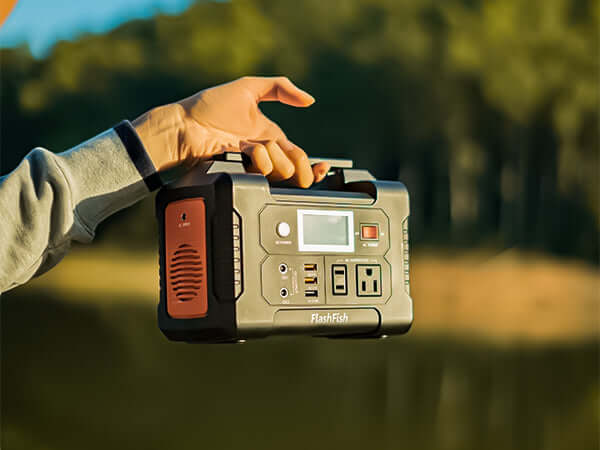
The FlashFish E103 is documented with 179.2Wh capacity, LiFePO4 battery chemistry, and 300W continuous pure-sine AC output. The FlashFish TELLUS-T300Pro is documented with 230Wh capacity, LiFePO4 battery chemistry, and 300W continuous pure-sine AC output. Treat these as product-documentation references for a label-first review. Confirm current U.S. model configuration, available ports, and the exact device connection before choosing either model for a specific trailhead setup.
Plan around the site and conditions
Ask the land manager or event lead about current rules for the meeting point, equipment placement, and access. Select a stable, protected location that does not obstruct the trailhead, parking area, or emergency access. Keep cables contained and do not continue the setup if weather, ground conditions, or the planned connection makes safe placement uncertain.
Volunteer check-in checklist
- Choose the essential check-in and communications devices.
- Verify each device label, manufacturer charger, connector, and cable.
- Compare the planned connection one device at a time with station documentation.
- Confirm current land-manager or event-lead rules.
- Bring a paper backup and relocate or pause if conditions change.
Related field check-in power resources
Use these current FlashFish pages and guides to continue your comparison:
- Browse current portable power stations
- Choose a portable station for an outdoor setup
- Compare a power station with a power bank
FAQ
Can a portable power station charge a volunteer radio?
Only if the exact radio, charger, cable, and station connection are supported by their documentation. Do not assume from the radio type or connector alone.
How long can the station support a check-in table?
Do not make a universal runtime estimate. Actual use depends on the specific devices, charging path, and conditions.
Do trailhead rules matter for a small charging table?
Yes. Confirm the current land-manager or event-lead requirements for the actual site and keep access routes clear.


Laisser un commentaire
Ce site est protégé par hCaptcha, et la Politique de confidentialité et les Conditions de service de hCaptcha s’appliquent.