

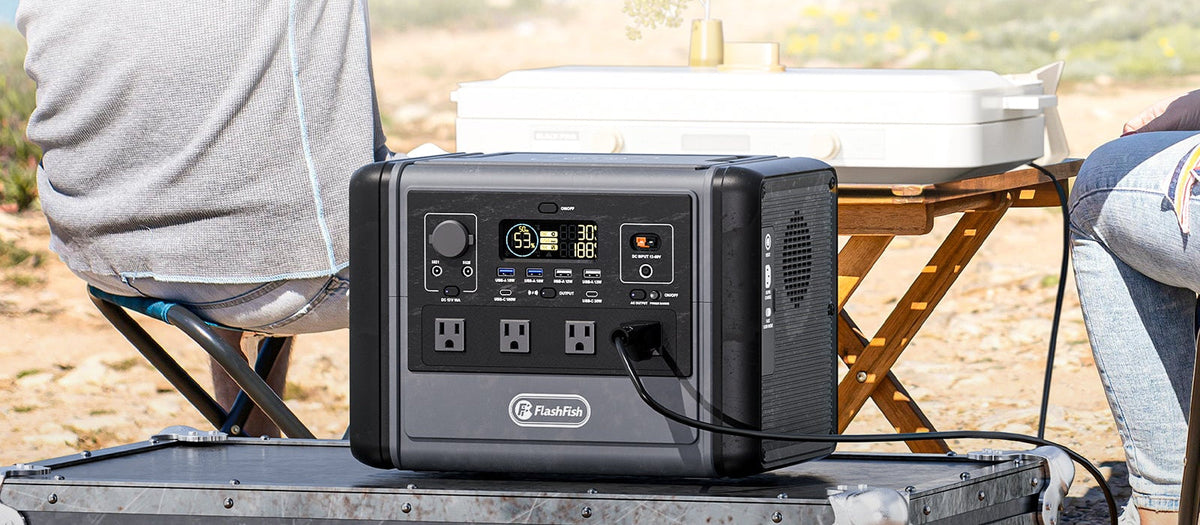
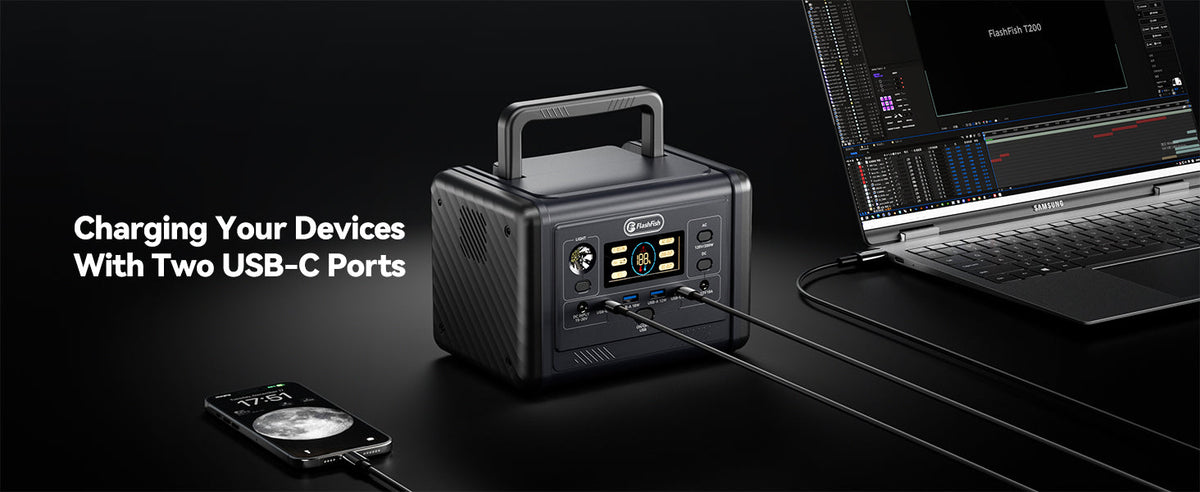
Choosing FlashFish T1200S instead of T300Pro does not raise the listed maximum of either USB-C port: both models list one USB-C output up to 100W and another up to 30W. T1200S has more stored energy and a higher continuous AC rating, but those are different specifications. The listed port ceilings alone do not establish a faster charging rate for your laptop, phone, or tablet.
Separate three numbers that answer different questions
| Specification | T300Pro / TELLUS-T300Pro | T1200S / TELLUS-T1200s | What it describes |
|---|---|---|---|
| Battery capacity | 230Wh | 768Wh | Listed stored energy |
| Continuous AC output | 300W | 1200W | AC output rating, not USB-C charging speed |
| First USB-C port | Up to 100W | Up to 100W | The individual listed port ceiling |
| Second USB-C port | Up to 30W | Up to 30W | The other individual listed port ceiling |
| Weight | 4.5kg | 12.45kg | The carrying burden of the station |
Both manuals list LiFePO4 batteries and pure-sine AC output. Those characteristics do not turn the AC rating into a USB-C rate. Read W and Wh with their headings: watts describe a power rating, while watt-hours describe an energy quantity.
Use the port ceiling as a screening value
A 100W ceiling is a maximum listed specification, not a statement that every connected device draws 100W. The device must support the intended charging method, and its accepted requirements must match the station's documented output and the cable. Resolve those details from the exact manuals before treating a connection as confirmed.
The larger model does not remove any of those checks. If a laptop's charging requirements are unknown, both models remain unconfirmed for that laptop. If you are comparing AC adapters instead, begin a separate AC assessment; do not carry a USB-C conclusion across to the adapter route.
Compare three USB-C purchase decisions
- A laptop whose documentation calls for more than 30W: the 30W port ceiling is insufficient for that stated requirement on either model. Assess the 100W port only if all documented charging details fit. Moving to T1200S does not increase the second port's listed ceiling.
- A phone with documented USB-C charging requirements: verify its supported method and cable first. Neither 768Wh capacity nor 1200W AC output establishes a faster phone charge than T300Pro's USB-C ports.
- A laptop and tablet intended to charge together: assess each device and the station's shared-output instructions. Do not add 100W and 30W and present 130W as a confirmed simultaneous allowance.
These are hypothetical documentation checks, not measured charging tests. They deliberately lead to a port decision or an information gap rather than an invented charging-time comparison.
When the larger battery is still relevant
T1200S's 768Wh capacity may be relevant when you are comparing stored-energy needs across a documented usage plan. T300Pro lists 230Wh and weighs less. This creates an energy-and-carry trade-off even though the two USB-C ceilings are the same.
That comparison is not a runtime calculation. A capacity ratio does not establish how many charging sessions either model delivers, and it does not prove that a session finishes sooner. Actual demand, operating pattern, starting charge, and output behavior still matter. Do not substitute a capacity figure for a device-specific charging record.
Record the reason for paying for the larger model
Write one sentence explaining which documented need the larger capacity or AC rating addresses. If the sentence is only “I want faster USB-C because the battery is bigger,” the listed specifications do not support it. Obtain the exact charging evidence rather than treating the upgrade as a rate guarantee.
If other loads require AC, keep their requirements on a separate worksheet. T300Pro's documentation lists a 120V AC configuration; T1200S distinguishes 110V U.S. and 230V regional versions. Confirm the exact unit and regional manual. This USB-C comparison does not approve an AC connection, interruption-free backup, or a household power arrangement.
Build a port-focused shortlist today
Collect the device's charging instructions, the intended cable details, and the exact station manual. Record the port you would use and every unanswered requirement. Only after that match is documented should capacity and carrying weight decide between otherwise suitable options.
The result can be “neither confirmed yet.” That is a useful purchasing outcome when it identifies the missing evidence. It is better to resolve a particular charging profile than repeatedly compare unrelated headline AC numbers.
Frequently asked questions
Does T1200S have a higher maximum USB-C rating than T300Pro?
No. Both list one USB-C output up to 100W and another up to 30W. The larger AC rating and battery capacity do not change those listed ceilings.
Will the same laptop charge at exactly the same speed on both?
This comparison does not establish actual speed on either model. Matching port ceilings are specifications; an exact-device charging result requires separate evidence.
Can I use both USB-C maxima at once?
Do not infer a simultaneous allowance by adding the two maxima. Check the exact station's shared-output instructions and both devices' requirements.
Why consider T1200S if USB-C ceilings are the same?
Its higher listed capacity or AC rating may address a separate documented need. Weigh that benefit against its 12.45kg weight, compared with T300Pro's 4.5kg.
Next step: Compare FlashFish T300Pro specifications with your requirements.


Laisser un commentaire
Ce site est protégé par hCaptcha, et la Politique de confidentialité et les Conditions de service de hCaptcha s’appliquent.