

Price a two-device travel power kit as a current, itemized purchase—not as a single promised total. For a phone, tablet, and their original adapters, record the current listed price of the exact power-station variant, any required cables or adapter replacements, the carry weight, and the rules at the planned stop or lodging. Avoid turning capacity into a runtime guarantee or assuming a portable battery is allowed everywhere.
Make a current-cost worksheet before you compare models
| Line item | What to verify | Why it belongs in the budget |
|---|---|---|
| Exact power-station variant | Current price, market-specific version, and what is included on the current listing | Prices, bundles, and listings can change. |
| Phone and tablet charging path | Original adapters, cables, connector condition, and device-label requirements | A connector that fits is not proof that an adapter is appropriate. |
| Carrying plan | Product weight plus the actual accessories and bag | The kit has to be practical to carry where it will be used. |
| Location plan | Lodging, transit, site, or airline rules for the exact itinerary | Permission and transport rules are separate from a product specification. |
What the A101 and E200 records can tell you
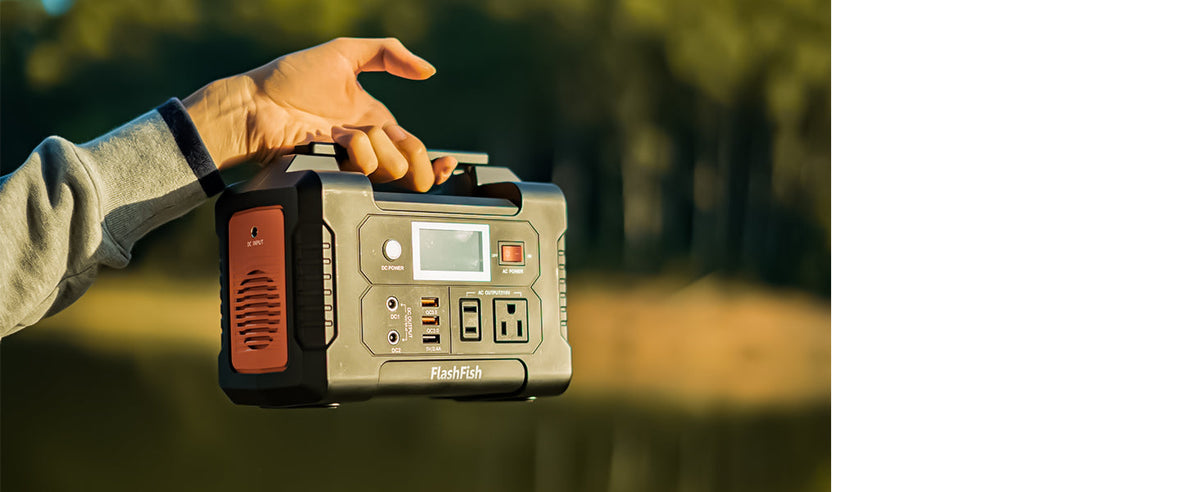
FlashFish A101 is documented at 97.68Wh with 120W continuous AC output and a listed weight of 1.2kg. Its source record describes a regional AC socket variation, so do not treat the recorded 230V specification as confirmation of a U.S. unit. The record also says airline and airport rules still apply even though the manual FAQ describes capacity below 100Wh.
FlashFish E200 is documented at 151Wh, 200W continuous modified-sine AC output, and about 1.85kg net weight. Its manual says the unit cannot be brought on board. These are technical and manual-record facts, not a current listing, stock, or price statement.
Separate the purchase decision from the travel decision
A lower product price does not settle whether a kit is right for an itinerary. A traveler also needs the applicable carrier rules, the property or venue rules, a safe place to use and store the equipment, and the labels for the phone, tablet, and original adapters. Check those sources close to the trip because policies and listings can change.
Keep the connection plan modest and documented
For occasional, low-draw use at a permitted stop or lodging, list the two devices and their normal charging accessories. Use only the connection path supported by their labels and manuals. Do not use a price worksheet to imply that an AC outlet, USB port, or battery capacity will deliver a particular runtime or work with every charger.
A three-step buying decision
- Check the current price and included items for the exact U.S. product variant you are considering.
- Compare documented capacity, output, and weight with the actual device and adapter labels.
- Confirm the travel or lodging rules before treating the kit as part of the itinerary.
Product fit: use a current listing only at the final step
A101 and E200 provide two documented reference points for a compact two-device comparison. The final choice should use the exact currently offered model and market variant, not an older specification alone. If the listing, manual, device labels, and trip rules do not align, do not force the kit into the plan.
Frequently asked questions
What is the total cost of a two-device travel power kit?
There is no stable single total. Add the current exact-model price and any genuinely needed accessories, then check the trip rules separately.
Can a compact power station go on a flight?
Check the specific carrier and airport rules. The A101 record says rules still apply; the E200 manual says the unit cannot be brought on board.
Can I use any USB cable or adapter?
No. Use the device and adapter labels and the original documentation to confirm the connection path.
Next step: Check the current FlashFish A101 product details and price.

Laisser un commentaire
Ce site est protégé par hCaptcha, et la Politique de confidentialité et les Conditions de service de hCaptcha s’appliquent.