


For the FlashFish E200 + TSP60 Solar Generator Kit, keep three labels separate before choosing a device or load: the station's output label, the panel's output label, and the device's own requirement. The kit's 200W / 151Wh / 60W listing is useful for planning, but it does not by itself decide compatibility, runtime, or solar charging performance.
One kit, three checks
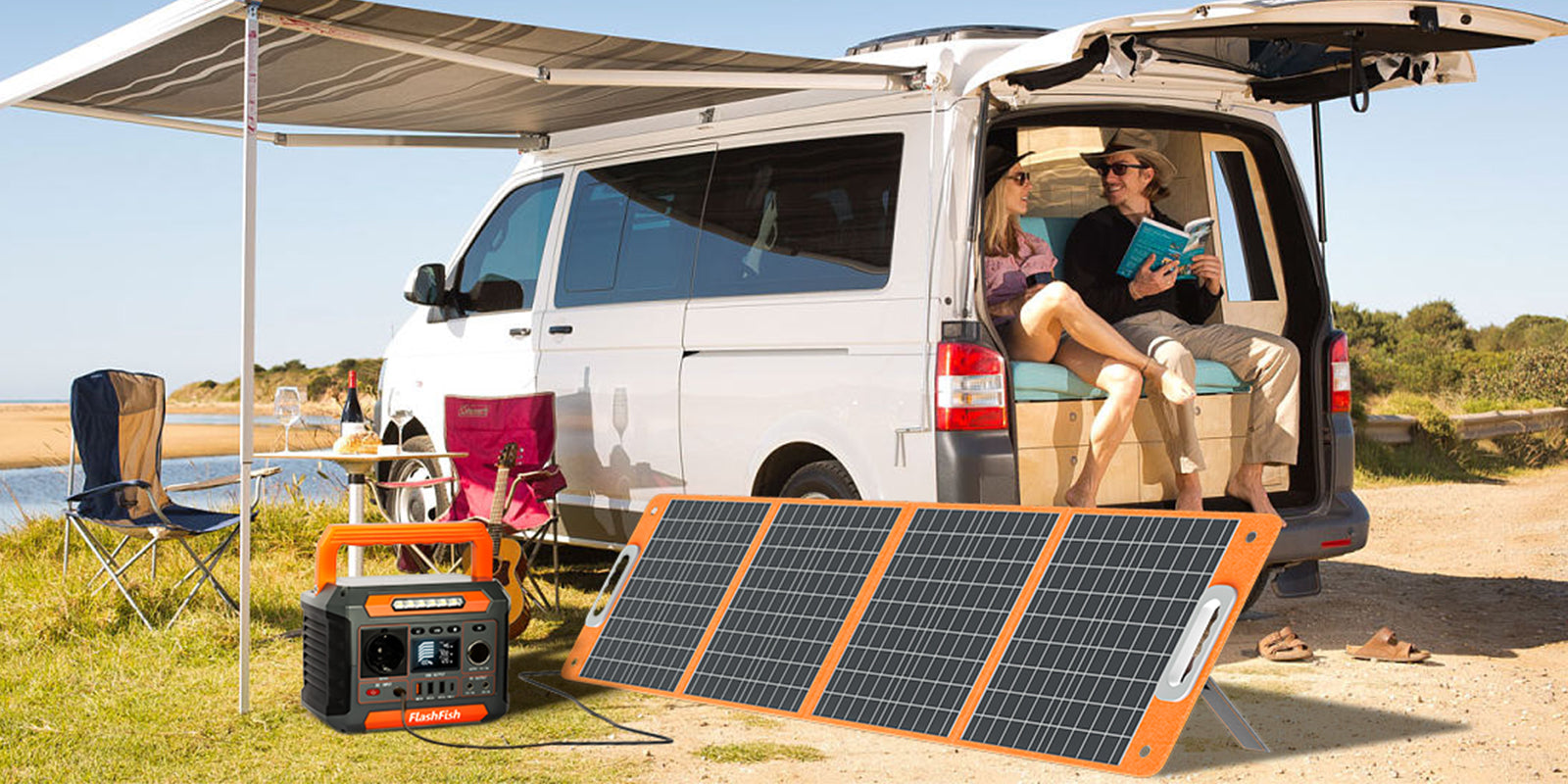
The E200 + TSP60 kit includes a station and a panel with different roles. The E200 stores energy and provides output paths. The TSP60 converts sunlight; it does not store energy. Your device or load has its own label, connector, and input requirements. A sound plan compares all three rather than treating the kit title as a device verdict.
| Check | E200 documented source | TSP60 documented source | Reader action | Do not infer |
|---|---|---|---|---|
| Station capacity | 151Wh | Not applicable | Use it as a station-side planning label. | How long a named device will run. |
| AC output | 200W continuous; 400W peak | Not applicable | Compare the device documentation with the continuous-output label. | That any device name is automatically suitable. |
| Solar/DC input | 40W maximum solar/DC input | 18V / 60W maximum DC output | Keep the station input limit separate from the panel rating. | A charging rate, recharge time, or connection conclusion. |
| USB output | Documented USB outputs | Direct USB-C and USB-A outputs are separate panel paths | Match the chosen path to the device's own requirements. | That USB labels establish appliance compatibility. |
Read the station label before the product name
The E200 documentation lists 200W continuous AC output and 400W peak output. For planning, continuous output is the figure to compare with a verified ongoing requirement; peak is not a blanket approval for every load. The manual also says the E200 is not suitable for long-term AC-motor loads. If your plan involves a motor load, do not turn a broad product category or a device name into a yes-or-no conclusion??eview the documentation and the specific load requirement first.
Likewise, the E200's 40W maximum solar/DC input is an input-side limit. It is not the same thing as the panel's 60W label and it is not a promise about how quickly the station will charge.
Choose an output path deliberately
The E200 has documented AC, DC, and USB output paths, while the TSP60 has direct USB-C and USB-A outputs in addition to its solar DC output. These are distinct paths. Before using one, identify the input stated on your device or load and verify the required cable and connector in the relevant documentation. Do not assume that a direct USB port, an AC outlet, or a solar-panel USB port makes every device a fit.
For a primer on matching a device to the right path, read Portable Power Station Ports: AC, USB-C, USB-A and DC. For E200 background that does not replace a load-label check, see What Is FlashFish E200 Used For?.
Sunlight is a condition, not stored power
The TSP60 panel converts sunlight to electricity, and its conversion depends on conditions including direct-sun angle, temperature, weather, and charging time. The panel does not store power. Treat those facts as a reason to verify the station, the intended input path, and the actual conditions??ot as a basis for a guaranteed output or recharge result.
When this checklist fits??nd when to pause
This checklist fits when you can read a device or load label and compare it with the documented station and panel labels. It helps you organize the questions before you rely on a particular output path.
Pause when a motor load is involved, the device requirement is unknown, an adapter or connector is needed, polarity is unclear, or the decision depends on guaranteed solar performance, runtime, or recharge time. Confirm those details from the exact documentation before proceeding.
FAQ
What does the E200's 200W continuous-output label mean for planning?
It is the documented continuous AC-output figure to compare with a verified ongoing requirement. It is not a universal compatibility promise.
Is the TSP60's 60W panel label the same as E200 charging performance?
No. The panel label and the E200's maximum solar/DC input are separate figures, and solar conversion depends on conditions.
Why should I check a device or load label first?
The device label identifies the requirement you need to compare with the selected output path. A device name does not establish that requirement.
Does the kit make a motor-load use case automatic?
No. The E200 manual says it is not suitable for long-term AC-motor loads, so that use case needs careful documentation review.
Does the solar panel store power after sunlight changes?
No. The panel converts sunlight to electricity; the station stores energy.

Laisser un commentaire
Ce site est protégé par hCaptcha, et la Politique de confidentialité et les Conditions de service de hCaptcha s’appliquent.