

For RV lights and phone charging, plan from the labels on your actual lights and chargers: add the energy you expect to use, then choose a portable battery with enough capacity and a documented solar input path. Do not choose by a generic ?hours? claim, because the answer depends on the equipment, settings, and charging conditions.
Quick answer: make a one-day energy list
Write down each light and phone charger, its labeled power or energy information, and the number of hours or charges you expect in a day. Add those entries together as an estimate. Keep a margin for uncertainty, and treat the result as a planning number rather than a runtime guarantee.
Start with labels, not assumptions
| Item | What to capture | Planning question |
|---|---|---|
| RV light | Labelled watts and expected hours | How much energy does the intended daily use represent? |
| Phone charger | Charger label and number of phones | Which documented output path will be used? |
| Power station | Capacity, output, and current input specifications | Does the documented station configuration fit the plan? |
| Solar panel | Panel specification and station connection documentation | Is the intended pairing expressly supported? |
Match capacity and output to separate needs
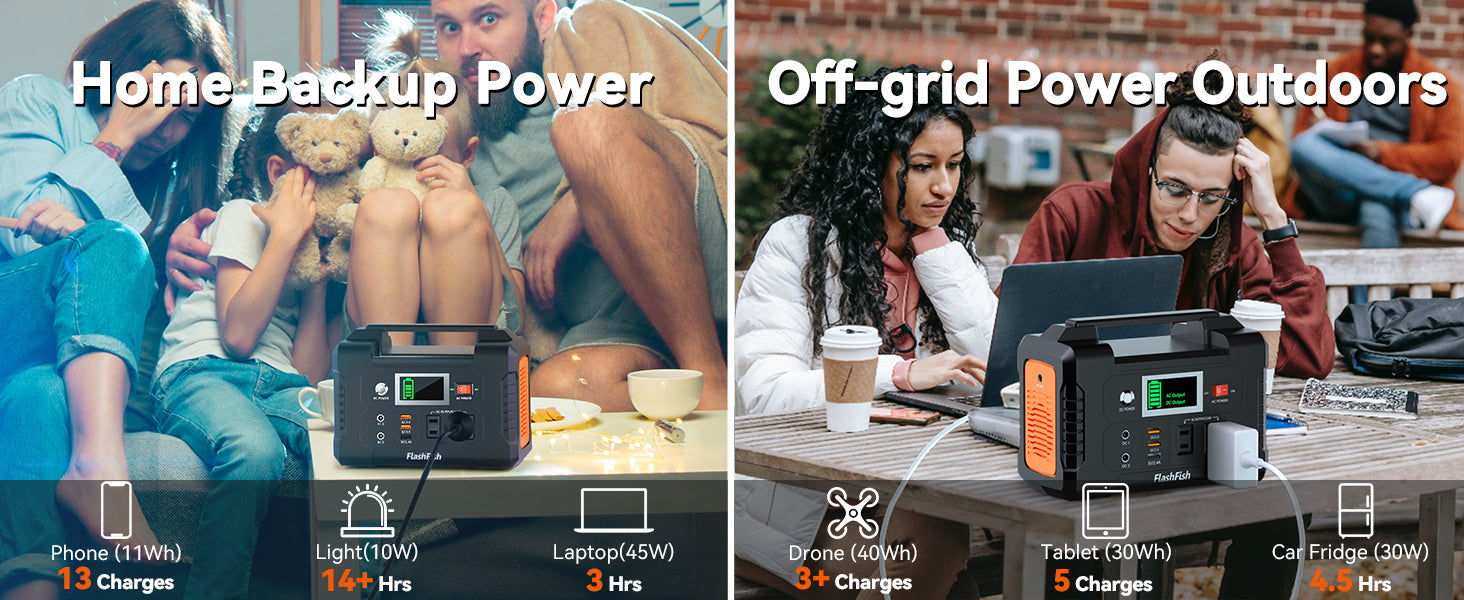
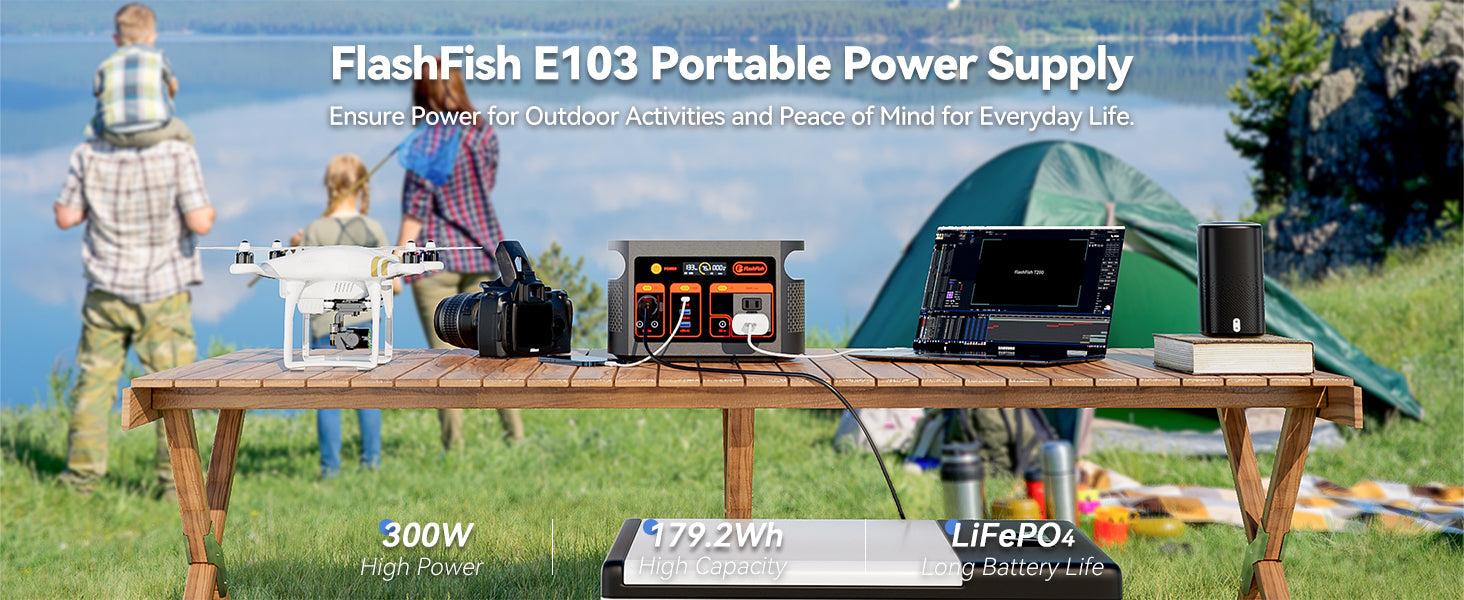
Capacity, measured in watt-hours, is the stored-energy number for planning. Output is a separate limit that must be checked against the device label and the output path you intend to use. The FlashFish E103 is listed at 179.2Wh with 300W continuous AC output, and the FlashFish T300PRO is listed at 230Wh with 300W continuous pure-sine AC output. These records help compare stations; they do not predict how long an individual RV device will operate.
Plan solar charging as a documented connection
The FlashFish TSP100 is a 100W, 18V foldable solar panel. Its wattage is useful context, but it does not establish that it can be connected to every station or that it will deliver a set amount of energy in a day. Before purchase or use, confirm the current station input requirements, selected U.S. variant, approved cable path, and any instructions supplied with the products.
Keep the RV plan simple
Use a short prioritized list: essential lights first, then phones. Charge phones through a documented charger and port path. Revisit the list after one trip with your actual labels and use pattern; that is better evidence than a generic runtime chart. Avoid treating a portable battery station as a substitute for RV electrical-system design or manufacturer instructions.
Before you leave
- Photograph or write down the labels on lights and chargers.
- Confirm the exact station and panel variants in current documentation.
- Pack only cables and adapters identified by the product or device manufacturer.
- Review the product manuals before connecting equipment.
FAQ
How much battery capacity do RV lights and phones need?
It depends on the labeled power or energy use and your intended daily use. Make a device-by-device estimate instead of relying on a generic figure.
Does a 100W panel guarantee a certain daily recharge?
No. Solar conditions, installation, and the documented station input path all matter.
Can I plug RV lights directly into a portable power station?
Check the light?s label and manufacturer instructions, then verify the appropriate output and connection path. Do not assume compatibility.

Laisser un commentaire
Ce site est protégé par hCaptcha, et la Politique de confidentialité et les Conditions de service de hCaptcha s’appliquent.