


Extra display digits do not prove that two charging-energy results differ meaningfully. Check the meter's specification for the actual function and range, then compare each reading with its applicable error allowance. Overlapping intervals leave the ranking unresolved; separated intervals support only the comparison covered by those assumptions.
A meter might show 10.00 Wh for one session and 10.06 Wh for another. The second number has more recorded energy on its display, but the 0.06 Wh difference is not automatically a verified saving. The measurement boundary, instrument limits and session conditions decide what you can conclude.
Method: The calculations below illustrate reading interpretation, not a test of a meter or FlashFish station. All energy readings and error allowances are invented. No named USB meter's energy accuracy or compatibility is established here.
Separate resolution, specified error and full uncertainty
Resolution concerns the smallest displayed increment on the selected function and range. An accuracy specification describes permitted error under stated conditions. A full uncertainty evaluation also considers relevant contributions beyond a display increment. A stable final digit does not establish that those other contributions are negligible.
Fluke's explanation of reading percentages and counts shows why the least-significant digit depends on the range. That explanation is about its multimeter example, not the Wh accuracy of an unspecified charging meter. Do not copy a voltage specification into an energy calculation.
NIST's uncertainty guidance requires considering significant contributions to the measurement process. Its Type B guidance includes manufacturer specifications and calibration information among possible inputs. A specification-based interval alone is not a completed NIST uncertainty analysis.
Read the specification for the quantity you recorded
- Identify the exact meter, manual revision and selected function. W, Wh, mAh and voltage readings answer different questions.
- Record the range, least displayed increment, applicable accuracy expression and operating conditions. Keep any calibration requirement attached.
- Determine whether the specification applies to the accumulated-energy result or only to an instantaneous component reading.
- Check that both records use the same measurement location, comparable device task and defined start and end conditions.
A USB output reading measures energy crossing that location. It does not automatically measure internal station depletion. For instrument placement, use the AC and USB measurement-boundary guide before interpreting small differences. This article adds no connection procedure or permission to insert an undocumented meter.
Build an interval only when the allowance applies
For this screening worksheet, call an applicable absolute error allowance b. A reading r produces the comparison interval [r - b, r + b]. This b is not automatically a standard uncertainty, confidence interval or probability bound; preserve the manufacturer's meaning.
If a hypothetical energy specification is plus or minus (1% of reading + 2 counts), and one count on that function is 0.01 Wh, then at 10.00 Wh the allowance is 0.01 x 10.00 + 2 x 0.01 = 0.12 Wh. The interval is 9.88 to 10.12 Wh. Neither this expression nor this accuracy is assigned to any real product.
| Record | Quantity and range | Resolution | Applicable allowance | Interval | Remaining limitation |
|---|---|---|---|---|---|
| Session A | Wh; exact range | From the energy function | Documented expression and conditions | rA minus bA to rA plus bA | Endpoint, timing or device-state differences |
| Session B | Same quantity and boundary | From its actual range | Applicable to this reading | rB minus bB to rB plus bB | Unquantified effects remain open |
| Comparison | Same completed task | Do not rank by digits | Do not invent absent terms | Separated, overlapping or unresolved | No statistical significance claim from overlap alone |
Three hypothetical outcomes
Example 1: Different displays, overlapping intervals
Assume A is 10.00 Wh and B is 10.06 Wh, each with an applicable 0.12 Wh allowance. Their intervals are 9.88-10.12 Wh and 9.94-10.18 Wh. They overlap. Report the observed difference, but do not rank the setups from this screening. Overlap does not prove equivalence either.
Example 2: Separated instrument-bound intervals
Assume A is 10.00 Wh and B is 10.50 Wh, each with an applicable 0.10 Wh allowance. The intervals are 9.90-10.10 Wh and 10.40-10.60 Wh. They are separated under those assumed bounds. That does not establish statistical significance, equal work completed, or superiority across other devices and conditions.
Example 3: The Wh specification is absent
A fictional meter displays hundredths of a Wh, but only its voltage accuracy is documented. Leave its energy interval unresolved. More decimal places cannot supply the missing accumulation specification, timing contribution or calibration evidence. Ask the manufacturer for the relevant function's limits before claiming a small energy advantage.
What E103 and T300PRO specifications can contribute
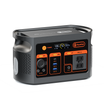
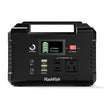
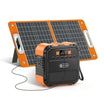
FlashFish E103 has a documented nominal capacity of 179.2 Wh and USB-C output up to 60 W. T300PRO has 230 Wh and USB-C outputs up to 100 W and 30 W. These identify different station options and port ceilings, not measurement accuracy or measured session consumption.
Check the exact output and meter requirements using the matching FlashFish manual and the meter manufacturer's documentation. No percentage of nominal station capacity can replace the meter's missing error specification. A whole-station efficiency comparison would need a different, fully defined measurement plan.
FAQ
Should I add half a display increment to every accuracy figure?
Not automatically. Determine what the applicable specification already includes and how the manufacturer defines it. Adding an assumed rounding term can double-count an included contribution.
Does using the same meter cancel all error?
No. Correlated effects may matter, but cancellation requires a justified model. Different ranges, temperatures or operating conditions can change the comparison. Do not assume either complete cancellation or independent random errors.
Will repeating the session fix an undocumented accuracy claim?
Repeated observations can show variation, but they do not create a missing instrument specification or remove a systematic effect. Keep repeatability evidence separate from calibration and function-specific accuracy.
Report a defensible comparison
Write the two readings, applicable allowances, intervals and remaining assumptions together. Choose separated, overlapping or unresolved as the worksheet outcome. Use E103 or T300PRO specifications to assess port needs, not to turn a marginal display difference into a product-performance claim.
Next step: Compare FlashFish E103 specifications with your requirements.


Leave a comment
Laman ini dilindungi oleh hCaptcha dan tertakluk pada Dasar Privasi dan Terma Perkhidmatan hCaptcha.