


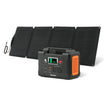
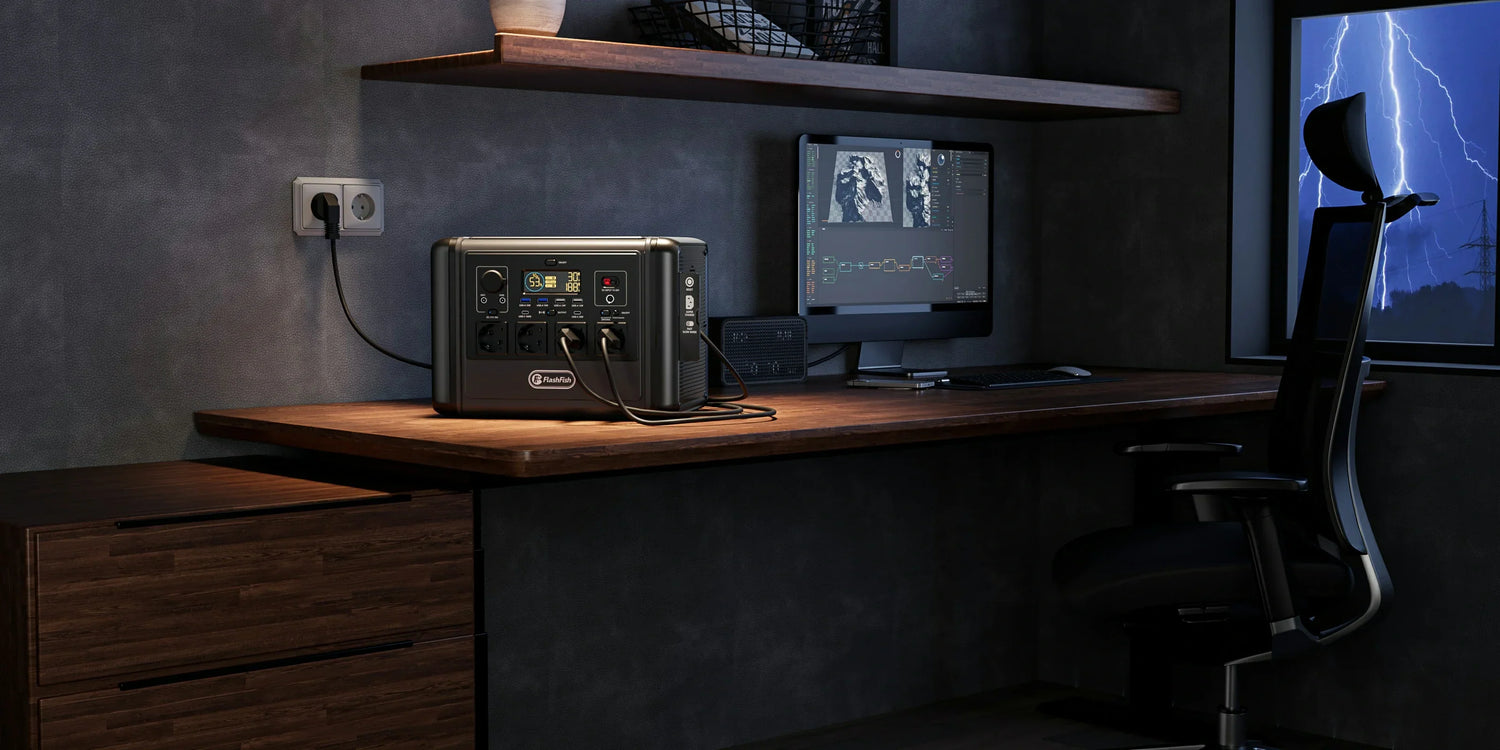
Short answer: using a portable power station while it charges is model-specific. Some stations may support charging and output at the same time, and some may include EPS-style backup behavior, but you should not assume that every portable station works like a true UPS. The safe planning rule is to check the product manual, keep the connected load below the continuous output rating, respect the input limit, and avoid using portable stations for medical, hardwired, or whole-home backup promises. In the FlashFish database, T300PRO is the only model in today's brief set whose summary mentions an EPS emergency backup function, so broader FlashFish pass-through or UPS-like claims should stay out of the body.
This question matters because shoppers often want one simple setup for a router, laptop, phone, light, or small office load during an outage. The words sound similar, but pass-through charging, EPS, and UPS do not mean the same thing. Treat them as separate features and verify the exact model before relying on them.
Definitions that prevent bad assumptions
| Term | Plain meaning | Planning boundary |
|---|---|---|
| Pass-through charging | The station can receive charging input while also powering connected devices. | It is model-specific and may have load, heat, battery, or port limits. |
| EPS / emergency power supply | A backup-style mode intended to supply power when normal input is interrupted. | It is not automatically the same as a true UPS and should be checked in the model manual. |
| UPS | A purpose-built uninterruptible power supply for fast switchover and equipment protection expectations. | Do not describe a portable power station as UPS-grade unless the exact documentation supports that claim. |
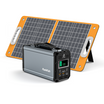
| Solar charging while powering loads | The station receives solar input while devices draw output. | Solar input varies with sunlight and may not keep up with the connected load. |
What to check before using a station this way
- The product manual must support the mode. Do not infer pass-through or EPS support from input and output specs alone.
- The connected load must stay under continuous output. Peak or surge watts are not the normal operating limit.
- The charging input must stay within the station's input range. Solar and adapter inputs have voltage, current, and wattage limits.
- Ventilation and temperature still matter. Charging and discharging at the same time can add heat, so follow the station's operating guidance.
- Critical devices need their own manufacturer guidance. Medical devices, servers, hardwired systems, and safety-critical equipment should not rely on a generic portable-station assumption.
FlashFish product discussion within today's source limits
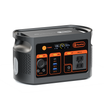
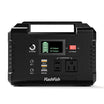
The local FlashFish product database supports a cautious, model-specific discussion. T300PRO is listed as a 230Wh LiFePO4 portable power station with 300W pure sine AC output, 600W peak output, 120W max solar input, and an EPS emergency backup function in the summary. That is enough to mention T300PRO as an EPS-labeled model in this draft, but it is not enough to promise uninterrupted switchover, server protection, or UPS-grade performance.
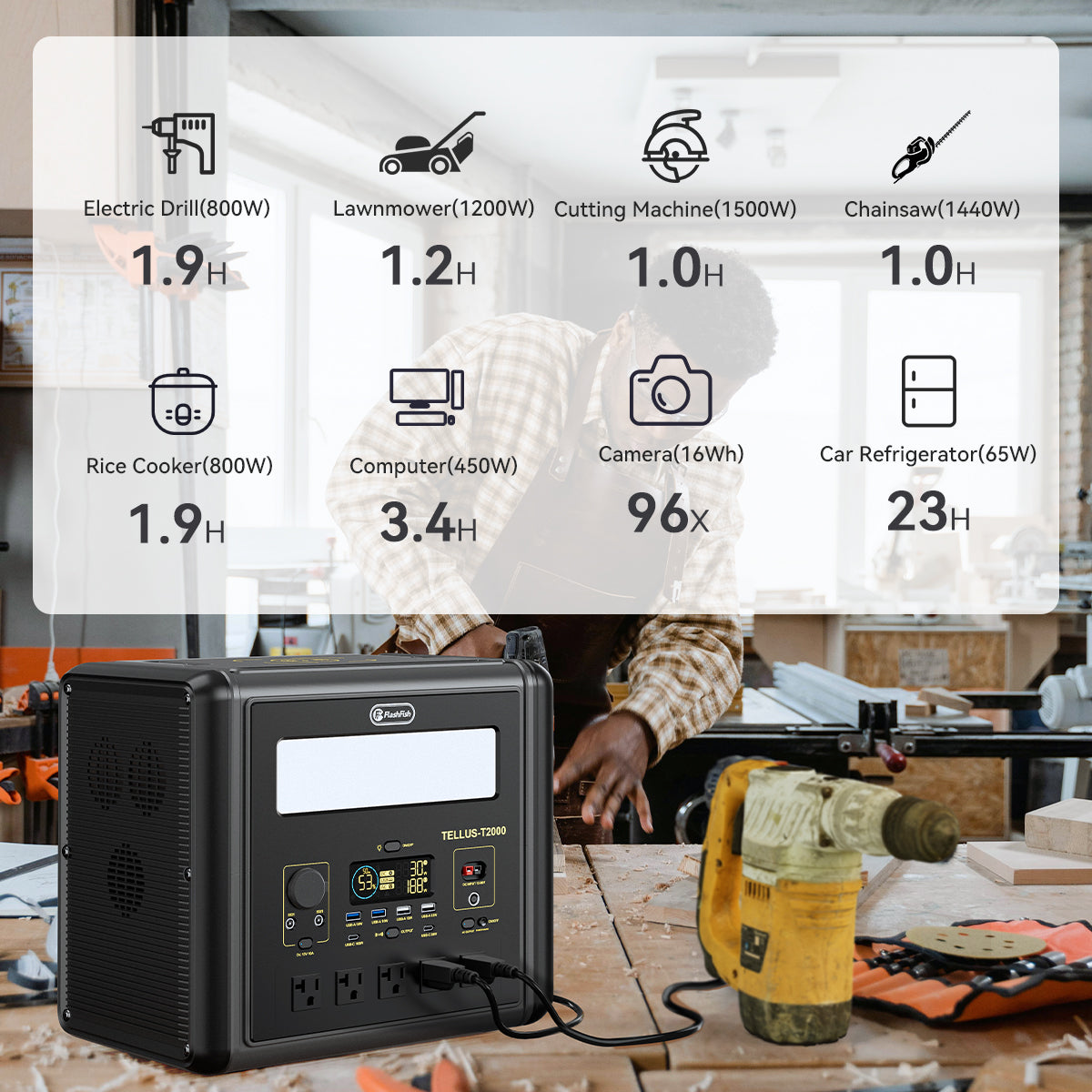
For T1200S and T2000, the database supports capacity and output planning: T1200S is listed at 768Wh, 1200W continuous AC, 2400W peak, and 400W max solar input; T2000 is listed at 1536Wh, 2000W continuous AC, 4000W peak, and 600W max solar input. The same database excerpt used for this draft does not establish pass-through or EPS behavior for those models, so they should be discussed only as output and capacity examples unless a later stage verifies exact manual language.
For compact models such as E200 and T200, use the same boundary. Their output and charging specs can help shoppers understand load and input limits, but the article should not state that either compact model supports pass-through charging unless the exact manual or current product page is verified in the run.
Home-office outage planning
A realistic home-office plan starts with a small list: router, modem, laptop charger, phone, and one efficient light. Check every device label or manual, then compare the combined load with the station's continuous output. If the load fits, watt-hours help estimate duration, but they still do not guarantee an exact runtime.
For this type of planning, the station is a selected-load backup, not a whole-home solution. Do not connect it to hardwired circuits. Do not use it for medical-device backup unless the device manufacturer and a qualified professional confirm the setup. Do not assume it will protect computers like a purpose-built UPS unless the model documentation says so.
Camping and solar use
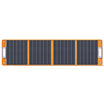
Solar charging adds another variable. A panel's rated wattage is not the same as guaranteed charging input all day. Solar radiation changes with weather, shade, season, panel angle, and time of day. The station's input limit also caps what it can accept.
For FlashFish models in today's product set, the database lists different input ceilings: E200 at 40W max solar/DC charging, T200 at 60W max solar input, T300PRO at 120W max solar input, T1200S at 400W max solar input, and T2000 at 600W max solar input. These values help match panels and expectations, but they do not prove that simultaneous solar charging and device output will sustain a load indefinitely.
Where portable stations should not be stretched
- Do not position a portable power station as whole-home backup.
- Do not imply it replaces a transfer switch, electrical panel work, or a professionally designed backup system.
- Do not promise refrigerator food safety, HVAC support, heating support, or medical-device protection.
- Do not describe pass-through or EPS as universal across a brand or category.
- Do not use fuel generators indoors; follow public safety guidance for outage planning and carbon monoxide risk.
Related charging and power-station checks
Use these current FlashFish pages and guides to continue your comparison:
- Browse current FlashFish portable power stations
- Review portable power station ratings and battery terminology
- Compare AC, USB-C, USB-A, and DC ports
FAQ
Can I use a portable power station while it is charging?
Only if the exact model supports that mode. Check the product manual and follow the load, input, ventilation, and battery guidance for that model.
Is pass-through charging the same as a UPS?
No. Pass-through charging means charging input and device output may happen at the same time on supported models. A UPS is a purpose-built backup product with its own switchover and protection expectations.
What is EPS on a portable power station?
EPS usually means emergency power supply behavior, but the details are model-specific. In today's FlashFish source set, T300PRO is the model whose database summary mentions an EPS emergency backup function.
Can I keep a router and laptop powered during an outage?
Possibly, if the combined load fits within the station's continuous output and the battery capacity suits your duration goal. Check the device labels and the station manual before relying on the setup.
Can I charge from solar while powering devices?
Only on supported setups, and only within the station's input and output limits. Sunlight variability means solar input may not keep up with active loads.
What devices should not rely on this setup?
Do not rely on a portable power station alone for medical equipment, hardwired home circuits, HVAC, heaters, large appliances, server-grade protection, or any safety-critical load unless the exact system is approved for that purpose.

Leave a comment
Laman ini dilindungi oleh hCaptcha dan tertakluk pada Dasar Privasi dan Terma Perkhidmatan hCaptcha.