

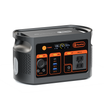
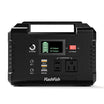

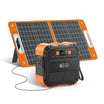

For an outdoor movie setup, choose between FlashFish E103 and P56 only after you have the projector, speaker, and adapter labels in hand. Compare the documented station output with the combined labeled demand, verify the connection path, then consider capacity. Neither model is automatically the best choice for an unnamed device.
Start with your equipment, not the comparison table
Record the manufacturer information for every item that will be powered. Include the projector, the speaker or its adapter, and any other powered accessory. Determine whether the listed information describes input, output, or an adapter, and consult the relevant manual when the label is incomplete. The selection cannot be made responsibly from a device class alone.
E103 and P56: documented storefront fields
| Model | Documented output figure | Documented capacity | Decision boundary |
|---|---|---|---|
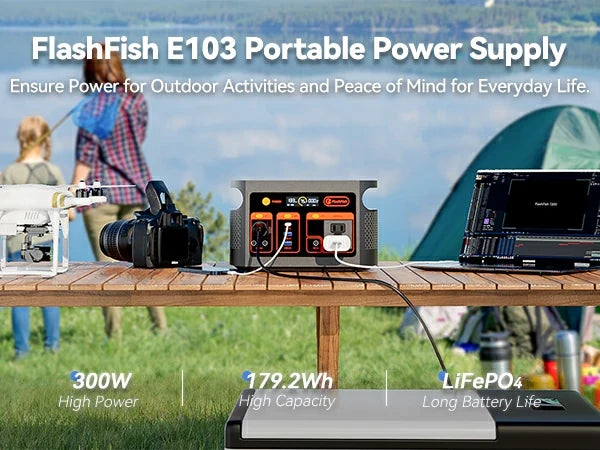
| FlashFish E103 | 300W | 179.2Wh | Evaluate only after the labeled load and required connection path have been verified. |
| FlashFish P56 | 330W | 288Wh | Evaluate only after the labeled load and required connection path have been verified. |
Watts and watt-hours answer different questions. The output figure is part of determining whether a labeled load can be considered; capacity is a separate part of planning. Neither figure proves runtime or connection compatibility by itself.
Use a simple decision sequence
- Add the labels for all equipment intended to run at the same time.
- Check each device manual for stated startup behavior or power-source restrictions.
- Compare the verified information with the selected station's documented limits.
- Confirm that the required outlet, port, cable, and adapter arrangement is documented.
- Only then use capacity as part of your event-planning decision.
If a device has unclear information or the arrangement needs a connection you cannot document, stop there and verify with the device manufacturer or current product documentation. That is more useful than assigning a universal winner based on a small numerical difference.
How this comparison fits an outdoor movie plan
This comparison is deliberately narrow: it helps you organize a known device stack. It does not certify that either station will power every projector, speaker, or entertainment setup. Build the load list from your actual labels first, and consult the FlashFish T200 vs E103 comparison only when that separate product pair is relevant.
When to consider a different solution
Look beyond these two compact models when the actual labels exceed a model's documented limits, the connection requirement is unknown, or a single number is being used as a substitute for a complete equipment check. Review the current FlashFish portable power stations collection after gathering the device information.
Frequently asked questions
Which is the first number to compare: watts or watt-hours?
Begin with the device's labeled demand and the station's documented output. Capacity is then a separate planning consideration; it does not establish that a device can be connected or supported.
Can a higher watt figure replace checking the device label?
No. The label and manual identify the requirements for the specific device. A station figure alone cannot establish a universal result for an unnamed projector or speaker.
What should a shopper verify before choosing E103 or P56?
Verify each device's manufacturer information, the combined intended load, any documented startup or power-source requirements, and the required connection path against current station documentation.

Leave a comment
Laman ini dilindungi oleh hCaptcha dan tertakluk pada Dasar Privasi dan Terma Perkhidmatan hCaptcha.