


A portable power station can be evaluated for an air-mattress pump only after the pump input label, supplied power path, manufacturer instructions, and the station's applicable output record are compared. If any required value or instruction is missing, this article cannot give a compatibility verdict.
The direct answer
A generic power-station category or one watt figure does not answer this question. The evidence has to describe one identifiable pump and one applicable station output path. Until both records are complete, "can it run?" remains unanswered.
Build the pump-side record first
| Evidence to locate | What to compare | If it is missing |
|---|---|---|
| Exact pump model | Use the model to connect the label to the correct instructions. | Do not compare an unnamed pump. |
| Input format | Identify the documented AC, DC, USB, rechargeable, or battery path. | Do not infer the path from connector shape. |
| Label values | Preserve the manufacturer's stated values and units. | Do not replace missing data with a typical value. |
| Supplied cord or adapter | Check the power path the manufacturer actually provides. | Do not assume an alternative cable or adapter is suitable. |
| Manufacturer instructions | Read any applicable directions and limitations. | Pause the assessment. |
Then read the station-side record
| Station field | Purpose in the comparison | What it does not prove |
|---|---|---|
| Applicable output type | It identifies which documented path is being considered. | That a similarly shaped plug establishes a pairing. |
| Rated or shared limit | It is a station-side value to compare with the device documentation. | That one number answers every device question. |
| Peak information, where documented | It is another field to read only with documented device requirements. | That an undocumented pump behavior can be assumed. |
| Port direction and regional variant | They help identify the applicable station record. | That a record from another variant applies automatically. |
Three evidence outcomes
Missing data: stop and obtain the pump's label or manual. A documented mismatch: follow the manufacturer's instructions rather than trying to bridge the gap with a connector or adapter assumption. Complete records: the documents may be ready for a manufacturer-confirmed assessment, but this article does not convert them into an operating or runtime claim.
Why a port or a higher number is incomplete evidence
Ports indicate possible output paths; they do not describe the pump's intended connection, its documented requirements, or its manufacturer guidance. Likewise, a larger station number does not fill in a missing pump label. Keep the comparison narrow: the pump's record, the proposed output record, and the instructions that govern both.
Where the E103 fits
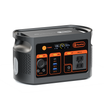
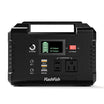
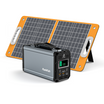
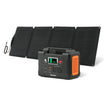
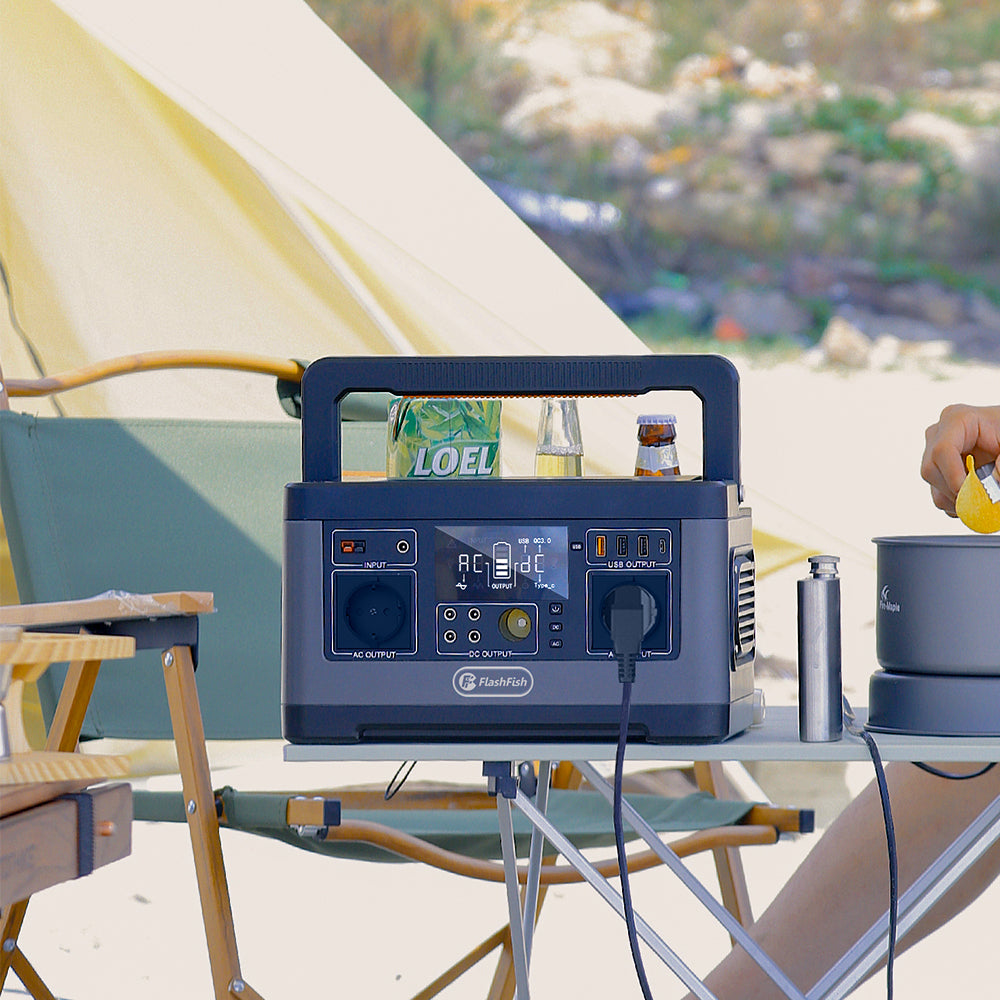
The FlashFish E103 has a documented 300W rated AC output and 600W surge output. Those are station-side comparison fields, not confirmation of an air-mattress-pump result. For another example of reading a device label before making a power-station decision, see the projector and speaker load-label guide.
FAQ
Which pump-label values matter most?
The relevant values are the ones stated on the exact pump label, along with its documented input format, supplied power path, and manufacturer instructions.
Does an AC outlet, 12V socket, or USB port alone prove compatibility?
No. It identifies a station output path but does not establish that the pump is intended to use that path.
Why is a pump's supplied adapter part of the check?
The supplied adapter is part of the manufacturer-documented power path. It should not be replaced by an assumption based on connector appearance.
What does a 300W rating not tell me about an unverified pump?
It does not establish operation, sustained use, runtime, inflation outcome, or the suitability of a cable or adapter for an unidentified pump.



Deixar comentário
Este site é protegido por hCaptcha e a Política de privacidade e os Termos de serviço do hCaptcha se aplicam.