







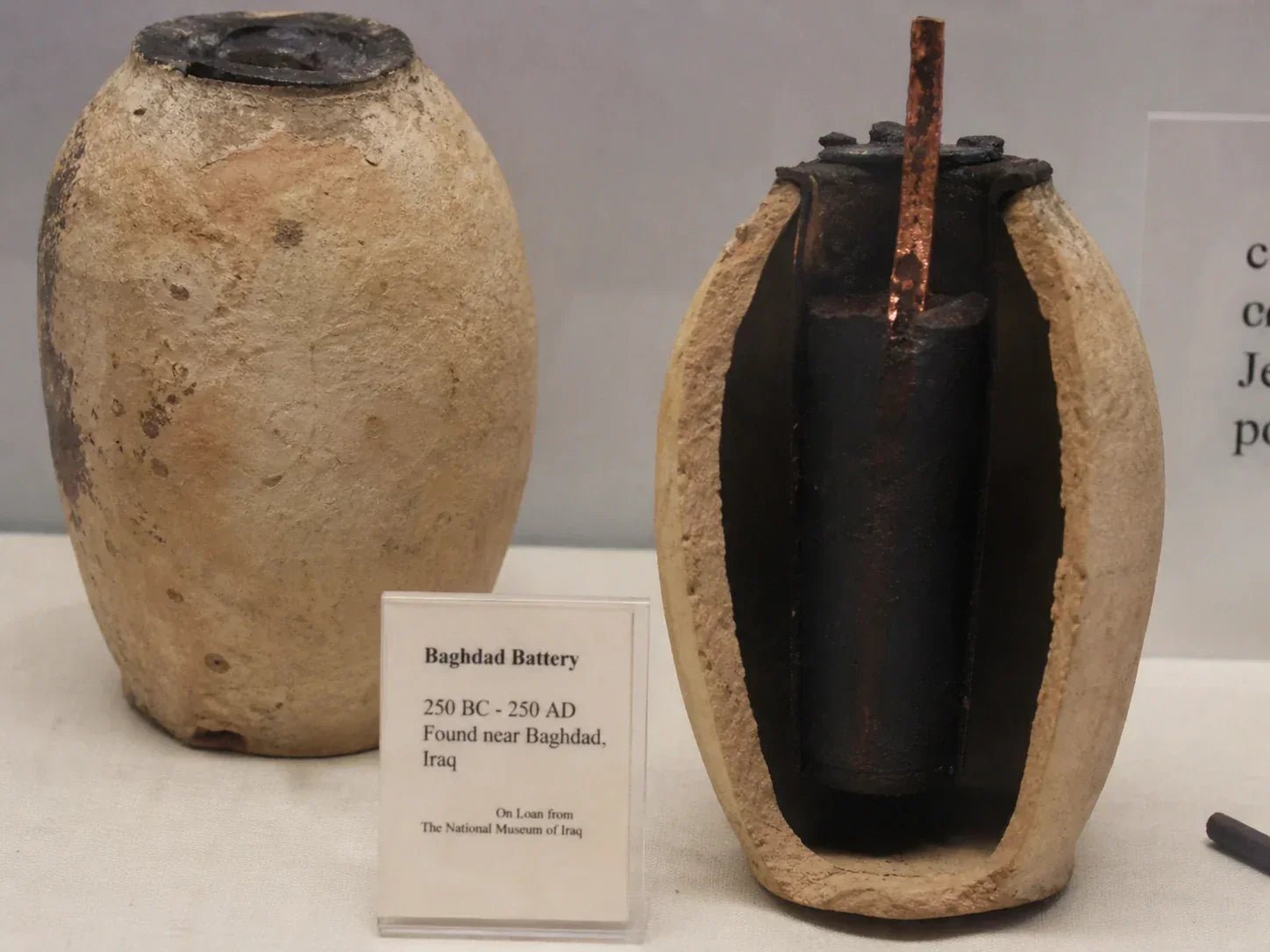
Quick answer: The so-called Baghdad Battery is an archaeological object made from a ceramic jar and metal components, but its original purpose is not established. Reconstructions can produce voltage when a suitable electrolyte and connections are added; that result does not prove that the ancient object was built or used as a battery.
What the artifact contains
The object associated with the Baghdad Battery name includes an earthenware container, a copper or bronze cylinder, an iron element, and bitumen. Those materials can be arranged as part of an electrochemical cell. The surviving archaeological context and original configuration, however, do not provide a complete operating system or written explanation.
Why an electrical use was proposed
Two different metals and an electrolyte can create an electrochemical potential. Modern replicas show that a jar-based arrangement can produce a measurable voltage after researchers choose an electrolyte and external connection. Proposed uses have included electroplating, but a working reconstruction demonstrates physical possibility, not historical intent.
Why the battery label remains disputed
Evidence normally used to establish a historical technology includes find context, repeated standardized devices, conductors or terminals, residues, associated tools, products of use, and written or visual records. The Baghdad Battery interpretation lacks enough of that evidence to settle the question.
A record in the Smithsonian Museum Conservation Institute bibliography summarizes an archaeological analysis that rejected the electroplating interpretation and proposed a ritual use for comparable finds. The disagreement is the important point: the artifact should be presented as a hypothesis, not a proven ancient power source.
How it differs from Volta's documented battery
Alessandro Volta described a repeatable electrochemical pile in 1800, and other researchers could reproduce and extend the work. That documentation, experimental continuity, and identifiable purpose are why the voltaic pile is recognized as the first electric battery. Read the related Volta and voltaic pile guide.
How to evaluate a historical technology claim
- Separate the surviving artifact from a modern reconstruction.
- Ask which added materials or connections were not found with the object.
- Look for archaeological context and repeated examples.
- Distinguish "could work" from "was used this way."
- Prefer museum, archival, and peer-reviewed evidence over a viral label.
What this history does not prove about modern storage
The artifact does not establish claims about modern battery capacity, safety, lifespan, solar charging, or off-grid suitability. Current products must be evaluated from their own specifications, manuals, installation requirements, and regional rules.
Frequently asked questions
Was the Baghdad Battery definitely a battery?
No. An electrical function is one hypothesis, and archaeological interpretations remain disputed.
Can a reconstruction make electricity?
A reconstruction can produce voltage when suitable materials and connections are supplied. That does not establish the ancient object's intended function.
Was it used for electroplating?
Electroplating has been proposed, but the available evidence does not prove that use.


Leave a comment
This site is protected by hCaptcha and the hCaptcha Privacy Policy and Terms of Service apply.