

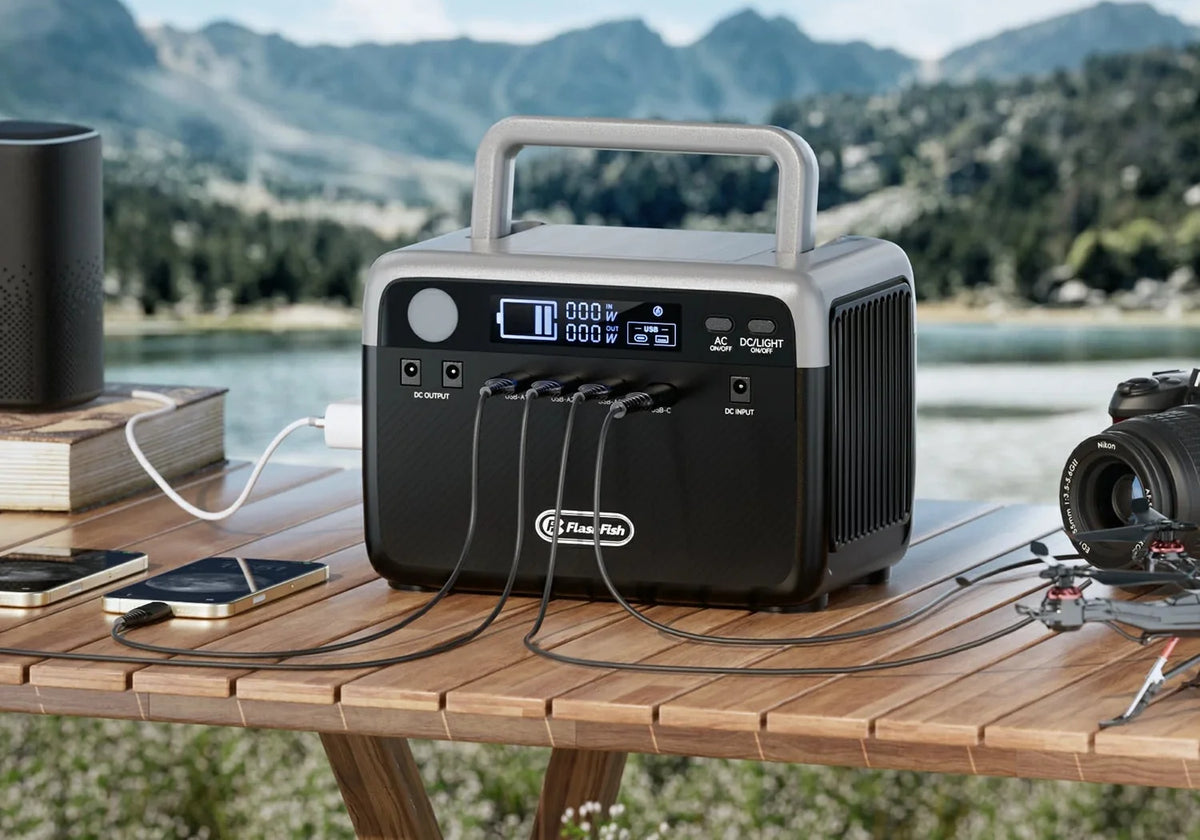
Compare the FlashFish A201 and T200 by the reading lamp's input, your phone's charging requirements, and what you want to carry. The documented A201 is lighter and has more nominal battery capacity; the T200 has a higher listed USB-C output ceiling and a documented 120V AC outlet. However, the A201 source is an EU 230V manual, so these records cannot establish an equivalent U.S. AC comparison. Neither model's battery rating establishes how many evenings your devices will run.
Start with the lamp you intend to bring
Check whether the lamp charges its own battery, runs directly from USB, or requires its AC adapter. A rechargeable lamp that only needs an occasional top-up creates a different plan from a plug-in lamp used for every reading session. Record the selected brightness level and the device manual's input requirements.
Then check the phone and cable. If the phone accepts a lower charging power than a station port can supply, a higher port rating does not mean the phone will use it. Charging protocols and the cable still matter. Include any personal electronics you intend to add, rather than leaving them outside the capacity estimate.
Documented A201 and T200 differences
The A201 specifications below are from its EU manual; T200 is also documented as TELLUS-T200 in its U.S. manual. Confirm the exact unit before using these figures for a purchase comparison.
| Planning detail | FlashFish A201 | FlashFish T200 / TELLUS-T200 |
|---|---|---|
| Nominal capacity | 172.8Wh | 153.6Wh |
| Listed weight | 1.7kg / 3.75lb | 2.5kg / 5.5lb |
| USB-C outputs | One, up to 18W | One up to 60W; one up to 18W |
| USB-A outputs | Two, up to 18W each | One up to 18W; one up to 12W |
| AC source boundary | 230V EU manual; 200W rated output | One 120V outlet; 200W continuous pure-sine output |
The product database does not provide A201's AC waveform or battery chemistry. Do not borrow those details from the T200. The T200's individual USB ratings also do not establish a combined output allowance for every port used together.
Three ways to narrow the choice
- A rechargeable USB lamp and one phone: If their documented charging profiles fit the A201's listed ports, its lower recorded weight may matter for carrying. Confirm that the actual model has those specifications before choosing it.
- A device requesting more than 18W over USB-C: Investigate the T200's 60W USB-C port. Confirm the required power profile and cable; a port ceiling is not a charging-speed promise.
- An AC reading lamp: The T200's documented 120V outlet supplies a relevant starting point. Compare the lamp adapter's voltage, waveform requirements, and draw with the exact unit's manual. The A201's EU record cannot confirm a U.S. AC fit.
These are screening decisions, not confirmed device pairings. A smaller setup using the lamp's internal battery may also meet your needs if you only need to recharge the phone. That reduces the number of connections you must plan, but still requires an energy estimate for the trip.
Compare energy needs separately from port ratings
Write down the number and length of reading sessions, then add the phone's expected charging needs. For a continuously powered lamp, average watts multiplied by hours gives a planning estimate in watt-hours. For rechargeable devices, use documented battery energy and the amount of charge you expect to replace when those values are available.
Allow for charging and conversion losses and keep a reserve. The A201's higher nominal Wh figure does not prove longer real-world runtime for this kit: the output path and device behavior also affect delivered energy. No runtime is established for your lamp-and-phone combination; the needed device draw and delivered energy remain unverified.
Pack for the charging plan you actually have
Confirm whether the cabin provides an outlet and when it will be accessible. If you intend to recharge during the stay, bring the documented charger for the exact station. If there is no confirmed charging opportunity, budget for the whole stay. Avoid assuming that a solar panel, adapter, or cable is included or compatible.
FAQ
Is the A201 the better choice because it has more Wh?
Only if its verified outputs and your energy needs fit. Capacity cannot compensate for an incompatible port or an unconfirmed AC configuration.
Will the T200 charge every phone at 60W?
No. The phone, cable, and negotiated charging profile determine what it can accept. The documented 60W value is a port maximum.
Can I assume both models have the same U.S. outlet?
No. The sources identify 230V for the A201 manual and 120V for the T200 manual. Confirm the destination-market model rather than treating them as interchangeable.
Make the final comparison
Use your lamp label, phone requirements, and trip schedule to compare the exact FlashFish model specifications. Prioritize verified port fit, then the energy budget and carrying weight. Check current model details and price only after that shortlist is established.
Next step: Compare FlashFish A201 specifications with your requirements.


Dejar un comentario
Este sitio está protegido por hCaptcha y se aplican la Política de privacidad de hCaptcha y los Términos del servicio.