

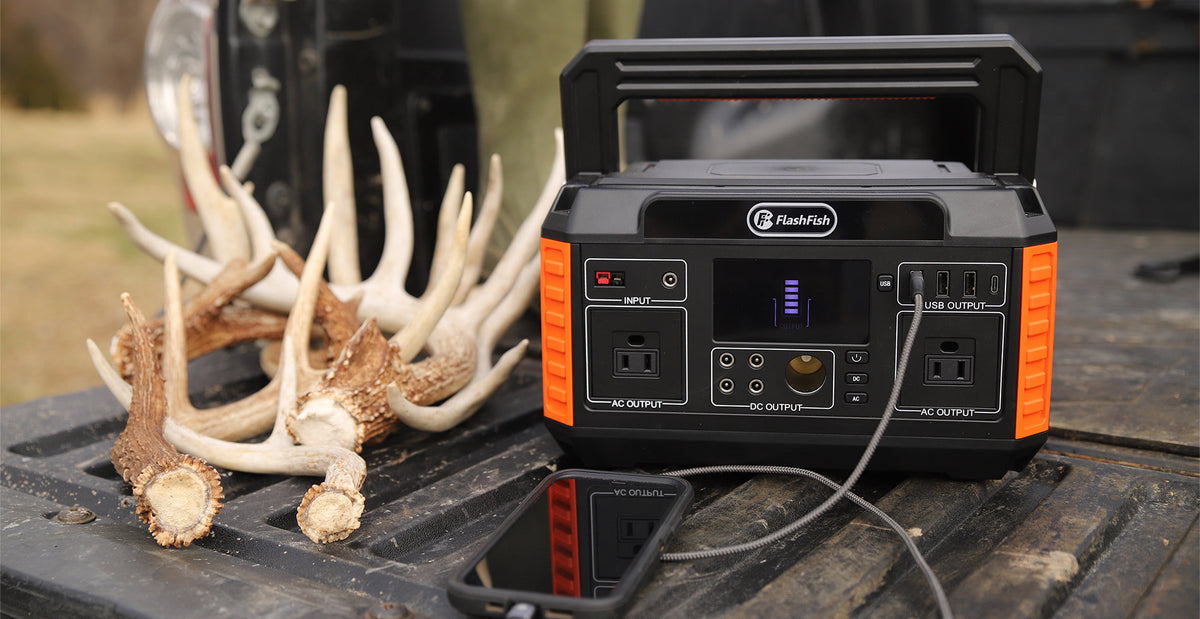
Yes, two portable stations can rank differently by nominal watt-hours per kilogram and nominal watt-hours per liter because mass and volume are different denominators. But FlashFish E200 and T200 do not reverse rank in this calculation: E200 has the higher calculated ratio on both measures. These whole-station nominal comparisons do not establish usable output energy, runtime, cell-level performance, or electrical suitability.
For this comparison, specific energy means nominal station Wh divided by net station mass. Bounding-volume energy density means nominal station Wh divided by the rectangular volume calculated from external product dimensions. Stating the denominator matters more than choosing an impressive-looking number.
Check task feasibility before ranking ratios
Start with stations that meet your documented device requirements. A favorable Wh/kg value cannot resolve the wrong output voltage, connector, or power limit. Match the exact regional version before using electrical specifications; the FlashFish U.S. manual directory explains that identification step.
Then decide what constrains the trip. Carrying the station makes net and complete-kit mass relevant. Transporting it in a fixed space makes dimensions and kit arrangement relevant. Neither ratio replaces those absolute measurements.
Use matching whole-product inputs
The table uses documented nominal capacity, net station mass, and product dimensions for each exact model. T200 is the short name for TELLUS-T200. The calculations exclude shipping cartons, cases, chargers, and cables.
| Exact model | Nominal Wh | Net mass | Product dimensions | Bounding volume | Nominal Wh/kg | Nominal Wh/L |
|---|---|---|---|---|---|---|
| FlashFish E200 | 151Wh | About 1.85kg | 208 × 110 × 158mm | 3.615L | About 81.6 | About 41.8 |
| FlashFish T200 (TELLUS-T200) | 153.6Wh | 2.5kg | 200 × 142 × 146mm | 4.146L | About 61.4 | About 37.0 |
Method: calculations from documented product figures, not measured discharge or packing tests. Rounded ratios do not imply extra precision in an approximate mass. The rectangular bounding volume is a comparison convention, not the actual case-material volume or internal battery volume.
Reproduce the unit conversions
Convert millimeters to centimeters before multiplying: E200 is 20.8 × 11.0 × 15.8cm. Multiplication gives 3,615.04 cubic centimeters. Divide by 1,000 to obtain 3.61504L. Then 151 ÷ 3.61504 is approximately 41.8 nominal Wh/L, while 151 ÷ 1.85 is approximately 81.6 nominal Wh/kg.
T200 is 20.0 × 14.2 × 14.6cm. Its bounding volume is 4,146.4 cubic centimeters, or 4.1464L. Dividing 153.6Wh by that volume gives about 37.0 nominal Wh/L; dividing by 2.5kg gives about 61.4 nominal Wh/kg.
T200 has slightly more nominal capacity in this comparison, but greater net mass and bounding volume. E200 therefore leads both ratios. That does not decide which station supplies the outputs your task needs or whether either completes a particular workload.
Three hypothetical decisions
These illustrate decision logic. Fictional Stations A and B are not FlashFish products. None of the scenarios is a field test.
Hypothetical example 1: rankings reverse
Station A has 200Wh, a 2kg net mass, and a 5L bounding volume: 100Wh/kg and 40Wh/L. Station B has 180Wh, a 3kg mass, and a 3L volume: 60Wh/kg and 60Wh/L. A leads on mass; B leads on volume. Use the relevant constraint after both satisfy the task.
Hypothetical example 2: carry allowance eliminates an option
Assume a reader sets a 2kg station-only carry allowance and has established electrical suitability. E200's documented approximate 1.85kg falls below it; T200's 2.5kg exceeds it. Account for accessories and verify the actual carried total before treating that station-only result as a complete-kit decision.
Hypothetical example 3: lower volume does not establish fit
A reader has an awkwardly shaped storage compartment. Even with E200's smaller bounding volume, one dimension or the chosen orientation may prevent placement. Compare dimensions and access needs. Neither ratio establishes permissible operation inside that compartment.
Keep kit mass and operating space separate
Create a second complete-kit mass column for required chargers, cases, and cables using documented or measured inputs. Do not add accessories to one station while leaving them out of the other. Unknown kit contents mean an unknown complete-kit ratio, even when station-only ratios are available.
For storage, retain all three dimensions. For operation, follow the exact manual's placement and clearance requirements. This article gives no enclosed-operation approval. A rectangular comparison volume cannot replace connector access, ventilation, or handling space.
FAQ
Can shipping weight replace net mass?
No. That would answer a packaged-shipment question. Use consistently defined net station mass for station ratios and a separately defined complete-kit mass for the carried kit.
Does higher Wh/L mean longer runtime?
The ratio alone does not supply runtime. It describes nominal capacity per bounding volume without measuring usable output energy or device consumption.
What if one dimension is missing?
Leave bounding volume and Wh/L unknown. Wh/kg remains calculable if nominal capacity and net mass are established. Do not infer dimensions from photos or substitute carton dimensions.
Make a constraint-based shortlist
Write down task requirements, carry allowance, and transport-space limits. Keep E200 and T200's ratios beside their absolute dimensions and mass, then eliminate models that fail a requirement. Compare exact specifications and complete-kit inputs before choosing; the higher ratio is one piece of the decision.
For other models, start with the FlashFish portable power station collection and compare consistently defined station measurements.
Next step: Compare FlashFish E200 specifications with your requirements.


Dejar un comentario
Este sitio está protegido por hCaptcha y se aplican la Política de privacidad de hCaptcha y los Términos del servicio.