

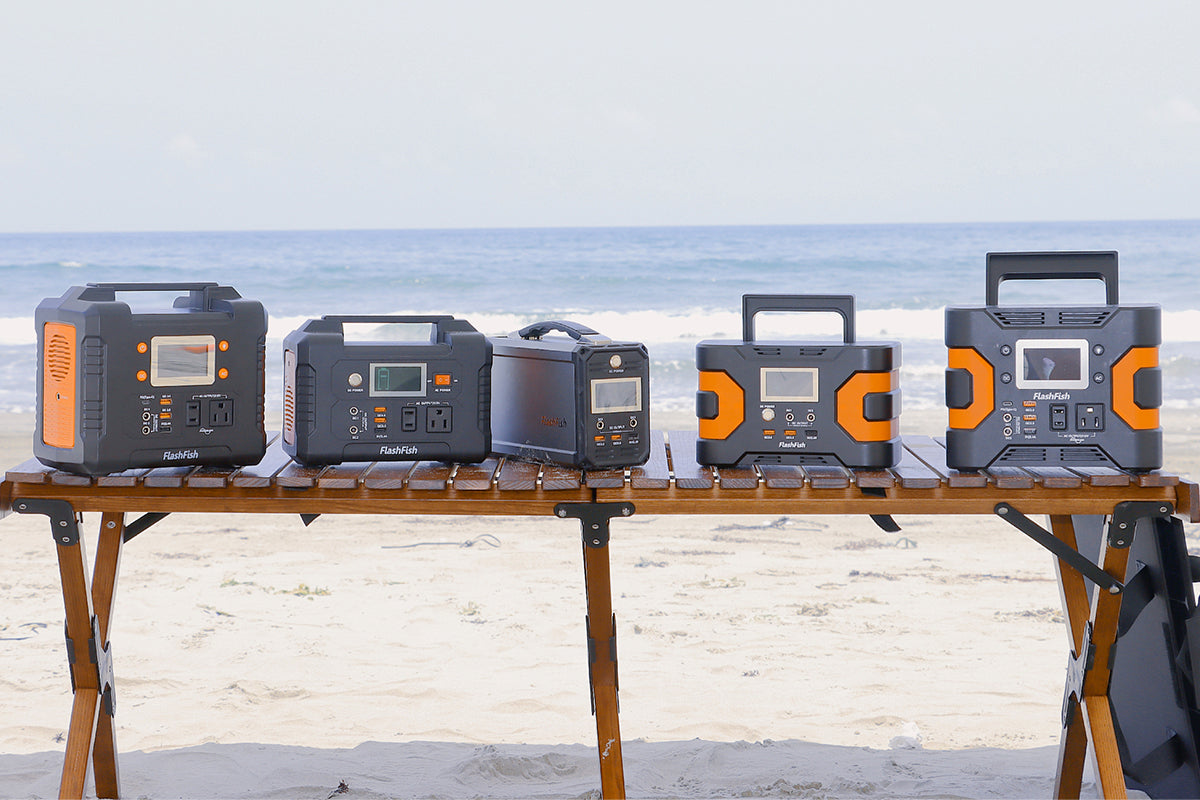
Short answer: FlashFish T300PRO is the practical choice for portable 300W-class electronics, 230Wh storage, and a 4.5kg carry weight. FlashFish T1200S is a different tier: 768Wh, 1200W continuous AC, 2400W peak output, and 12.45kg. Choose between them from your largest load and total energy requirement, not from the idea that the larger model is automatically better.
T300PRO vs T1200S comparison
| Feature | T300PRO | T1200S |
|---|---|---|
| Capacity | 230Wh | 768Wh |
| Continuous AC | 300W | 1200W |
| Peak AC | 600W | 2400W |
| AC waveform | Pure sine wave | Pure sine wave |
| Battery chemistry | LiFePO4 | LiFePO4 |
| Cycle-life statement | More than 3,500 cycles to more than 80% capacity | More than 3,500 cycles to more than 80% capacity |
| Highest USB-C output | 100W | 100W |
| Solar input | 120W maximum | 400W maximum |
| Weight | 4.5kg | 12.45kg |
Choose T300PRO when portability is the constraint
The FlashFish T300PRO is designed for users whose largest planned AC load remains within 300W and whose total energy needs fit a 230Wh station. Its 100W USB-C port is useful for compatible laptops and tablets, while the 300W pure sine AC output supports selected adapters, chargers, lights, cameras, and small electronics.
At 4.5kg, T300PRO is much easier to move than T1200S. It fits car camping, field work, photography, temporary desk charging, and small outage kits where the load list is controlled. The documented 600W peak does not turn it into a 600W continuous station. Startup behavior must still be checked.
T300PRO includes an EPS emergency backup function with an approximately 20ms switch in the available documentation. It is described as a non-professional UPS. Do not use that feature to promise uninterrupted operation for medical, server, safety, or other critical equipment.
Choose T1200S when load and energy needs are clearly larger
The FlashFish T1200S moves to 768Wh and 1200W continuous AC, with a 2400W peak figure. It is suited to broader multi-device plans and selected higher-wattage equipment when official running and startup requirements fit.
The tradeoff is physical: T1200S weighs 12.45kg, nearly eight kilograms more than T300PRO. That is reasonable for a station intended to provide a larger energy reserve, but it matters for stairs, repeated loading, tent access, and storage. Buy the larger class only when the load sheet justifies it.
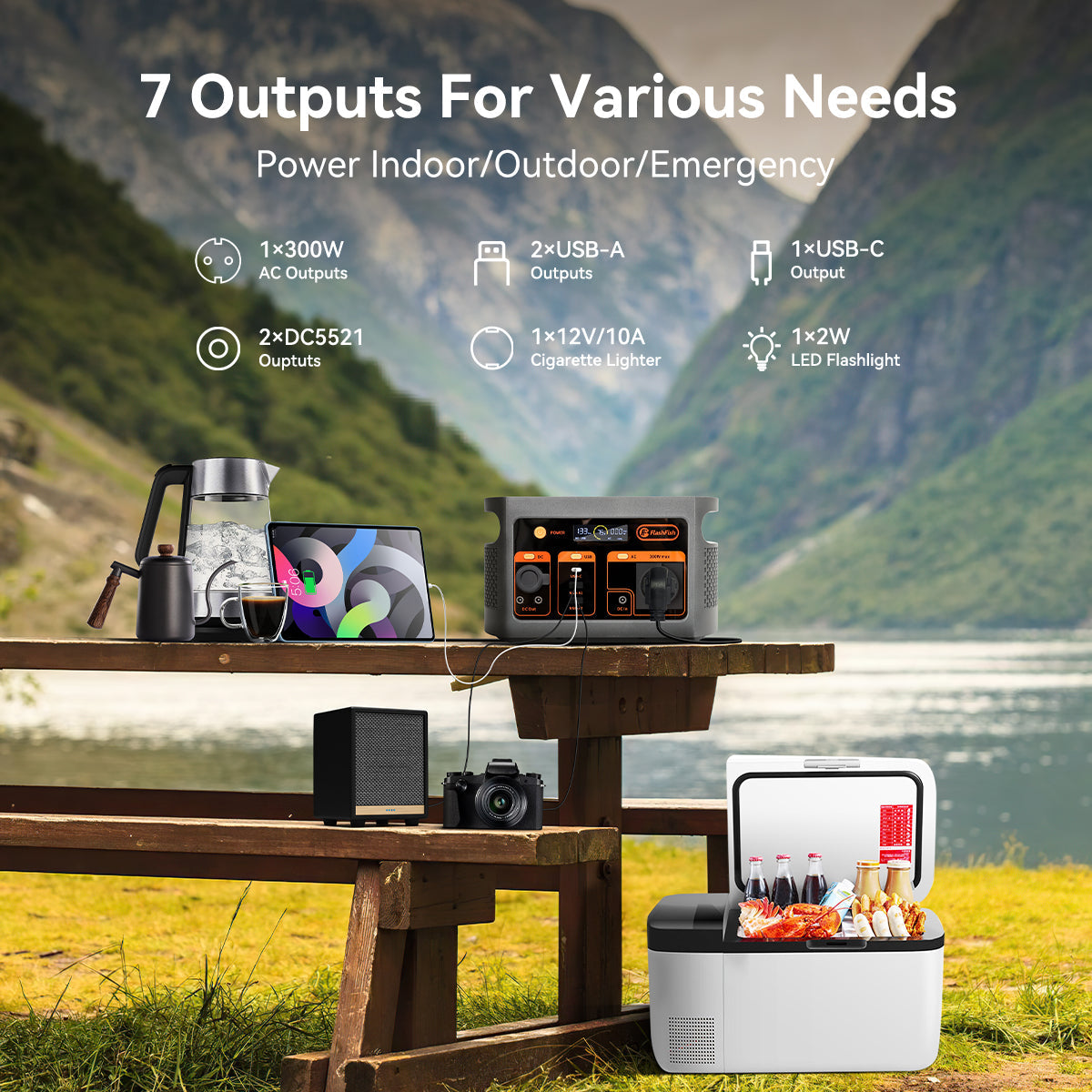
T1200S also expands connection options with four AC outlets, two USB-C outputs including one up to 100W, multiple USB-A ports, shared DC outputs, and wireless charging up to 15W. More ports do not increase the 1200W AC limit or remove the need to manage total demand.
How to choose the correct tier
Start with the largest device
If the largest required AC load exceeds 300W, T300PRO is not the right choice even if its 230Wh energy budget seems sufficient. If all loads fit below 300W, T1200S may be unnecessary unless longer energy reserve or more simultaneous connections are required.
Then calculate total energy
List estimated watt-hours for each device and usage period. Leave room for conversion losses, standby consumption, temperature, and battery condition. Do not divide watt-hours by nameplate watts and present the result as guaranteed runtime.
Check charging access
T300PRO documents up to 120W solar input. T1200S documents up to 400W solar input. Actual solar production varies with panel compatibility and field conditions. Charging speed should not be guaranteed from the maximum input figure alone.
Price the unused capacity
This article does not use current prices because pricing changes. The useful question is whether the larger station's additional capacity, output, and ports solve a real need. Paying for unused output can add cost and carrying burden without improving a small-device plan.
Scenario guidance
Camping electronics: T300PRO is usually easier for phones, lights, laptops, cameras, and modest AC loads. T1200S fits a larger group or a broader load list when the extra weight is acceptable.
Home-office outage planning: T300PRO can support selected laptop, monitor, router, and charging combinations only after a combined-watt check. T1200S provides more headroom and stored energy, but neither guarantees internet service or uninterrupted work.
RV light-duty use: Match the actual appliance labels and connector path. Neither model should be connected to an RV electrical system without following approved equipment instructions.
Field production: T300PRO favors mobility. T1200S favors a larger energy budget for more devices. Build the equipment list before choosing.
Related FlashFish comparisons
For a closer 300W-class comparison, see T300PRO vs E103. For a smaller camping tier, read T200 vs T300PRO. The T1200S home-office outage guide provides a scenario-focused load checklist.
FAQ
Is T1200S better than T300PRO?
It has more capacity and output, but it is also much heavier. It is better only when your documented loads and energy requirements need the larger class.
Can T300PRO power a 500W appliance?
No continuous 500W claim is supported. T300PRO is rated for 300W continuous AC; its 600W peak figure is not a 500W continuous rating.
Do both models have LiFePO4 batteries?
Yes. The available specifications document LiFePO4 chemistry for both T300PRO and T1200S.
Which model is easier to carry?
T300PRO weighs 4.5kg, while T1200S weighs 12.45kg. T300PRO is the more portable option.
Which has faster solar-input capability?
T1200S documents up to 400W solar input, compared with 120W for T300PRO. Real solar charging varies with compatible panels and conditions.

Laisser un commentaire
Ce site est protégé par hCaptcha, et la Politique de confidentialité et les Conditions de service de hCaptcha s’appliquent.