

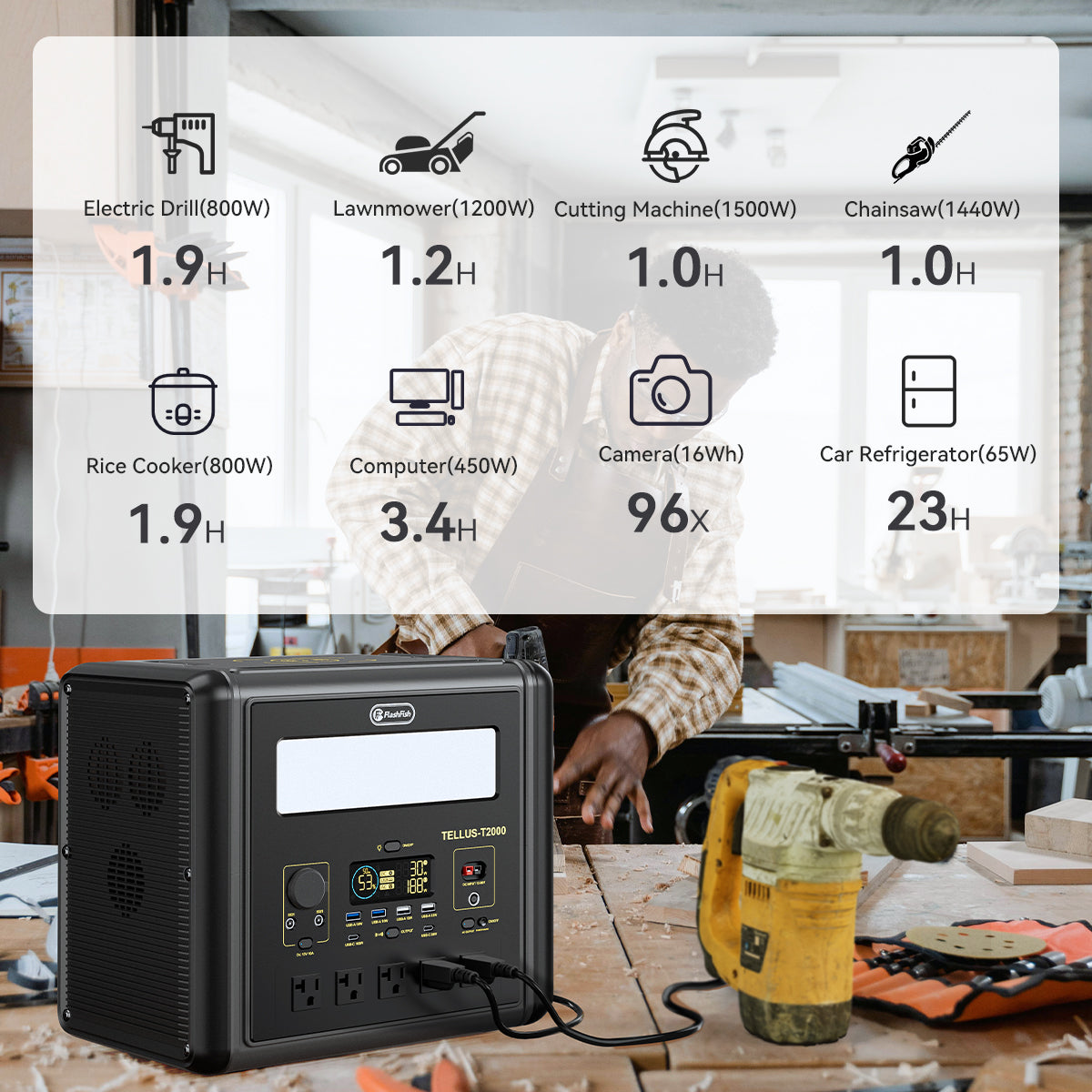
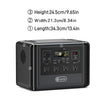
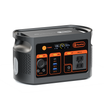
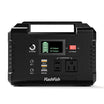

Short answer: FlashFish E200 and T200 are both compact 200W portable power stations, so the decision is less about output watts and more about battery chemistry, AC waveform, charging input, and carry weight. E200 is the lighter 151Wh model in the product database, with modified sine AC output and 40W max solar/DC charging. T200 is the 153.6Wh LiFePO4 model with pure sine AC output and 60W max solar input. Before choosing either one, check the wattage and charging needs of the devices you plan to connect.
A compact 200W power station is usually for small-device planning, not for replacing household power. The best choice depends on what you value most: lower carry weight, LiFePO4 chemistry, pure sine AC output, solar-input headroom, or a kit that pairs the station with a small portable solar panel.
Core comparison
| Spec | FlashFish E200 | FlashFish T200 |
|---|---|---|
| Battery capacity | 151Wh | 153.6Wh |
| Continuous AC output | 200W | 200W |
| Peak output | 400W | 400W |
| Battery chemistry | Lithium-ion | LiFePO4 |
| AC waveform | Modified sine wave | Pure sine wave |
| Max solar/DC input | 40W max solar/DC charging | 60W max solar input; 60W DC adapter input; 60W USB-C input |
| Weight | About 1.85kg | 2.5kg |
| Best-fit user | Users who prioritize light carry and simple low-draw power planning. | Users who prioritize LiFePO4 chemistry, pure sine AC, and stronger input flexibility. |
Choose E200 if carry weight matters most
The E200 is the lighter of the two models in the product database, at about 1.85kg. That makes it easier to understand as a grab-and-go compact station for simple camping, day trips, camera charging, phones, small lights, and many laptop or router scenarios after checking the connected device's wattage.
Its main limits should stay visible. The local product database lists E200 with 200W modified sine AC output, 400W peak output, and 40W max solar/DC charging. Modified sine AC can be acceptable for some simple loads, but users with AC-powered electronics should check the device manual and should not assume the same compatibility profile as pure sine AC.
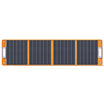
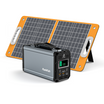
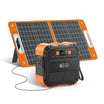
The E200 + TSP60 solar generator kit can make sense for shoppers who want a starter solar bundle around a compact station. The TSP60 is listed in the product database as a 60W foldable monocrystalline panel with 18V DC output and USB charging outputs. Solar performance still depends on sunlight, panel angle, temperature, and the station's input limit, so the kit should be framed as charging support rather than a guaranteed always-on system.
Choose T200 if waveform and battery chemistry matter more
The T200 keeps the same 200W continuous AC class and 400W peak output, but its product database record changes the decision in several ways. It is listed as a 153.6Wh LiFePO4 station with pure sine AC output, high-temperature, low-temperature, over-discharge, over-charge, overload, short-circuit, and over-current protections, and 60W input options through solar, DC adapter, and USB-C.
Pure sine AC is the safer comparison point for shoppers who have been researching AC waveform differences, especially after reading about pure sine versus modified sine power. That does not mean T200 can power every sensitive device. It still has a 200W continuous output rating, so device wattage and manufacturer guidance remain the first checks.
The tradeoff is weight. At 2.5kg, T200 is heavier than E200. For a buyer walking longer distances or packing very light, that difference may matter more than a small capacity increase.
What both compact 200W models are good for
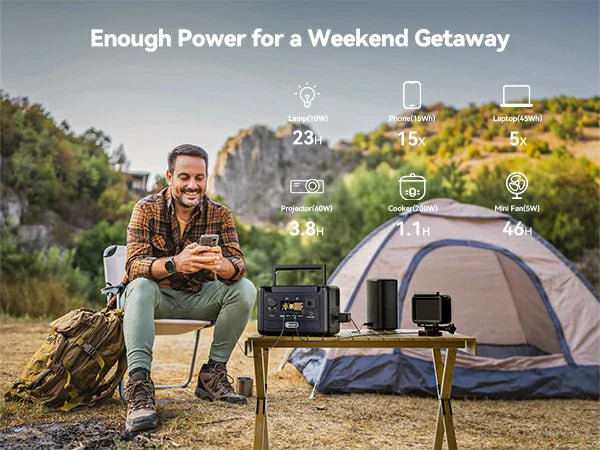
Both E200 and T200 fit the compact portable power station lane. They are easier to position around low-draw electronics than around high-watt appliances. Typical planning categories include phones, LED lights, cameras, small fans, routers, tablets, and many laptop chargers after checking the actual label or manual. The Department of Energy recommends using device labels or measuring tools when estimating energy use, which is more reliable than assuming every device in a category draws the same power.
For backup use, keep the expectation narrow. A compact 200W station can help with selected essentials that fit within its limits, but it is not a whole-home backup system, hardwired backup, medical-device guarantee, or refrigerator food-safety solution.
What neither model should be asked to do
- Do not use either model for high-watt cooking, heating, HVAC, or large appliances.
- Do not treat the 400W peak number as a 400W continuous rating.
- Do not promise exact laptop, router, or fan runtime without a verified device wattage and test boundary.
- Do not use either station as a substitute for medical backup equipment or professionally installed home backup.
- Do not assume solar charging will keep up with active loads; sunlight and input limits control the result.
Station alone or solar kit?
Choose the station alone if you mainly need charged-battery backup for short trips, desk-side emergency charging, or a compact power source you recharge from the wall before use. Consider a solar kit if your use case includes camping, daytime top-ups, or learning a small solar generator setup, and if you are comfortable with slower, sunlight-dependent charging.
For E200 specifically, the product database lists a 40W max solar/DC charging limit for the station. That input limit should guide expectations even when the paired panel is rated higher than the station can accept under ideal conditions.
Compare the current FlashFish E200 and T200 pages
Use these current FlashFish pages and guides to continue your comparison:
- View the current FlashFish E200 product page
- View the current FlashFish T200 product page
- Review what changes between 200W and 300W stations
FAQ
What is the main difference between FlashFish E200 and T200?
Both are compact 200W stations, but the product database lists E200 as a lighter 151Wh lithium-ion model with modified sine AC output, while T200 is a 153.6Wh LiFePO4 model with pure sine AC output.
Is E200 or T200 better for laptop backup?
It depends on the laptop charger wattage and AC requirements. T200 has pure sine AC in the product database, while E200 is lighter. In both cases, check the charger label and stay within the station's continuous output limit.
Which model has pure sine AC output?
The product database lists T200 with pure sine AC output. It lists E200 with modified sine AC output.
Which model is easier to carry for camping?
E200 is lighter in the product database at about 1.85kg, compared with 2.5kg for T200.
Should I choose a solar kit or the power station alone?
Choose the station alone for simple charged-battery use. Consider a solar kit when you want daytime top-up capability and understand that charging depends on sunlight, panel setup, and the station's input limit.

Leave a comment
Situs ini dilindungi oleh hCaptcha dan berlaku Kebijakan Privasi serta Ketentuan Layanan hCaptcha.