


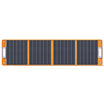
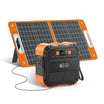
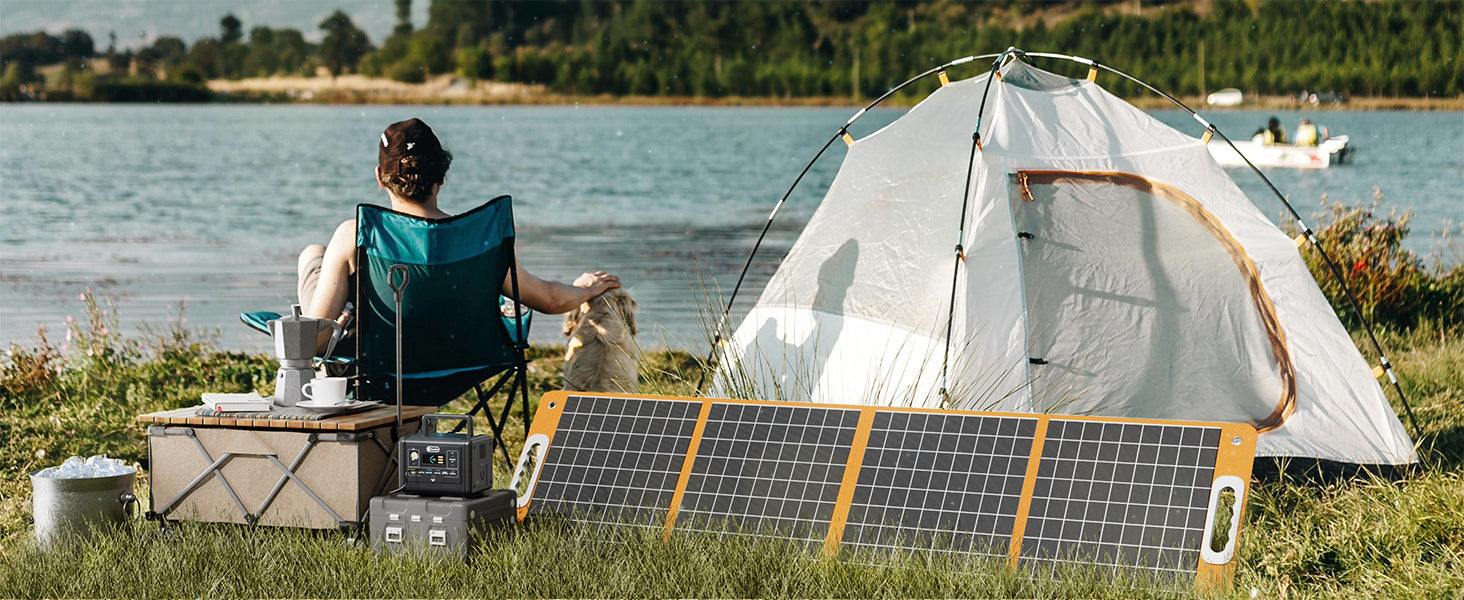
Short answer: FlashFish TSP60 is a foldable 60W solar panel for converting direct sunlight into charging power for a compatible portable power station or a suitable USB device. It does not store electricity. Actual charging depends on sunlight, panel angle, shade, weather, the cable path, and the receiving device's input limit.
What a 60W portable solar panel is for
A portable solar panel is a charging source, not a stored-power source. In a camping plan, it can help create a daytime charging path to a compatible station. For USB charging, the connected device and cable still need to support the available output. A charged power station is what provides stored energy later, including after sunlight is gone.
TSP60 facts to check before planning
| Planning factor | Documented value | Why it matters |
|---|---|---|
| Panel type | 60W foldable monocrystalline solar panel | It converts sunlight into charging power; it is not a battery. |
| DC output | 18V, 3.34A, up to 60W | A station's input range and connector path must be checked first. |
| USB-C output | Up to 45W | Useful only where the device and cable support the charging path. |
| USB-A output | Up to 18W | May suit compatible low-power USB charging plans. |
| Weight and size | About 1.9kg; 455.93 ? 416.81mm folded and 832.1 ? 455.93mm unfolded | Plan for a stable, open setup area. |
Common TSP60 use cases
Camping power-station top-up
TSP60 can be part of a camping top-up plan when the station accepts its voltage and connector path. Treat the panel as an input source rather than a promise of a full charge in a fixed time. Sun angle, shade, temperature, and the station's input limit affect the result.
Compatible USB-device charging
The listed USB-C output is up to 45W and USB-A output is up to 18W. Those maxima do not guarantee that every phone, camera, fan, tablet, or battery pack will charge, or that it will draw the maximum. Check the receiving device's documentation and use an appropriate cable.
Solar-generator planning
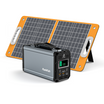
If the goal is stored energy for evening use, choose the power station first by capacity, output type, ports, and carry weight. Then choose the panel path. The FlashFish solar generator kits collection is a useful starting point for shoppers who need both a station and a solar charging path.
Compact campsite setup
The folded panel can be easier to pack than a rigid panel, but the unfolded dimensions still require a clear, stable place in direct sun. For setup basics, see How to Set Up a Portable Solar Panel at a Campsite.
TSP60 planning checklist
| Planned use | What to verify | Fit logic | Boundary |
|---|---|---|---|
| Station top-up | Input range, connector, and cable | 18V / 60W DC output can support a compatible charging plan | No recharge-time promise |
| USB device charging | Device, cable, and input requirements | USB-C up to 45W or USB-A up to 18W where supported | No universal compatibility claim |
| Solar kit planning | Station capacity and output first | The panel adds a charging source to a stored-power plan | No appliance or runtime promise |
| Evening camping use | A charged station or battery source | Store energy before sunset for later use | The panel alone is not backup power |
What TSP60 does not do
TSP60 does not store energy, provide AC output, guarantee all-weather charging, or establish a universal connection to every station or USB device. It also is not a basis for an exact solar yield, recharge-time, appliance-runtime, or overnight-power promise. Direct sun and the receiving equipment are part of every solar plan.
Choose panel-only or a stored-power path
Choose panel-only when you already have a compatible station or you only need conditional USB charging in good sun. Choose a station-and-panel path when stored watt-hours and output ports matter. The FlashFish portable solar panels collection helps compare panel formats, while the portable power stations collection is a better place to begin with storage and output needs.
When FlashFish fits and when it may not
FlashFish can fit a portable camping solar plan when the station or USB device has been checked for input compatibility and the user can set up in suitable sun. It may not fit when the plan needs guaranteed output, exact recharge timing, universal device compatibility, weather-exposed operation, or stored power without a battery station.
Related solar-planning guides
For a panel-size decision, see 60W vs 100W Portable Solar Panel for a Power Station. For a station-versus-kit choice, see Portable Power Station or Solar Generator Kit First?. For a direct USB-device boundary, see Can a Portable Solar Panel Power a Camping Fan Directly?.
FAQ
What can FlashFish TSP60 be used for?
It can be used for compatible power-station top-up, camping solar planning, and USB charging where the device, cable, and sunlight conditions fit.
Does TSP60 store power?
No. It converts sunlight into charging power. Use a compatible power station or battery source when stored energy is needed.
Can TSP60 charge a power station?
It can support a compatible station charging path when voltage, connector, cable, and station input limits match. This does not promise a particular recharge time.
Can TSP60 charge a phone or USB device directly?
It lists USB-C output up to 45W and USB-A output up to 18W, but the device and cable must support the path. Do not assume compatibility from the connector alone.
Is TSP60 enough for a camping trip?
It can be a useful charging source in suitable sun, but it is not stored backup power. Start with the device load list and decide whether a compatible station is also needed.

Leave a comment
Situs ini dilindungi oleh hCaptcha dan berlaku Kebijakan Privasi serta Ketentuan Layanan hCaptcha.