

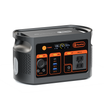
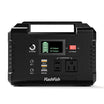

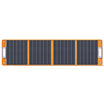
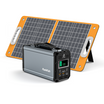
FlashFish TSP60 vs TSP100 for Direct USB Charging: What Changes?
Short answer: For direct USB planning, compare the documented USB-C and USB-A outputs, not only the 60W or 100W DC panel labels. The TSP60 manual lists PD USB-C up to 45W and QC USB-A up to 18W; the TSP100 manual lists PD USB-C up to 65W and QC USB-A up to 18W. In either case, confirm the device input, cable, and sunlight conditions before connecting.
Neither panel stores power. Both convert sunlight, so a port maximum is not a promise of a particular device's charging result.
Compare output paths before headline wattage
| Criterion | TSP60 documented source | TSP100 documented source | Reader decision | Boundary |
|---|---|---|---|---|
| DC panel path | 18V DC / 60W maximum. | 18V DC / 100W maximum. | Use a station manual to evaluate its input requirements. | DC ratings do not approve a connection by themselves. |
| Direct USB-C path | PD USB-C up to 45W. | PD USB-C up to 65W. | Check the device's USB-C input and cable. | Do not translate a port maximum into a guaranteed charging rate. |
| Direct USB-A path | QC USB-A up to 18W. | QC USB-A up to 18W. | Check the device's USB-A charging requirements. | Do not assume every device uses the same path. |
| Energy availability | Converts sunlight; no stored power. | Converts sunlight; no stored power. | Plan around current conditions and your power need. | Neither panel is a battery. |
Direct USB charging is a separate comparison
The 60W and 100W labels are DC panel ratings. They are relevant when planning a panel-to-power-station path, but they are not the same as the direct USB-C or USB-A port specifications. A reader looking for a direct device path should identify the device's accepted input first, then compare the applicable port.
For a USB-C device, the documented comparison is up to 45W on the TSP60 and up to 65W on the TSP100. That is useful planning information, but it does not establish what a particular device will draw. The device, its cable, and real solar conditions remain necessary checks.
What both panels have in common
Both manuals describe foldable monocrystalline solar panels with USB charging outputs and a DC path for portable-power-station planning. Both also state that conversion depends on conditions such as direct sun angle, temperature, weather, and charging conditions. Neither product is a source of stored power after sunlight changes.
When this comparison fits and when to pause
This comparison fits when you already know whether the intended connection is USB-C, USB-A, or DC to a power station and can verify the receiving device or station.
Pause and check further if you are choosing solely from the 60W or 100W headline, if the target device's input is unknown, or if a power-station connector, polarity, cable, or input limit has not been confirmed in that station's manual.
Explore the correct product or next step
Read the documented product details for the FlashFish TSP60 portable solar panel and the FlashFish TSP100 portable solar panel. If your real question is a panel-to-station decision, see 60W vs 100W Portable Solar Panel for a Power Station; direct USB output is a different check.
FAQ
What is the documented USB-C output of TSP60 and TSP100?
The TSP60 manual lists PD USB-C up to 45W. The TSP100 manual lists PD USB-C up to 65W.
Does a 100W panel automatically deliver 100W over USB-C?
No. The 100W value is a DC panel maximum. The USB-C port has its own documented maximum, and conditions plus device input affect the setup.
Do both panels have USB-A outputs?
Both manuals list a QC USB-A output up to 18W.
Is this the same as choosing a panel for a power station?
No. A power-station path requires its own check of accepted voltage, current, power, connector, polarity, and approved cable.
Why is a device and cable check still needed?
Port labels alone do not establish whether a particular device accepts that input or what it will receive.

Commenta
Questo sito è protetto da hCaptcha e applica le Norme sulla privacy e i Termini di servizio di hCaptcha.