


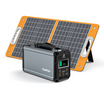
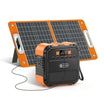
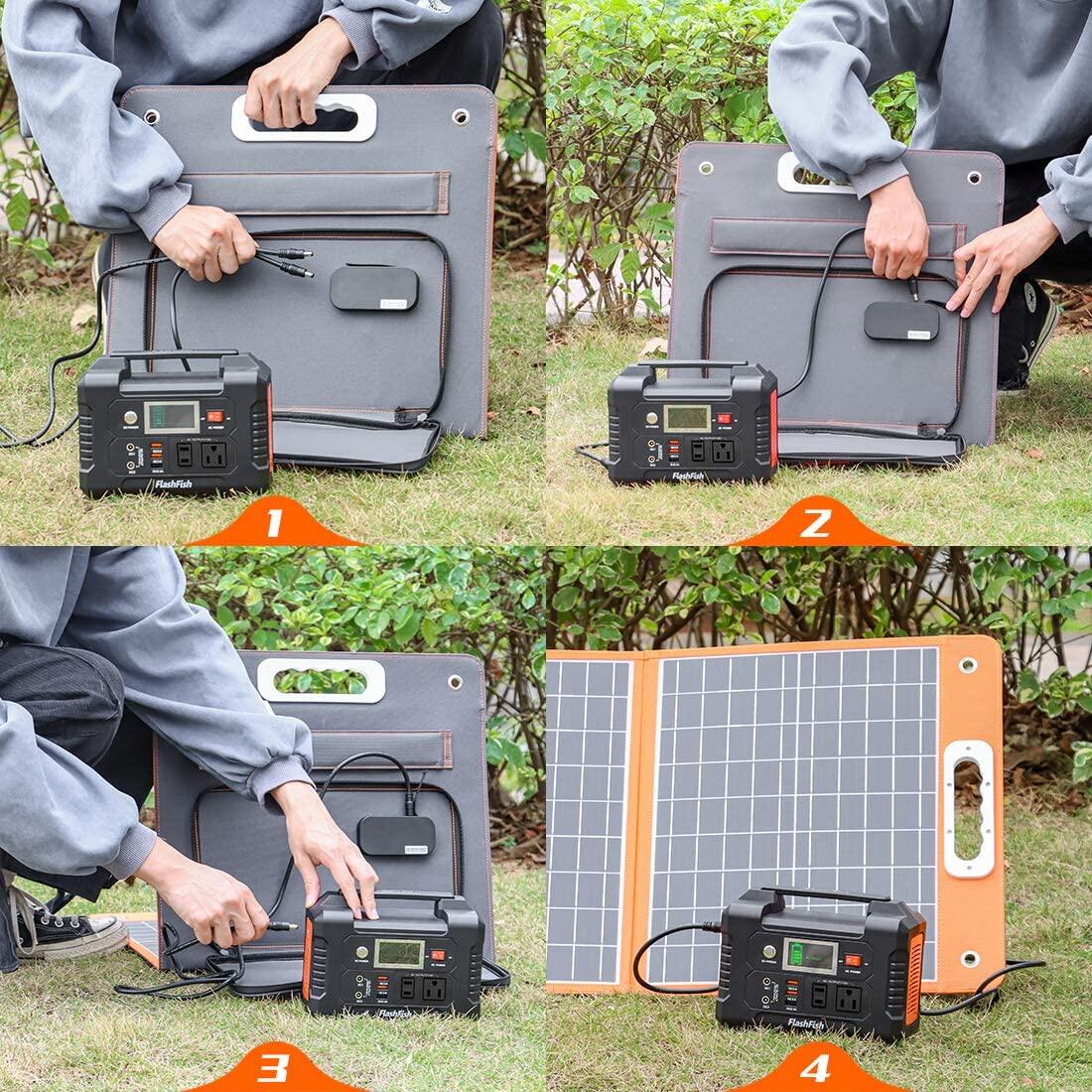
Moving a supported portable solar panel setup can be worthwhile when the extra accepted input after the move exceeds the input forgone while charging stops. Compare usable time remaining, comparable station input readings, and the full interruption. If those inputs are missing or conditions changed between readings, the move's energy benefit remains unsubstantiated.
This guide is for campers choosing between two permitted, dry outdoor locations for an already verified panel and station combination. It answers a narrow question: whether a better location can repay the interruption. It does not establish an electrical pairing or predict how much charge your battery will gain.
Start with accepted input, not panel wattage
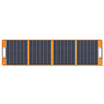
A panel's rated watts and the watts a station currently accepts answer different questions. FlashFish TSP18V60W is rated at 60W and TSP18V100W at 100W. Neither figure supplies a reading for your campsite. Use the same documented station input indicator or supported measurement method for both locations.
Before treating either location as an option, verify the exact panel, receiving station, cable, connector, polarity, and input limits against their original instructions. The panel specifications reviewed here do not provide open-circuit voltage and describe model-dependent cables. Their 18V DC output specification alone cannot establish compatibility. This calculation starts only after those questions are resolved.
Make the two observations comparable
Write down the time, accepted input reading, station charge level, connected loads, and visible conditions for each observation. Follow the original instructions for setup and any interruption; this is not a disconnect or reconnect procedure. Record the whole interval without accepted solar input, including packing, carrying, setup, and any delay before input resumes.
Readings taken hours apart can reflect changing sunlight rather than location. A station approaching its charging limit may also make an earlier observation a poor comparison. If you cannot obtain reasonably comparable observations using the supported setup, record the uncertainty instead of assigning an expected gain. An exploratory move itself consumes time and should be logged.
| Worksheet field | What to record | Why it matters |
|---|---|---|
| Location A | Comparable accepted input in W | Baseline for staying |
| Location B | Comparable accepted input in W | Conditional input after relocation |
| Remaining window | Minutes from the decision until charging must end | Includes the interruption |
| Relocation downtime | Full minutes without accepted input | Reduces time available at B |
| Lost baseline input | A watts multiplied by downtime in hours | Energy forgone during the move |
| Conditional net gain | B input over its shorter window minus A input over the full window | Positive only under the stated assumptions |
Calculate the minimum remaining window
Let A and B be comparable accepted input in watts, T the remaining time in minutes measured before the move, and d the interruption in minutes. Assume input stops completely during relocation and both readings would otherwise remain constant. Staying gives A × T ÷ 60 watt-hours of input; moving gives B × (T − d) ÷ 60.
Conditional net input gain = [B × (T − d) − A × T] ÷ 60 Wh. When B is greater than A, the break-even remaining window is B × d ÷ (B − A) minutes. T must exceed that value for a positive result. When B is no greater than A, a positive interruption cannot be repaid through higher input under this model.
The break-even threshold includes downtime. If you instead count the remaining window only after reconnecting, you need a different expression: post-move time must exceed A × d ÷ (B − A). Keep the clock boundary explicit so the same lost minutes are not omitted or counted twice.
Three hypothetical relocation decisions
These invented figures demonstrate the worksheet. They are not FlashFish tests, expected panel output, or a forecast.
Example 1: Enough time to recover the interruption
Suppose A is 30W, B is 45W, downtime is 6 minutes, and 60 minutes remain before departure. Staying gives 30Wh of input; moving gives 40.5Wh. The conditional difference is 10.5Wh. Break-even is 18 minutes from the decision, so the assumed hour clears it.
Example 2: A better reading with too little time left
Keep the same readings and interruption, but allow only 12 minutes before departure. Staying gives 6Wh; moving gives 4.5Wh. The conditional difference is −1.5Wh. A higher reading at B does not compensate for losing half the remaining window.
Example 3: Readings that cannot support the comparison
Suppose A was observed under cloud and B later under clear sunlight, while the station's charge level also changed. Even if B's displayed number is larger, leave conditional gain and break-even blank. The observations do not isolate the location's effect.
Where the FlashFish panels fit
TSP18V60W and TSP18V100W are candidate panels to evaluate with this method once the exact receiving setup is documented. Their respective 60W and 100W ratings do not determine whether moving is useful. The same panel may show little difference between two locations, and a larger rating does not remove the station's input constraints.
The model compares input energy at one measurement boundary. It does not calculate stored battery energy, delivered device energy, charging completion, or extra runtime. Changing conditions and a station's changing accepted input can erase the apparent advantage. Treat a small positive result cautiously when the uncertainty is of similar size.
Frequently asked questions
Should I move whenever the input reading rises?
No. Include the full interruption and the time remaining. A larger reading can still produce less input over the available window, and readings from different conditions may not support a location comparison at all.
Can I substitute the panel's 60W or 100W rating?
No. The worksheet needs comparable accepted input for the receiving setup. A nameplate rating cannot supply that observation or confirm that the panel and station are compatible.
Does a positive result tell me when the station will be full?
No. It is a conditional input comparison over a chosen interval. It does not account for the station's complete charging behavior or establish a full-charge time.
Your next decision
First complete the compatibility and location checks. Then fill in A, B, T, and d, keeping missing observations blank. Use the result to decide whether the proposed move has a documented energy case; evaluate product specifications only after identifying the receiving setup and the input evidence you still need.
Next step: Compare FlashFish TSP18V60W specifications with your equipment list.

Commenta
Questo sito è protetto da hCaptcha e applica le Norme sulla privacy e i Termini di servizio di hCaptcha.