

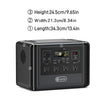
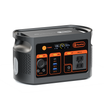
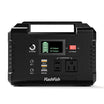

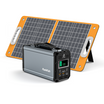
Short answer: Use the device's dimensions to check space for the unpacked power station, the single-unit box dimensions to check space for that box, and master-carton dimensions only when you need to accommodate the full carton. Confirm the exact model, packaging revision, units, and dimension order. An inner box is not automatically the outer parcel delivered to your home.
For U.S. buyers planning a storage compartment and a place for an unopened delivery, one “size” field is not enough. The useful result is two separate decisions: whether the device fits and whether the actual box you will receive fits.
Separate the three objects before comparing sizes
| Object | Question it answers | What it cannot establish |
|---|---|---|
| Unpacked device | Can the station body fit the measured space in the intended orientation? | Box size, cable room, or operating clearance |
| Single-unit inner box | Can this documented one-unit package fit? | Size of an added shipping overbox |
| Master carton | Can the full documented multi-unit carton fit? | Size of one station or one retail box |
Package weight has the same identity problem. A net unit weight, a unit-plus-inner-box weight, and the gross weight of a complete carton describe different objects. Do not infer a box's dimensions from a weight field or substitute a carton field for a missing single-box measurement.
A101 and E200: device sizes and documented packaging variants
The table uses device dimensions from the FlashFish manuals and separate box dimensions from a manufacturer-provided packaging sheet. The packaging entries describe documented supplier variants and revisions; they do not confirm today's U.S. order packaging. All dimensions are in centimeters, in the source's length × width × height order.
| Model and packaging source | Device, cm | Inner box, cm | Master carton, cm | Units per carton |
|---|---|---|---|---|
| A101, YET record; revision date unprovided | 15.8 × 15.8 × 9.0 | 20.0 × 20.0 × 17.0 | 58.0 × 27.0 × 45.0 | 8 |
| A101, XJM record; revision date unprovided | 15.8 × 15.8 × 9.0 | 25.6 × 20.5 × 13.6 | 58.0 × 27.0 × 45.0 | 8 |
| E200, explicitly selected post-July-2024 logistics revision | 20.8 × 11.0 × 15.8 | 31.0 × 16.5 × 20.0 | 35.1 × 32.8 × 43.0 | 4 |
A101's two packaging records are parallel entries with no revision dates. Their order in a table does not establish which is newer or which a customer will receive. A supplier selection for another technical field also does not establish the packaging on a particular shipment.
E200's logistics selection has an explicit revision, but its source sheet reports a device size of 21 × 12 × 13 cm, conflicting with the accepted manual dimensions of 20.8 × 11 × 15.8 cm. The table retains the manual dimensions for the device and the packaging-sheet values for the boxes. Do not average them or build a third size from whichever axis looks convenient.
A101 has similar differences between manual dimensions and logistics-sheet device values. That conflict does not erase the separately recorded box dimensions; it does mean that model and source identity deserve attention before a close-fit purchase.
Measure the space and the path into it
Record usable internal length, width, and height, then measure the opening separately. A compartment can have enough interior room but an opening that blocks the object. Note lips, hinges, handles, fixed shelves, and the space needed to place or retrieve it.
Keep units consistent. Divide millimeters by 10 to obtain centimeters; divide centimeters by 2.54 to obtain inches. Retain the original values beside conversions. Rounded inch measurements are poor evidence for a compartment with almost no remaining room.
Match each object axis to the intended orientation. For a simple rectangular check, each dimension must be no larger than the corresponding available dimension. If you consider another orientation, write down the new axis mapping instead of silently sorting the numbers.
A passing check is a preliminary geometry result. It does not establish storage conditions, operating ventilation, connected-cable space, or permission to charge in a closed compartment. Resolve those questions from the original manual for the exact unit; no clearance value is invented here.
Three hypothetical space checks
These spaces are invented examples, not measurements of customer furniture or confirmations of actual deliveries. Each check assumes a clear opening, the listed orientation, and bare rectangular dimensions without extra handling allowance.
Example 1: A101 device fits; neither inner box fits
For a 17 × 17 × 10 cm space, the accepted A101 device dimensions leave 1.2 × 1.2 × 1.0 cm of dimensional difference. Its body passes the simple check. The YET inner box exceeds the space on every axis; the XJM inner box also fails. Record “device passes geometry; documented inner boxes fail,” not “A101 delivery fits.”
Example 2: A101 packaging variant changes the answer
For a 22 × 22 × 18 cm space, the 20 × 20 × 17 cm YET inner box passes. The 25.6 × 20.5 × 13.6 cm XJM inner box fails in the stated orientation because 25.6 cm exceeds 22 cm. With the order's packaging variant unknown, the final box-fit decision remains unknown.
Example 3: E200 device and inner box fit; master carton does not
For a 32 × 18 × 21 cm space, the accepted E200 device dimensions and the recorded 31 × 16.5 × 20 cm inner box pass. The 35.1 × 32.8 × 43 cm four-unit carton fails. Any shipping overbox remains unmeasured, so this does not establish that an unopened delivered parcel will fit.
Make a comparison that preserves the unknowns
For product selection, compare A101 and E200 using the device dimensions when the unpacked station is the object you will store. For delivery planning, compare the confirmed parcel dimensions. A smaller device does not automatically arrive in the smaller box.
Your worksheet should have separate fields for model, device source, packaging supplier or revision, measurement units, orientation, compartment interior, opening, and result. Mark a result as “passes preliminary geometry,” “fails in this orientation,” or “unknown pending package confirmation.”
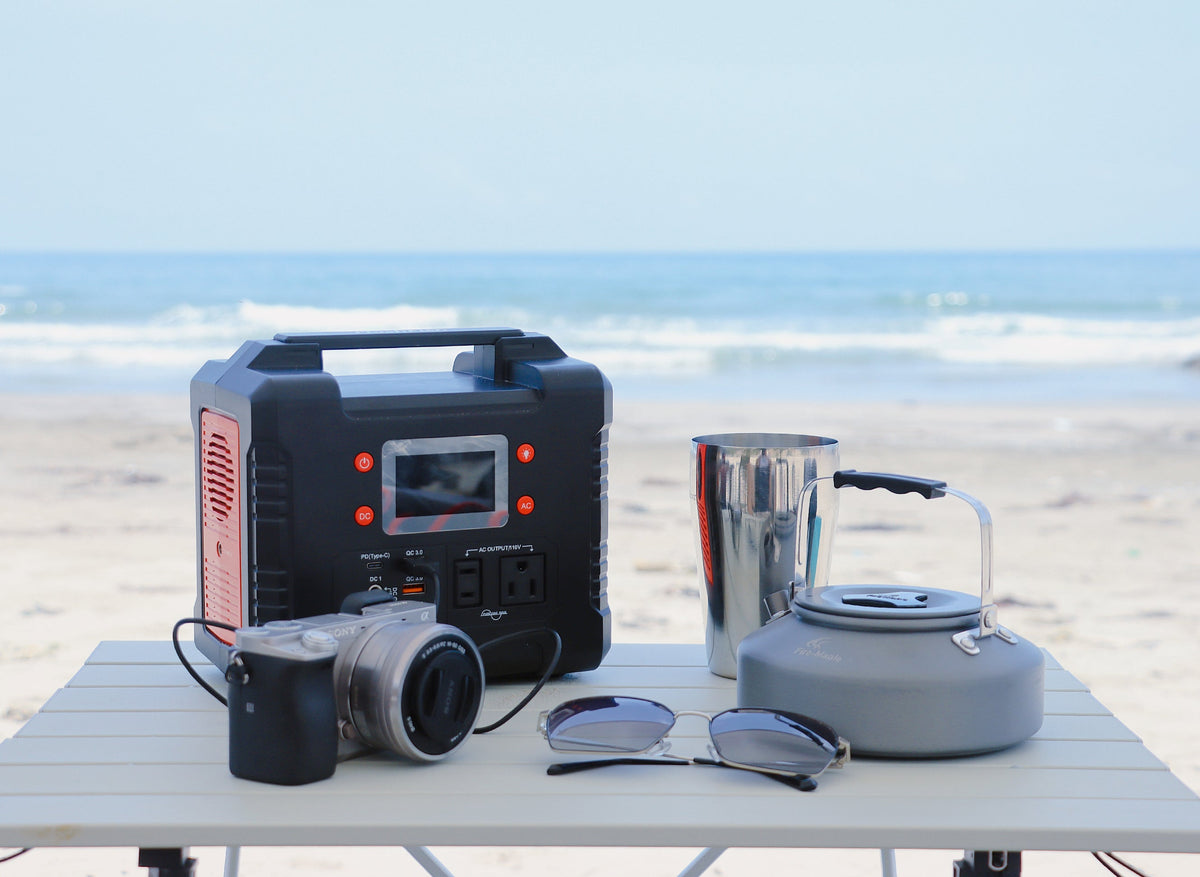
For an order with little spare room, obtain the actual single-unit package or shipping-parcel dimensions before deciding. If only the master-carton dimensions are supplied, request the dimensions of the object you will receive. A picture of the unit beside its box does not replace those measurements.
Frequently asked questions
Are inner-box dimensions the same as delivery-box dimensions?
They may describe different objects. An inner box can sit inside a separate parcel or a multi-unit carton. The historical packaging entries do not confirm today's U.S. parcel for your order. Obtain the outer dimensions of the actual package if unopened-delivery fit matters.
Can I rotate the device or box to make it fit?
You can evaluate another axis mapping as a geometry exercise, but also check the opening and handling path. For a device, follow its documented storage and operating orientation. A successful dimensional permutation does not authorize using or charging it in that position.
Which A101 packaging row should I use?
Use the row confirmed for your actual package. The YET and XJM logistics entries have no revision dates and remain parallel records. Until supplier or package identity is confirmed, retain both results and treat any variant-dependent fit conclusion as unknown.
Resolve the size question before ordering
Measure your space and opening, make the device-fit decision, and then request the exact single-box or parcel dimensions needed for the second decision. Compare the confirmed U.S. model and packaging against both records before purchasing. Keep operating-clearance and storage requirements as separate manual checks.
Next step: Compare FlashFish A101 specifications with your requirements.

Leave a comment
This site is protected by hCaptcha and the hCaptcha Privacy Policy and Terms of Service apply.