


The maximum required-accessory quote your budget can accept is your budget cap minus the confirmed station cost and all other nonoptional costs. Compare the accessory's complete quote with that remaining amount. A quote at or below the ceiling passes the affordability calculation; a higher quote fails it. If a required cost or the accessory requirement is unconfirmed, keep the result conditional.
This approach is for a buyer with one verified device power path and a required item that has not yet been quoted. It answers “How much room is left?” before you choose a station. It does not estimate an accessory's market price or prove that an inexpensive cable, adapter, or other item is suitable.
Confirm what the quote must cover
First identify the exact missing item from the matching product and device documentation. Record the approved specification and the reason it is required. A connector that looks similar is not enough evidence to substitute an item, and a product family's package list does not confirm what a particular offer includes.
Then choose a consistent quote basis. For example, a delivered accessory quote should include its applicable tax and shipping, while those charges must be excluded from “other costs” to avoid counting them twice. If the seller gives only a pre-tax item price, the delivered quote remains incomplete until the missing charges are known.
Work backward from a fixed budget
Use C = B − S − O, where C is the accessory quote ceiling, B is the fixed budget, S is the confirmed station cost on your chosen checkout basis, and O is every other nonoptional cost not already included in S or the accessory quote. Use amounts for the same purchase, destination, currency, and quote conditions.
Do not fill an unknown cost with zero. Zero is appropriate only when the item or charge is confirmed unnecessary, already included, or otherwise costs nothing for this purchase. If station cost is unknown, write the expression and ask for that amount; a numeric ceiling is not yet available.
| Candidate | Budget B | Confirmed station basis S | Other costs O | Missing required item | Maximum quote C | Result |
|---|---|---|---|---|---|---|
| FlashFish A101, exact offer pending | Reader's cap | Exact checkout amount needed | Confirmed nonoptional costs needed | Item specified by verified device path | B − S − O | Unresolved until costs and requirement are confirmed |
| FlashFish E200, exact offer pending | Same reader cap | Separate exact checkout amount needed | Candidate-specific costs needed | Item specified by this verified path | B − S − O | Evaluate independently |
Use three result states instead of forcing a winner
Pass: the complete confirmed quote is at or below a nonnegative ceiling, with all required costs accounted for. Fail: it exceeds that ceiling, or the confirmed station and other costs already exceed the budget. Unresolved: any essential cost, inclusion, quote condition, or accessory requirement is missing.
A pass is an affordability result only. Keep electrical fit and purchase terms as separate checks. If the quote expires, the destination changes, or the item turns out to be different from the approved requirement, recompute rather than carrying the old result into checkout.
Three hypothetical quote decisions
All dollar amounts in these examples are invented worksheet inputs in U.S. dollars. They are not FlashFish prices, seller quotes, expected taxes, or claims about what any accessory should cost. Each example assumes the device path and required item have already been confirmed.
Example 1: A complete quote fits the ceiling
A buyer sets B at $240. A hypothetical confirmed station amount S is $170, and other committed costs O are $20. The ceiling is $240 − $170 − $20 = $50. A complete required-accessory quote of $35 fits, leaving $15 uncommitted. That $15 is budget room, not a claimed saving or a reason to add an unneeded item.
Example 2: The lower station amount loses its advantage
With the same $240 cap, Candidate A has a hypothetical station amount of $160 and other costs of $20, leaving a $60 ceiling. Its approved accessory quote is $70, so it fails. Candidate B has a station amount of $185 and other costs of $10, leaving $45. Its approved accessory quote is $30, so it passes. These candidates are abstract; the figures are not assigned to A101 or E200.
Example 3: An incomplete quote cannot pass
The budget is $240 and confirmed station cost is $175, but other nonoptional costs are unknown. Write C = $65 − O. A seller's $25 item-only quote cannot establish affordability if accessory tax or shipping is also unknown. Request a complete quote and resolve O before marking the candidate pass or fail.
Consider FlashFish A101 and E200 only after confirming the path
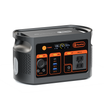
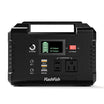
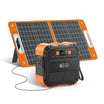
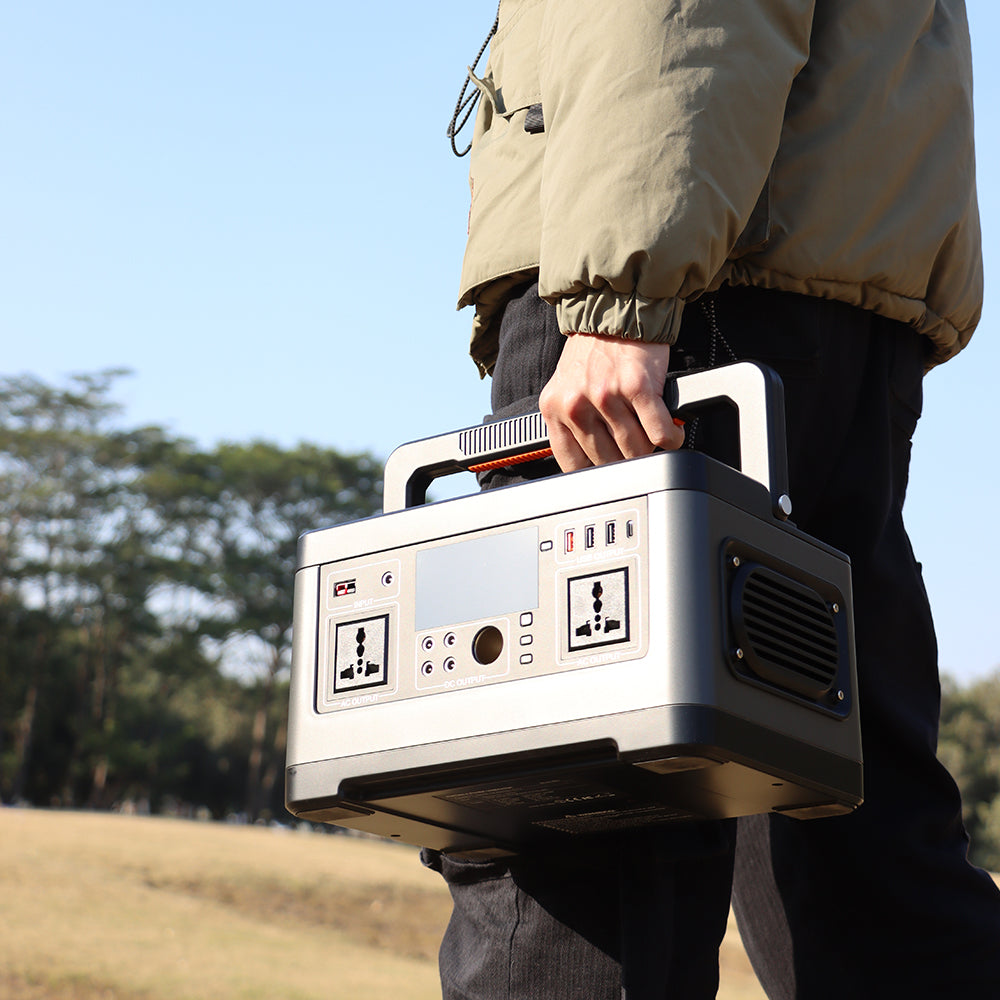
FlashFish A101 is specified at 97.68 Wh and two USB-C outputs up to 18 W each, plus two USB-A outputs up to 18 W each. These port specifications are starting points for checking a device's requirements; they do not establish combined output, a particular cable's suitability, or the contents of today's offer. The source also has a regional AC boundary, so do not infer U.S. AC configuration from the model name alone.
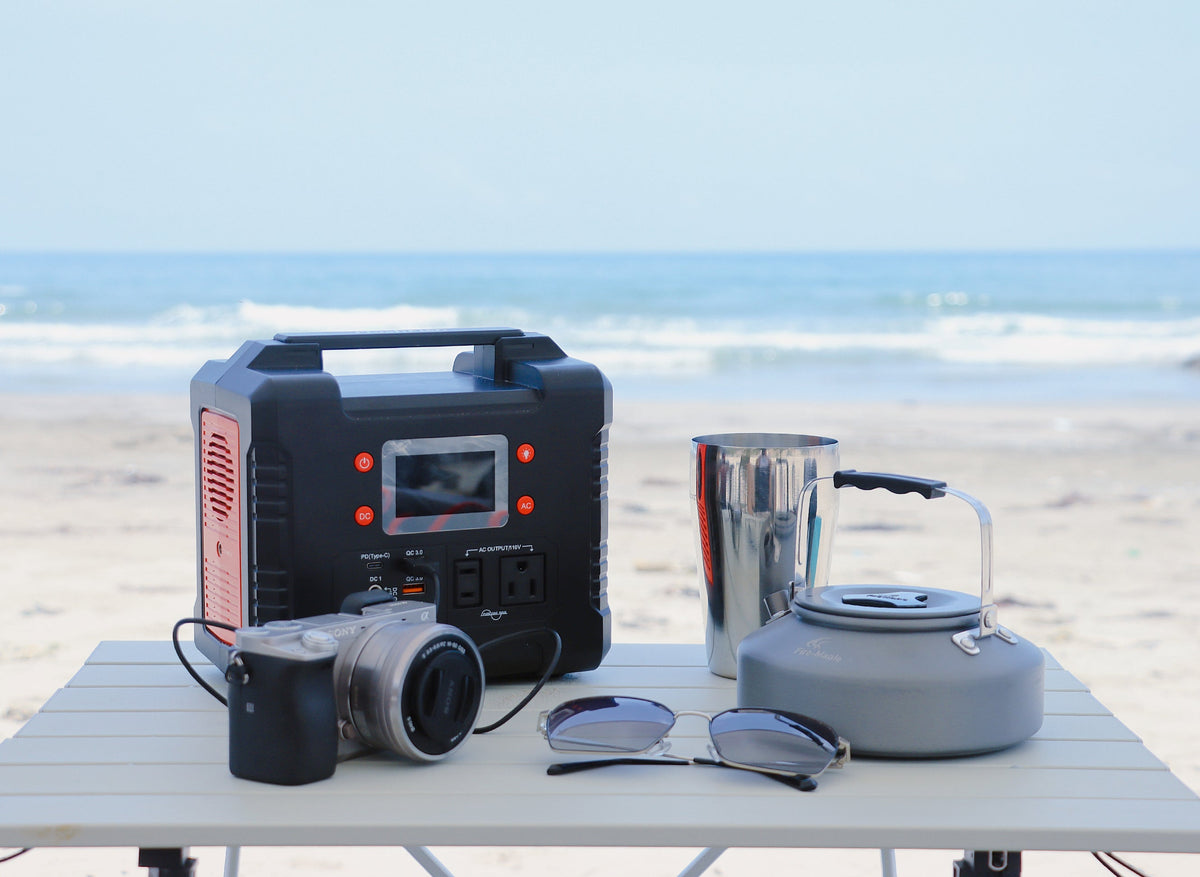
FlashFish E200 is specified at 151 Wh, two USB-A outputs up to 18 W and one USB-A output up to 12 W. Do not assume its documented USB-A configuration provides the same connection path as A101's USB-C ports. A budget comparison becomes meaningful only after each candidate has a separately verified way to serve the intended device.
No current station price, accessory quote, offer inclusion, or availability is supplied here. Technical specifications do not establish today's checkout cost. Compare the complete candidate paths and their actual quotes rather than declaring a model cheaper from nominal capacity or port count.
Keep optional upgrades outside the required-item ceiling
A carry bag or second charging option may be useful to a particular reader, but it should not silently become a required cost. Mark each item required, optional, already owned and verified, or unresolved. Calculate required affordability first; evaluate optional spending separately against any remaining budget.
If two required items remain unquoted, C is their combined remaining allowance, not the maximum for each item individually. You can accept one quote and calculate the remainder for the other, but you cannot spend the full ceiling twice. Likewise, an already owned accessory reduces the shopping list only after its fit has been confirmed.
FAQ
Can a negative ceiling be treated as zero?
No. A negative ceiling means the confirmed station and other nonoptional costs already exceed the budget. A free accessory would not fix that gap. Reconsider the candidate or the budget before requesting a quote solely to finish the calculation.
Should I include shipping and tax?
Include every applicable nonoptional charge once, using the actual quote basis for your purchase. Put station checkout charges in S, accessory charges in its complete quote, and any remaining committed charges in O. If a charge is unknown, the affordability result remains unresolved.
Can I substitute a cheaper accessory to pass?
Only after the replacement is confirmed suitable for the exact documented path. A lower price does not establish fit. If the proposed replacement changes the specification or adds another required item, revise the path and the worksheet before comparing its quote with the ceiling.
Make the next quote request specific
Write down the required item specification, destination, quote basis, and maximum acceptable complete quote. For each FlashFish candidate, retain a dated cost record and a pass, fail, or unresolved result. Then compare current model details and the confirmed device path before making the purchase decision.
Next step: Check the current FlashFish A101 product details and price.

Leave a comment
This site is protected by hCaptcha and the hCaptcha Privacy Policy and Terms of Service apply.