

Solar Generator for RV Camping: How to Size Battery and Panels
Short answer: For RV camping, size a solar generator by listing your daily watt-hour needs first, then matching a portable power station and solar panel setup to your real campsite routine. A larger battery helps overnight. Solar panels help during the day. Neither replaces checking campground rules, weather, shade, and device wattage.
RV campers often search for a single "best solar generator," but the better question is: What do you need to power away from the pedestal? National Park Service camping guidance encourages planning around site rules and low-impact behavior, while many campgrounds set quiet-hour or generator-use limits. A battery power station is useful because it runs silently after charging, and a portable solar panel can extend the trip when there is enough sun.
Step 1: list your RV-camping loads
Start with the devices you actually use in a day. The common mistake is sizing for every appliance at once. For a practical weekend setup, separate essential, comfort, and optional loads.
| Load group | Examples | Planning note |
|---|---|---|
| Essential | Phones, headlamps, GPS, small radio | Low wattage, high priority |
| Camp comfort | Small fan, laptop, camera batteries, portable cooler accessory | Estimate watts and hours carefully |
| RV extras | 12V accessories, lights, inflator, small kitchen gear | Check surge and outlet type before connecting |
| High draw | Microwave, kettle, hair dryer, heater | Often a poor fit for battery-first camping unless the model and load are verified |
Once you have the list, multiply watts by hours. A 40W fan for five hours is roughly 200Wh before losses. A 60W laptop charger for two hours is roughly 120Wh before losses. Add a buffer for inverter loss and weather uncertainty.
Step 2: choose battery size for overnight needs
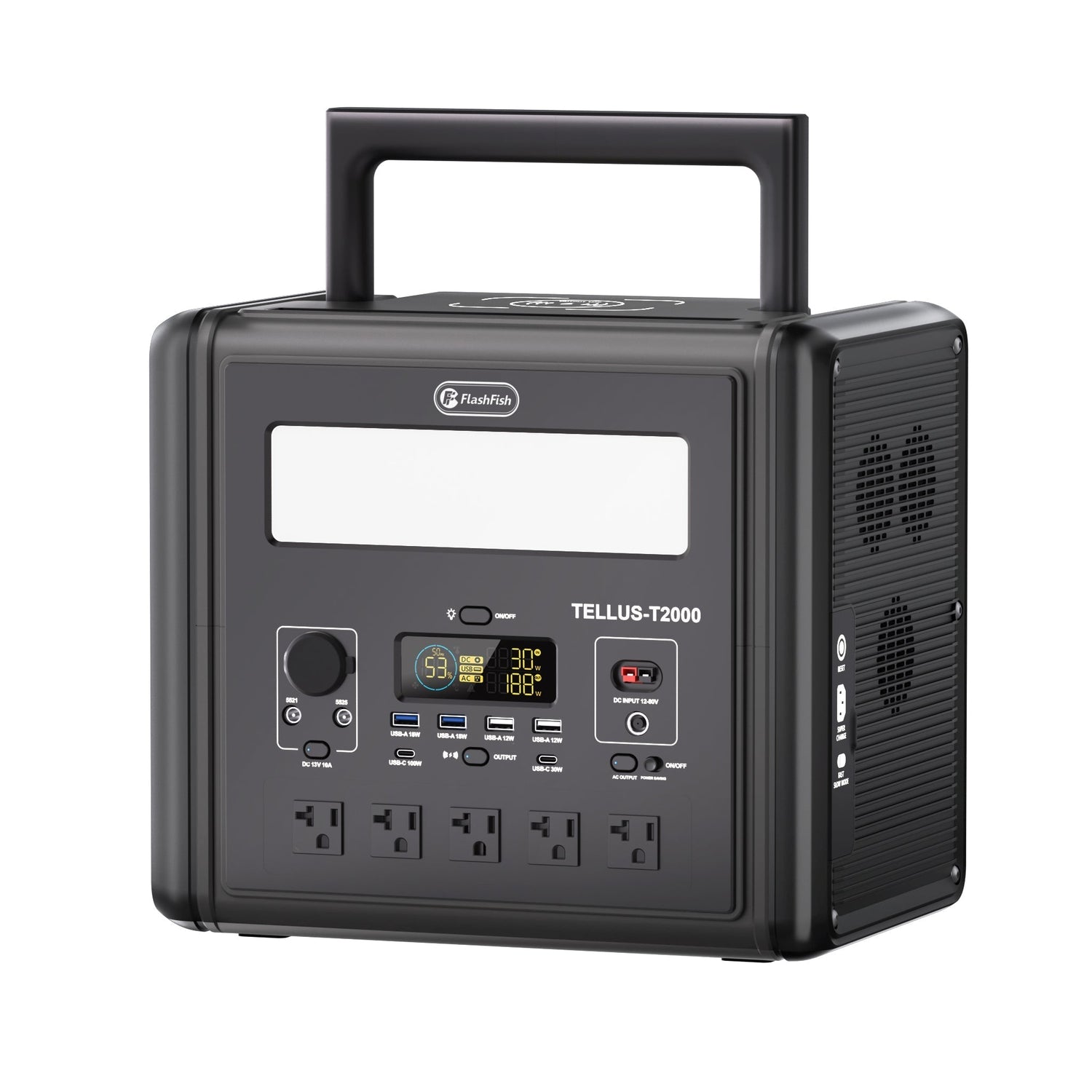
A solar panel is valuable, but the battery is what carries you through evening and overnight use. For larger RV-camping setups, the FlashFish T2000 Portable Power Station gives a larger 1536Wh planning base and 2000W product-title output rating. Live U.S. Shopify data shows U.S. plug and TSP100 bundle variants are active today.
For a more portable balance, the FlashFish T1200S gives a smaller 768Wh base that can still support many camping essentials when you prioritize low-watt devices.
Step 3: add portable solar for daytime recovery
A solar generator kit pairs a battery with a panel. The FlashFish TSP100 Portable Solar Panel is a 100W foldable panel option for compatible setups, and the FlashFish solar generator kit collection is the right place to compare paired kits.
Solar output depends on sun angle, cloud cover, shade, temperature, cable setup, and the power station's input limits. A 100W panel does not deliver 100W every hour of a real camping day. Treat solar as a way to reduce drain and recover during daylight, not as a guarantee that every high-watt device can run indefinitely.
Step 4: match the campsite style
| Camping style | Better fit | Why |
|---|---|---|
| Weekend tent or car camping | E200, E103, T300PRO, TSP60/TSP100 | Compact load list and easy packing |
| RV weekend with phones, fans, laptop, lights | T1200S + TSP100 or T2000 + TSP100 | More battery headroom and solar recovery |
| Multi-day campsite with uncertain sun | T2000 plus multiple TSP100 panels if compatible | Larger capacity reduces dependence on perfect sun |
Quiet power matters at camp
Many campers want backup power without the sound and exhaust of a fuel generator. A charged battery power station runs quietly, which helps around campground quiet hours and crowded RV loops. If you use any fuel generator elsewhere in your setup, follow the campground rules and public safety guidance for exhaust and placement.
FlashFish setup examples
- Light RV weekend: T1200S for phones, lights, router-style small electronics, camera batteries, and a fan, with TSP100 for daytime recharge.
- Bigger RV backup: T2000 for a larger watt-hour cushion and optional TSP100 bundles for solar recovery.
- Compact camping kit: E200 + TSP60 or E103 + TSP60 for smaller device lists and easy packing.
FAQ
How many watts do I need for RV camping?
Use watt-hours, not only watts. Watts tell you how much power a device draws at a moment; watt-hours estimate how much energy it uses over time.
Can one solar panel keep an RV power station full?
Sometimes for light loads, but not always. Sun, shade, weather, and daily use matter. Plan with a buffer and choose lower-watt devices when you want solar to keep up.
Is a solar generator better than an RV fuel generator?
It depends on the load. A battery solar generator is quiet and useful for electronics and moderate loads. Fuel generators may handle different jobs but require strict outdoor use, campground-rule compliance, and carbon monoxide precautions.
Human review checklist
- Verify T2000, T1200S, TSP100, and kit variants remain active and available.
- Confirm no solar-output guarantee is overstated.
- Check campground-rule wording is general and not legal advice.
- Preview image and all internal links.


Dejar un comentario
Este sitio está protegido por hCaptcha y se aplican la Política de privacidad de hCaptcha y los Términos del servicio.