

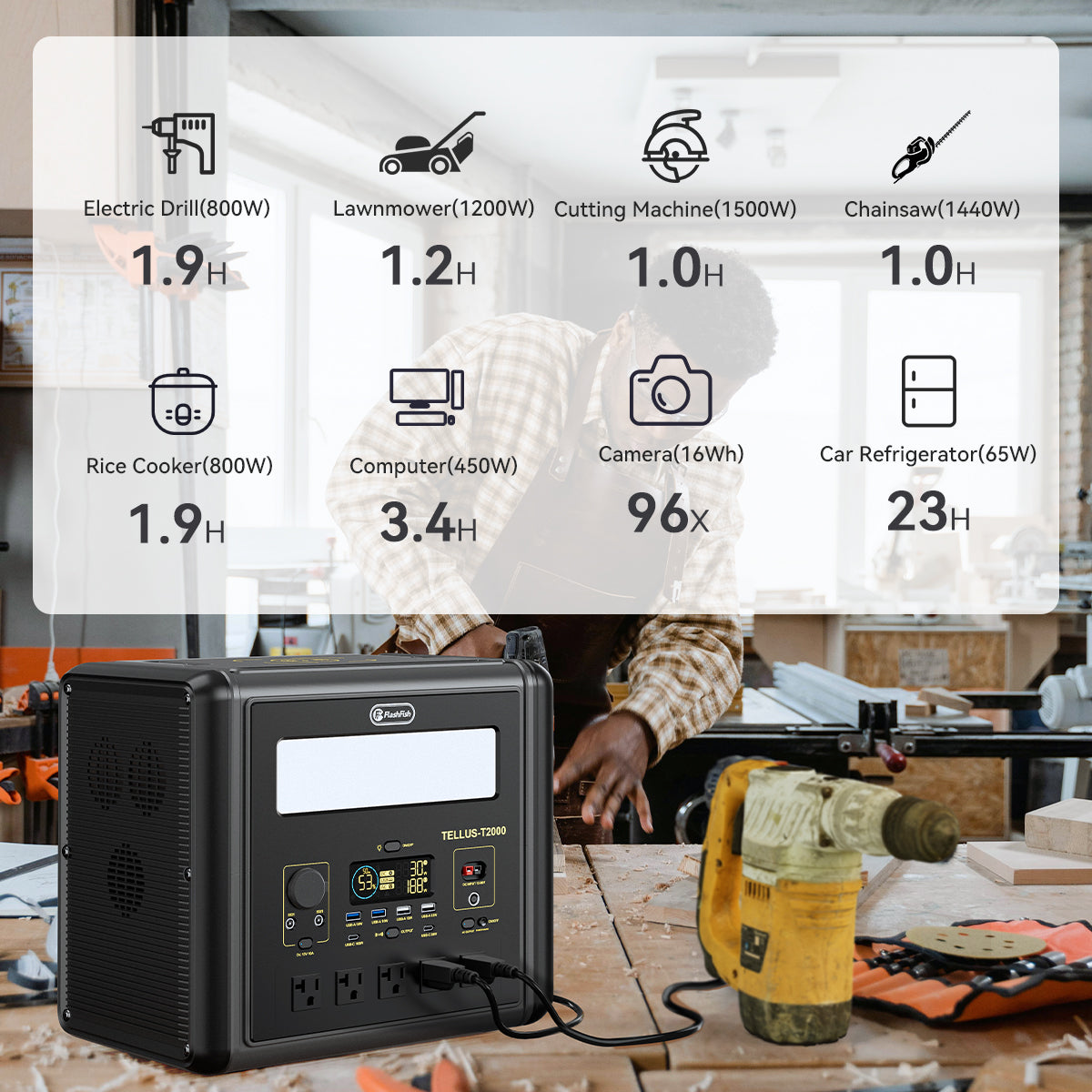
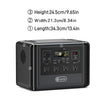

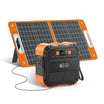

Use battery percentage to follow the station's displayed charge trend, interpreted through its exact documentation. Use a suitable delivered-energy meter to record Wh crossing a defined output location over a known interval. These readings answer different questions. Without documented calibration, neither a percentage drop nor nominal battery capacity establishes the energy delivered to a device.
During a non-critical device session, you might record a lower battery percentage and a higher external Wh total. Both observations can be useful. The mistake is treating them as two interchangeable measurements of the same thing. A useful plan keeps the charge display, measured output energy, and device behavior in separate columns.
Match the reading to the question
| Reading | Boundary | Units | Losses outside the reading | Supported decision | Unresolved calibration |
|---|---|---|---|---|---|
| Station battery percentage | Station's documented charge indication | % | Does not separately report output-path losses | Record the displayed charge trend during a session | Relationship between percentage change and delivered Wh |
| External energy counter | Meter's documented position on one output path | Wh | Losses before the meter are outside its count; losses after it are not separated | Record energy crossing that location during the interval | Accuracy, resolution, reset behavior, and coverage of other outputs |
| Average power calculated from counter change | Same meter location and complete interval | W | Shares the counter's boundary | Describe average measured-path power for that interval | Does not reveal instantaneous peaks or future consumption |
A meter before a device's charger and a meter after that charger cover different boundaries. Label the location clearly. Also record whether other station outputs or functions were active. A counter on one cable cannot establish the total energy delivered through every output.
Collect two parallel records without forcing agreement
- Identify the exact station, device, output path, and intended non-critical task.
- Use the station documentation to identify what its charge indication means. Preserve unknown calibration or display behavior.
- Choose an external measurement only when its instructions support the electrical path and operating conditions. Record its units, resolution, accuracy information, and reset behavior.
- At the start, record the time, displayed percentage, and energy-counter value. Do the same at the end.
- Record interruptions, changes in device state, other outputs, and any counter reset. Split the log when the configuration changes.
- Subtract valid counter endpoints to obtain interval Wh. Keep the percentage observations beside that result, without converting them into Wh.
If the counter reset during the session and you did not retain the earlier reading, the missing segment remains unknown. A final counter value may describe the period after the reset rather than the whole session. Similarly, a meter's placement can change the configuration being measured; consult its instructions instead of assuming every inline setup behaves identically.
Three examples of choosing the right evidence
1. You want average power for a recorded session
In a hypothetical example, a suitable energy counter begins at 5Wh and ends at 17Wh after two uninterrupted hours. The difference is 12Wh, and 12Wh ÷ 2 hours equals 6W average at that measurement location. These invented figures illustrate arithmetic, not a FlashFish test. They establish neither peak power nor the next session's consumption.
2. The percentage changes during that same session
Suppose the display moves from 70% to 60% while the counter records the hypothetical 12Wh difference. Save both observations. Do not conclude that every percentage point will deliver 1.2Wh, or that the same drop will recur under a different load. This single record does not establish a calibrated relationship across the station's charge range or operating conditions.
3. You compare two device configurations
Suppose you want to compare a light at two brightness settings. Use the same supported meter boundary, elapsed interval, and recorded starting conditions, and note each setting. Compare the resulting counter differences only within the instrument's limits. Keep the station percentage as a separate observation; do not replace missing counter data with a percentage-based estimate.
Why nominal capacity cannot complete the missing calculation
Nominal battery Wh is a product specification. Delivered Wh is an interval measurement at an output boundary. Turning one into the other requires evidence about the usable energy and the path involved. This article does not supply a universal loss percentage or a fixed conversion from displayed charge to output energy.
For planning, retain the actual device, configuration, task duration, and meter location alongside each session result. A relevant prior observation can inform a later plan, but changes in device activity or the measurement setup limit that comparison. Do not extend one session into a guaranteed runtime.
Where E200 and T300Pro fit
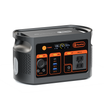
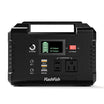
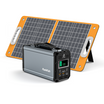
FlashFish E200 has a nominal capacity of 151Wh and T300Pro (TELLUS-T300Pro) has 230Wh. E200 has two USB-A outputs up to 18W and one up to 12W. T300Pro has USB-C outputs up to 100W and 30W. These specifications help identify candidate output paths after checking your device's requirements.
The capacities do not prove how much either station will deliver to your device. A calibrated percentage-to-delivered-Wh relationship, numerical display accuracy, and an approved external meter pairing remain undocumented here. Regional AC configurations also require exact U.S. documentation if you choose an AC measurement path. No model wins this comparison on capacity alone.
FAQ
Can I multiply capacity by the remaining percentage?
That calculation does not establish deliverable device energy without a documented relationship between the display, usable battery energy, and output path. Keep that value unknown rather than presenting it as measured Wh.
Does an output meter count energy stored inside my phone?
It records energy at its own location. It does not independently measure what the phone stores internally or separate the phone's operating consumption from charging.
Which reading should I record first?
Record both at the start and end if available, with timestamps. Use the percentage for the documented charge indication and the valid counter difference for measured-path energy.
Choose a station after defining the measurement task
Write down the output path your device needs and the evidence you want to collect. Compare E200 and T300Pro documentation against those requirements, then confirm the exact model and measurement setup. Use recorded delivered energy for the device session and preserve battery percentage as its own observation.
Next step: Compare FlashFish E200 specifications with your requirements.


发表评论
此站点受 hCaptcha 保护,并且 hCaptcha 隐私政策和服务条款适用。