

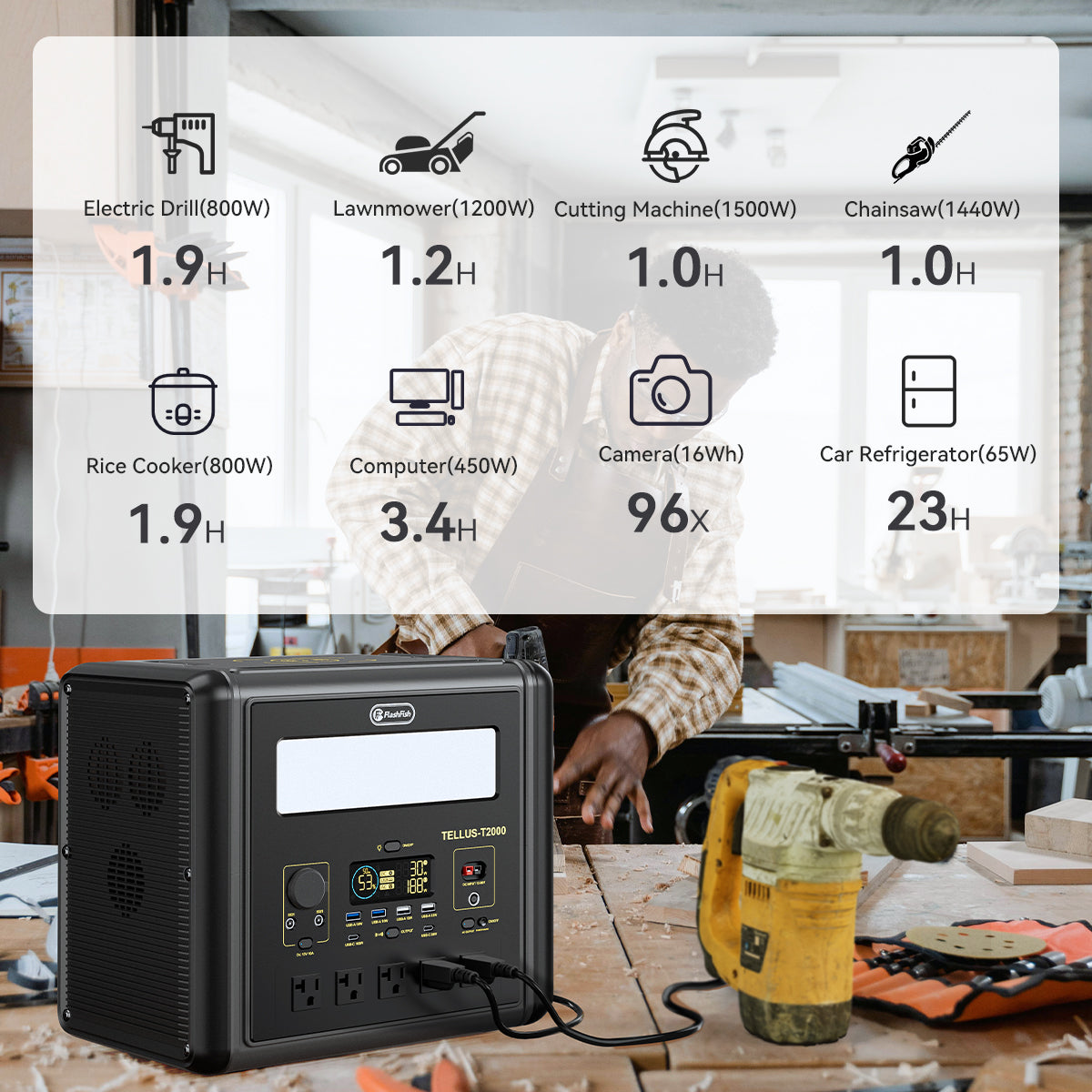
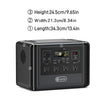
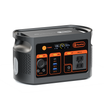
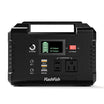

No. FlashFish T1200S and T2000 each list a shared 130W DC output limit across the cigarette-lighter socket, DC5521 port, and DC5525 port. T2000's larger battery does not increase that shared DC allowance. Check each accessory's voltage, connector, polarity, and electrical requirements before allocating the budget.
Three connection points can look like three independent supplies. For these two stations, that is the wrong starting assumption. The useful comparison is whether your documented accessories fit one shared DC output group, then whether the battery capacity and handling demands suit your plan. This article addresses those DC connections; it does not approve an installed vehicle system, a medical device, or a household circuit.
The DC comparison that matters
| Specification | T1200S | T2000 |
|---|---|---|
| Listed DC output | 13V, 10A | 13V, 10A |
| Connection points in the shared group | One cigarette-lighter socket, one DC5521, one DC5525 | One cigarette-lighter socket, one DC5521, one DC5525 |
| Shared maximum DC output | 130W across that group | 130W across that group |
| Nominal battery capacity | 768Wh | 1536Wh |
| Listed weight | 12.45kg / 27.45lb | 19.2kg / 42.33lb |
The model manuals describe DC5521, DC5525, and cigarette-lighter power sharing. Do not count 130W separately for each socket or substitute either station's AC rating for this DC limit. T2000 doubles nominal battery capacity, but the DC output figures above remain the same.
The 13V listing also matters independently of wattage. An accessory described casually as “12V” still needs documentation showing that the proposed supply voltage is acceptable. A connector that appears to fit does not establish voltage tolerance, polarity, or a sufficient cable rating.
Build a connection map before adding watts
| Field for each accessory | What to capture | Leave unresolved when |
|---|---|---|
| Supply voltage | Manufacturer's permitted input range | The label gives only a nominal name or omits the range |
| Connector and polarity | Exact plug dimensions, polarity, and manufacturer-specified cable | A barrel plug merely looks similar |
| Power requirements | Documented maximum input and any startup behavior | Only an average measurement or an adapter's output ceiling is available |
| Usage schedule | Which accessories must run together and which may wait | Shared use changes without an updated list |
| Station controls | Exact model's DC switch and operating instructions | Behavior is inferred from another output group |
Resolve the connection requirements first. Adding wattages cannot repair an unsuitable voltage or an undocumented adapter. If a manufacturer states current rather than power, calculate power using the documented voltage and current for that same operating condition; do not mix a nominal voltage from one line with a maximum current from another without checking their meaning.
Account for one shared allowance
Group the DC accessories that would be on at the same time. Compare their documented requirements with the shared 130W ceiling, while checking the exact station manual for individual socket, cable, and operating limits. A combined number below 130W is only one screening result. It is not a guarantee that the connections, startup demands, or operating behavior fit.
Keep an unresolved startup requirement visibly unresolved. Do not plan to solve it by repeatedly triggering overload protection or by assuming the higher-capacity station has a higher DC limit. When documentation does not support the proposed combination, change the schedule or obtain the missing information before proceeding.
Three hypothetical accessory lists
- Two accessories documented at 40W and 30W: their stated concurrent total is 70W. That is below the shared ceiling on either model, but voltage, polarity, cables, and startup requirements still need checking. The arithmetic is not a tested combination.
- Three accessories documented at 50W each: the stated total is 150W, above the listed shared maximum on both stations. T2000's larger battery does not fix that mismatch. Review whether a documented schedule can avoid concurrent use, or select a different documented supply.
- One accessory with no readable electrical label: the port count and remaining numerical allowance cannot approve it. Obtain the exact manual or manufacturer specifications before including it in either station's connection map.
Choose capacity only after the DC map fits
If the connection map can be supported on either model, T1200S offers the lower listed weight and lower nominal stored energy. T2000 offers more nominal stored energy with a heavier unit. Compare those trade-offs against where the station will be placed, how it will be moved, and your documented use schedule.
Battery capacity does not establish delivered DC energy or a specific operating duration. Conversion losses, actual device behavior, battery condition, and operating conditions remain separate questions. This comparison provides no measured runtime, automatic-backup result, or simultaneous-output test.
Keep DC, USB, and AC checks separate
The shared group discussed here is the listed DC5521/DC5525/cigarette-lighter group. It does not establish a combined limit for every output on the station. Check the exact model manual before using DC alongside USB or AC. Moving an accessory to another output requires a documented power path of its own; an improvised adapter is not a substitute for that evidence.
Before buying, finish the connection map, mark the accessories that need to run together, and resolve missing limits. Confirm the exact U.S. unit and manual, then compare capacity and handling. If the intended use involves installed wiring or specialized equipment, obtain the appropriate qualified assessment separately.
Frequently asked questions
Does T2000 provide a larger DC allowance than T1200S?
No. Both list 13V, 10A DC output with a 130W maximum shared by the cigarette-lighter, DC5521, and DC5525 connections.
Can I use 130W from each of the three connections?
No. The documented 130W maximum is shared across that group, not repeated for every socket. Individual connection and cable requirements still apply.
Will a device marked 12V work with the listed 13V output?
The nominal name alone cannot answer that. Verify its permitted input-voltage range, connector, polarity, cable, and other requirements against the exact station documentation.
Does twice the battery capacity mean twice the DC runtime?
No. T2000 has twice the nominal capacity, but delivered energy and operating duration for a particular accessory schedule have not been established here.
Next step: Compare FlashFish T1200s specifications with your requirements.


发表评论
此站点受 hCaptcha 保护,并且 hCaptcha 隐私政策和服务条款适用。