

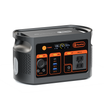
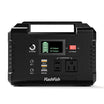

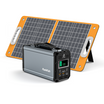
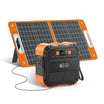

E103 has documented AC charging up to 100W and DC charging up to 90W; up to 190W refers to its documented combined mode. Its available U.S. manual and product record disagree on AC input voltage. Check your unit's label and matching manual before connecting a source.
If you have seen 90W, 100W and 190W attached to the same power station, those figures do not describe three interchangeable charger choices. They describe different input paths. A fourth number, the station's 300W continuous AC output rating, describes supplying equipment, not charging the battery.
Which E103 figure belongs to which charging path?
| Path or specification | Documented figure | What it establishes | What it does not establish |
|---|---|---|---|
| AC charging | Up to 100W; voltage discrepancy described below | The documented maximum for the AC charging path | Permission to connect every voltage mentioned in a different regional document |
| DC charging | 12-30V, 4A, up to 90W | The listed DC input limits | Connector polarity, exact plug dimensions or compatibility with an arbitrary panel |
| Combined AC and DC charging | Up to 190W in the documented combined mode | A separate mode described in the E103 product record | A 190W rating for either individual input |
| USB-C | Up to 60W output | A documented device-charging output | A documented USB-C input for charging E103 |
| AC equipment output | 300W continuous | A power limit for supplying equipment | The battery's charging input limit |
The E103 capacity recorded in the product database is 179.2Wh. Capacity is an energy quantity; input and output watts are power limits. Dividing capacity by a headline input figure cannot establish an exact full-charge time: initial charge, changing accepted power and losses are not supplied by that calculation.
The AC voltage discrepancy needs a unit-specific answer
The product database and the current U.S. product-page specifications list AC input as 100-240V, up to 100W. However, the E103 110V manual linked by the official U.S. user-guide page lists AC charging as 100-120V, up to 100W on printed page 4 (PDF page 7). These sources agree on maximum charging power but not on voltage range. This comparison was checked on October 7, 2026.
Do not resolve that difference by choosing the wider range. A document title, store location or matching model name is not enough to identify every hardware revision. Read the input rating printed on your exact unit, identify its manual revision and ask FlashFish to resolve any mismatch before connection. A travel adapter changes a plug shape; it does not by itself establish an acceptable supply voltage.
This guide reports the conflicting documentation rather than certifying either range for every E103. It also does not authorize higher-voltage operation or replace the instructions supplied with your unit. The official user-guide directory is the starting point for finding the appropriate document, not proof that a particular revision matches your hardware.
DC compatibility requires more than a wattage match
The local E103 record and the available U.S. manual agree on the listed DC limits: 12-30V, 4A and 90W maximum. Read them together, not as alternative ways to qualify a source. A panel advertised as 90W or 100W is not automatically a suitable charger.
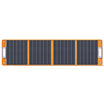
Before buying a cable or panel, obtain the panel's open-circuit voltage and relevant operating specifications, the exact connector and polarity, and the compatibility instructions for your station revision. A nominal panel voltage is not a substitute for its open-circuit voltage. The product database's E103 connector field says only DC input; it does not provide enough detail to approve an arbitrary connector or adapter.
Use manufacturer-supported equipment and the matching instructions. Do not improvise a cable arrangement, connect the station's output back into its input, or infer an approved vehicle connection from a plug that happens to fit.
Three examples of a claim that needs a second check
These are documentation checks, not measured charging tests or connection instructions.
Example 1: A 100W AC input is described as 190W
A seller highlights the combined-mode figure beside a single AC charger. The individual AC path is documented at up to 100W, not 190W. The combined figure belongs only to the separately documented AC-plus-DC mode. Ask which path the specification describes; do not transfer a combined limit to one socket.
Example 2: A 100W panel is selected because DC accepts 90W
The two wattage labels alone leave the decision unresolved. You still need the panel's voltage data, connector, polarity and approved pairing. The 90W figure is an input ceiling, not a promise that the station accepts any panel with a nearby wattage or will take 90W throughout charging.
Example 3: A 220-230V source is justified by a web specification
The broader product specification conflicts with the available 110V manual's AC charging entry. Stop the compatibility decision until your unit's label and matching revision are confirmed. A regionally different illustration or a socket adapter cannot resolve the discrepancy.
Keep a small source record before choosing a charger
Record the exact model and revision, photograph the unit's input label, save the matching manual page and note whether a figure describes AC input, DC input, combined charging or an output. For a candidate source, keep its complete rating and manufacturer-approved cable information. Leave unresolved fields blank instead of copying values from another FlashFish model.
The available manual also treats its power display as a reference, not a precision instrument. A display observation cannot validate a source's voltage compatibility. Likewise, the advertised approximately 70-minute combined-charge statement is not a guarantee for your initial charge level, equipment or operating conditions.
Frequently asked questions
Can E103 accept 190W through AC charging alone?
No. The documented AC input maximum is 100W. Up to 190W refers to the documented combined AC and DC mode, not a single AC charging path.
Is the 60W USB-C port a documented E103 charging input?
The product database identifies it as an output. This guide does not approve charging E103 through USB-C without revision-specific input documentation.
Which AC voltage range should I rely on?
The available sources disagree: the product record lists 100-240V while the linked 110V manual lists 100-120V. Confirm the label and matching manual for your exact unit and seek manufacturer clarification before connection; this guide does not authorize the wider range.
Next step: View the current FlashFish E103 product details.


コメントを書く
このサイトはhCaptchaによって保護されており、hCaptchaプライバシーポリシーおよび利用規約が適用されます。