



Before claiming that a device's startup peak was captured, check the instrument's documented measurement quantity, response or acquisition timing, rated connection path, and recording mode against the event you want to observe. A peak-hold label or the largest number in a sampled log does not establish that every shorter event was captured. If the necessary specifications are missing, the uncaptured peak remains unknown.
This comparison is for people assessing existing observations of ordinary, non-critical devices. It helps you decide what a reading can support and what documentation to request. It does not recommend a meter, provide an overload test, or certify that a device will start on a particular portable power station.
Start with the quantity you need to know
Write the question before comparing instruments: are you trying to document a maximum reported power in watts, a current reading in amps, or a time series over a startup interval? Keep the quantity and units attached to every result. A display that reports maximum current does not, by that label alone, document a maximum real-power measurement.
Next identify what the device documentation says about the event. If there is no documented duration, do not invent one from how quickly the device seems to turn on. If there is no exact instrument manual, you cannot establish its ability to capture that event. The comparison can still produce a useful list of missing evidence.
What peak hold and a sampled log can tell you
A peak-hold mode may be useful when the instrument documentation defines the quantity retained and the conditions under which it is captured. A sampled log may be useful when you need a sequence of recorded observations with times. Their usefulness depends on the actual implementation, so neither label is enough to choose a winner.
| Evidence field | Peak-hold mode | Sampled log |
|---|---|---|
| Measured quantity | What maximum is retained, with units | What each saved value represents, with units |
| Timing | Documented capture response or acquisition window | Internal acquisition details and saved-record cadence |
| Processing | Trigger, averaging, reset, and hold behavior | Instantaneous, averaged, or interval-maximum records |
| Rated path | Exact connection type and applicable operating limits | Same checks for the actual logging setup |
| Event evidence | Known event duration and conditions | Event duration plus alignment with recorded timestamps |
| Recorded maximum | Retained reading with configuration notes | Largest saved value with the original sequence |
| Blind spot | Unsupported event durations or undocumented behavior | Unobserved intervals or undocumented processing |
Separate screen refresh from acquisition and storage
The documentation must tell you which timing specification applies to your question. A screen refresh interval, an internal acquisition interval, and a saved-record interval are different fields to check. Do not assume that a log saving one value per second takes only one internal measurement per second; equally, do not assume it preserves an internal maximum.
Look for the exact mode used in the manual, including any averaging or maximum function. Record the manual revision and settings beside the observation. If the manufacturer gives only a display-update specification, describe that limitation rather than translating it into an undocumented transient-capture capability.
Even a response specification that looks shorter than an event duration does not settle every issue. You still need relevant quantity, range, trigger behavior, and operating conditions. The strongest supported statement may remain “this instrument reported this value under these settings,” rather than “this is the device's true startup peak.”
Three hypothetical timing comparisons
These are simplified evidence examples, not specifications for any real meter or startup data for a FlashFish product.
1. Isolated samples leave an unobserved interval
Suppose an instrument is documented to save instantaneous point samples at 1-second intervals, with no intervening maximum retention. A hypothetical event lasting 20 milliseconds occurs entirely between two samples. The saved values do not establish its maximum. Dividing or multiplying a recorded value cannot recover the missing peak.
2. A response figure needs its conditions
Suppose a hypothetical peak-hold specification gives a 10-millisecond capture condition, and device documentation describes a 100-millisecond event. That timing comparison is worth checking, but it does not automatically validate the measurement. Confirm what the 10-millisecond figure means and whether the quantity, range, trigger, and event conditions match.
3. A fast-looking display has no response evidence
Suppose a screen updates every 0.5 seconds, but the manual does not describe transient capture or the saved statistic. A displayed maximum is still an observation. Its refresh rate alone cannot support a claim that a 5-millisecond event was captured.
Keep the review within documented use
Use existing records and manufacturer documentation to build the comparison first. Any actual connection requires the exact instrument, station, and device instructions to establish the intended path and operating limits. This article does not supply that authorization or an electrical measurement procedure. Do not open equipment, improvise probes, or deliberately force an overload to fill an evidence gap.
If the documentation does not establish a suitable method, request clarification from the manufacturers. Preserve missing information as unknown. An article about evidence quality cannot replace an instrument manual or instructions for the exact unit.
Product fit: FlashFish E103 and T300Pro
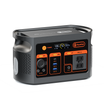
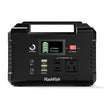
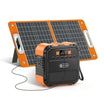
FlashFish E103 is specified at 179.2Wh with 300W rated pure-sine AC output. The referenced manual is for a 230V version; verify the exact U.S. unit documentation before applying AC information. FlashFish T300PRO (TELLUS-T300Pro) is specified at 230Wh with 300W continuous pure-sine AC output and a 120V, 60Hz configuration.
These are product ratings, not measured startup traces. These ratings do not establish an instrument response specification, the duration of your device's startup event, or proof that the pair is compatible. Choosing between these stations still requires the actual device requirements and regional product documentation; neither capacity nor an observed meter maximum resolves those questions.
Frequently asked questions
Is a peak-hold meter always better for startup?
No. Compare its documented capture behavior with the exact question and event. A log may offer useful timing context, while a hold mode may retain a value without a sequence. Neither function establishes capture of an unspecified event.
Can a sampled maximum prove the device never drew more?
Only make a claim within the documented coverage of that measurement. If intervals or processing behavior leave events unobserved, the maximum saved value cannot rule out a larger uncaptured event. State the observation and the missing evidence separately.
Does successful startup confirm ongoing compatibility?
An observed start describes that occasion. It does not establish every operating condition, another device configuration, or a guaranteed result. Keep the observation separate from product ratings and the manufacturer's requirements for the complete setup.
Make an evidence card before selecting a station
Record the instrument and mode, rated path, measured quantity, timing specification, event evidence, observed maximum, and blind spot. When a field is missing, write the exact documentation question beside it. Use that card alongside your device requirements to compare the exact FlashFish model details before committing to a configuration.
Next step: Compare FlashFish E103 specifications with your requirements.


Leave a comment
เว็บไซต์นี้ได้รับการคุ้มครองโดย hCaptcha และมีการนำนโยบายความเป็นส่วนตัวของ hCaptcha และข้อกำหนดในการใช้บริการมาใช้