



For a recharge billed at one applicable energy rate, multiply measured wall-input kilowatt-hours by your marginal electricity rate in dollars per kilowatt-hour. Use the difference between the meter's ending and starting readings. Nominal battery capacity is not a measured wall-input value, and a fixed monthly charge belongs outside this incremental calculation if the recharge does not change it.
The answer depends on your charging session and bill. This worksheet estimates the added electricity expense for a defined recharge, separately from the station purchase price, accessories, or total household bill. It provides no national rate estimate and no measured FlashFish recharge cost.
Measure the energy you are paying for
Use a wall-energy meter only with equipment and connections covered by its instructions and the station's charging documentation. Identify the exact station and charger. Record the starting charge indication, the ending condition you intend to measure, the meter's units, and the measurement start and finish.
For a cumulative meter, subtract the starting kWh reading from the ending reading. If the meter can be reset, follow its instructions and still record how you established the starting value. Keep the station charger as the defined load; unrelated equipment included in the same measurement would change the meaning of the result.
Choose an endpoint before starting. A partial top-up and a recharge to the station's documented full-charge indication are different sessions. If you include time left connected afterward, say so. A station input-watt display is not a substitute for cumulative energy measured at the household outlet.
Find the rate that applies to the extra energy
Read your applicable tariff or bill rather than borrowing an average online rate. Identify the charges that change when you add the measured kWh. For a simple single-rate worksheet, combine only the applicable per-kWh components and document what they include.
If your tariff changes by time or usage tier, identify the rate applying to each part of the session. A total cumulative meter reading may be insufficient to allocate energy between rate periods. Use an appropriate interval record or measure sessions within a known rate period; otherwise retain the allocation as unknown.
A fixed customer charge that is unchanged by the recharge adds zero to this particular incremental calculation. If your bill includes another charge affected by the session, the simple kWh formula does not establish its contribution. Check the tariff's calculation rather than assuming every bill line is either included or excluded.
Three hypothetical cost calculations
Every reading and rate below is hypothetical. They are arithmetic examples, not current utility tariffs, FlashFish test results, or full-charge estimates for a specific model.
| Case | Meter start | Meter end | Input difference | Assumed applicable components | Total variable rate | Session cost |
|---|---|---|---|---|---|---|
| 1 | 1.000 kWh | 1.200 kWh | 0.200 kWh | $0.12 energy + $0.03 variable delivery per kWh | $0.15/kWh | $0.030, or 3 cents |
| 2 | 2.000 kWh | 2.300 kWh | 0.300 kWh | $0.25/kWh combined applicable variable charge | $0.25/kWh | $0.075, or 7.5 cents |
| 3 | 0.500 kWh | 0.620 kWh | 0.120 kWh | $0.35/kWh combined applicable variable charge | $0.35/kWh | $0.042, or 4.2 cents |
In case 1, the calculation is (1.200 − 1.000) × 0.15 = $0.030. Case 2 costs more because both the assumed energy use and rate are higher. Case 3 uses less energy but has a higher assumed rate. No case establishes what your station will draw or what your utility will charge.
Retain the unrounded result in your worksheet. The precision of your meter and the billing method limit the precision of the estimate. To estimate several sessions, add their measured costs; do not assume every top-up consumes the same kWh.
Why E200 and T200 capacity does not settle the bill
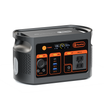
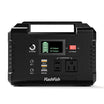
FlashFish E200 has a documented nominal capacity of 151 Wh, while T200 has 153.6 Wh. Converting those values gives 0.151 and 0.1536 kWh of nominal battery capacity. Neither number is a measured household-outlet recharge reading.
The starting charge condition, endpoint, and energy used in the charging path are not supplied by the nominal-capacity label. Neither capacity specification supplies the session-specific wall-input measurement needed for this worksheet. Do not add an invented efficiency factor or assume the two models have equal recharge expense because their capacities are close.
For product fit, confirm the exact U.S. unit's charging path and equipment first. Then evaluate E200 or T200 using a documented wall-input session and your own tariff. This operating-cost method does not establish output compatibility, runtime, or the better purchase.
FAQ
Can I use the total bill divided by total kWh?
That produces an average bill figure that may include unchanged fixed charges. It does not necessarily represent the rate applying to the added recharge. Identify the applicable variable components instead.
What if I have no wall meter?
Keep actual session consumption unknown. Nominal battery capacity can identify the model, but it cannot establish a measured recharge cost. Obtain a documented input measurement before presenting a result as observed.
Does this include the cost of the station?
No. Keep purchase cost and accessories in a separate budget. This worksheet addresses only the additional electricity charge for its defined session and rate assumptions.
Build your own recharge-cost record
Start with the exact E200 or T200 charging documentation, a suitable meter, and your applicable bill or tariff. Save the readings, session endpoint, rate components, and calculation together. That record gives you a concrete operating-cost figure to use alongside current product details when choosing a station.
Next step: Check the current FlashFish E200 product details and price.


Leave a comment
เว็บไซต์นี้ได้รับการคุ้มครองโดย hCaptcha และมีการนำนโยบายความเป็นส่วนตัวของ hCaptcha และข้อกำหนดในการใช้บริการมาใช้