

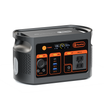
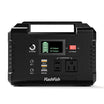

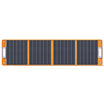
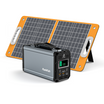
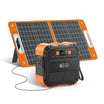
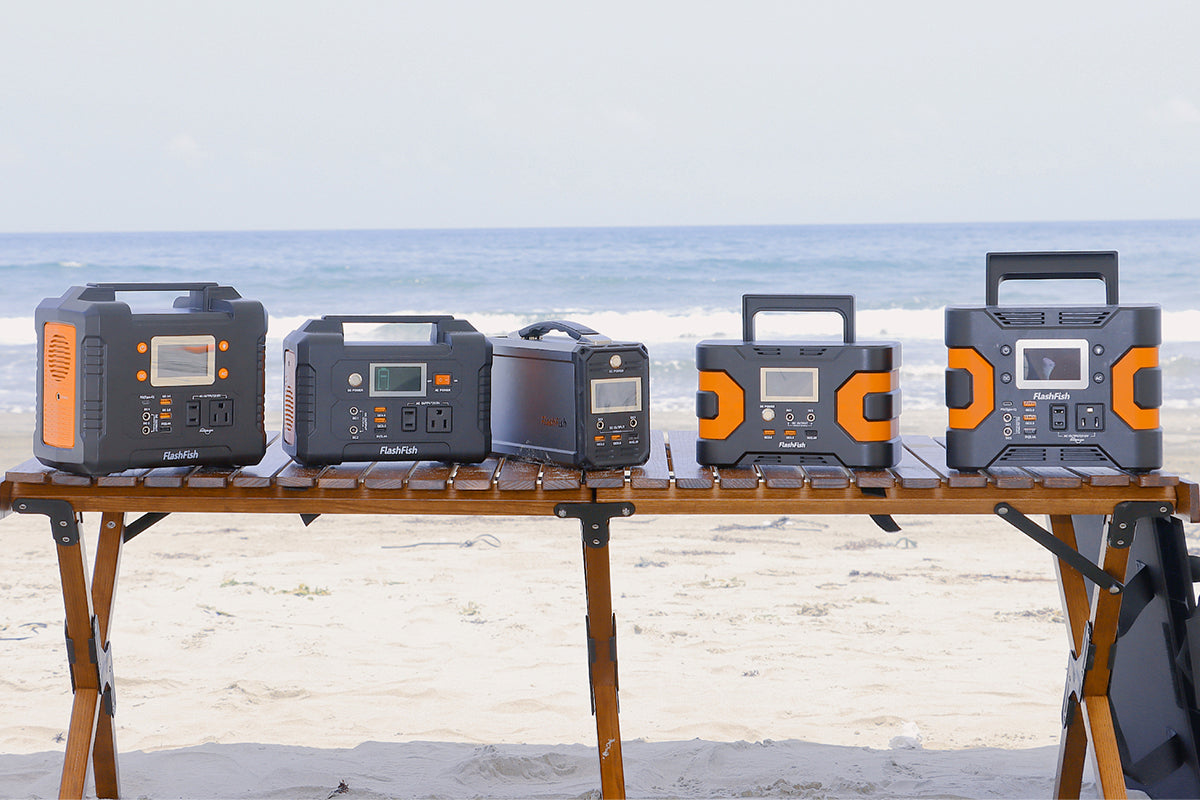
The first FlashFish portable power station to compare should come from your largest device load, total watt-hour need, required ports, recharge path, and carry limit. Compact models fit light charging and small AC plans, T300PRO and E103 fit selected 300W-class plans, T1200S fits larger portable loads, and T2000 is the high-capacity boundary. No single model is universally best.
Quick answer: start with your largest load and use case
Do not start with a model name. Start with the highest-watt device you actually plan to use, the number of devices that may run at the same time, and whether you need AC, USB-C, USB-A, DC, or solar input. Once those basics are clear, compare only the FlashFish models whose documented limits fit the plan.
The current U.S. store lists the FlashFish portable power stations collection as the main comparison path.
How to choose the first FlashFish model to compare
- Find the largest load. Use the official label or manual for the device, adapter, or charger.
- Check the port path. Decide whether the load uses AC, USB-C, USB-A, or DC.
- Check simultaneous use. A station that fits one device may not fit every device at once.
- Set the carry limit. A larger station can add output and capacity, but it also adds weight.
- Decide whether solar matters. Choose station storage first unless outdoor top-up is part of the plan.
Model-selection table
| Planning tier | Documented examples | Start here when | Boundary |
|---|---|---|---|
| Ultra-compact | A101 | Lowest carried weight and lower-power charging matter most | Available facts do not provide chemistry or AC waveform |
| Compact 200W | E200, T200 | Small AC or USB charging plans fit after label checks | E200 USB-C is not documented; no runtime promise |
| 300W class | E103, T300PRO | Selected compact higher-output loads need a 300W class | E103 chemistry is not provided in the available product facts |
| 1200W class | T1200S | Larger selected loads and more stored energy are needed | No whole-home claim |
| 2000W class | T2000 | Higher output or capacity headroom is documented as necessary | No appliance guarantee |
| Solar path | TSP60, TSP100, active kits | Outdoor recharge or top-up is part of the plan | No exact recharge time |
Compact USB and light AC planning
Start with A101, E200, or T200 when the load list is mostly phones, small lights, compact USB devices, and lower-power AC charging. A101 is documented at 97.68Wh with 120W continuous AC output and 1.2kg weight. E200 is documented at 151Wh with 200W continuous AC output and modified sine wave AC. T200 is documented at 153.6Wh with 200W continuous AC output, LiFePO4 chemistry, pure sine wave AC, and USB-C up to 60W.
300W-class planning
Compare E103 or T300PRO when a compact 200W class is too small but a larger station is unnecessary. E103 is documented at 179.2Wh with 300W pure sine AC output and USB-C up to 60W, but its chemistry is not provided in the available product facts. T300PRO is documented at 230Wh with 300W continuous AC output, 600W peak output, LiFePO4 chemistry, pure sine wave AC, and USB-C up to 100W.
1200W-class planning
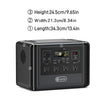
Start with T1200S when the load list needs a larger portable station but does not justify the T2000 class. T1200S is documented at 768Wh with 1200W continuous AC output, 2400W peak output, LiFePO4 chemistry, pure sine wave AC, four AC outlets, USB-C up to 100W and 30W, and 12.45kg weight. It is a portable load-planning option, not a whole-home backup claim.
2000W-class planning
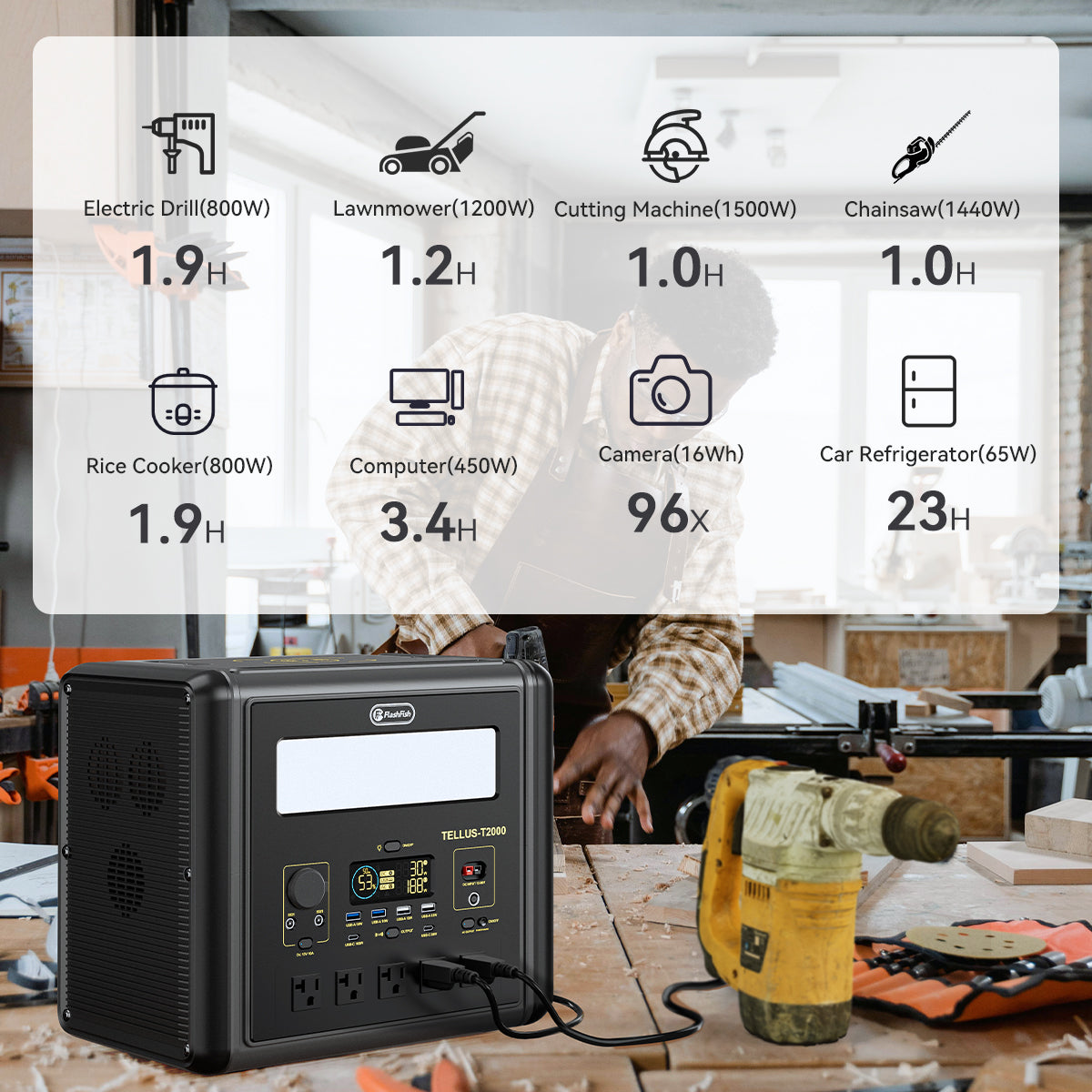
Compare T2000 first when your checked load list needs the higher documented output and capacity. T2000 is documented at 1536Wh with 2000W continuous AC output, 4000W peak output, LiFePO4 chemistry, pure sine wave AC, four AC outlets, USB-C up to 100W and 30W, 600W max solar/DC input, and 19.2kg weight. This is the high-capacity boundary in this comparison, not a promise that every appliance will run.
When to add solar-panel or kit comparison
Add the solar generator kits collection or the portable solar panels collection only after the station itself fits the load plan. TSP60 is documented as a 60W, 18V foldable panel, and TSP100 is documented as a 100W, 18V foldable panel. A panel is a recharge path; it does not replace stored energy in the station.
Where available facts are incomplete
Some active Shopify products are not fully covered by available manual-level facts in this run. Treat P56, P63, P66, BP030B, A201, and X60 as active store paths only unless a later review supplies verified details. Do not fill blank chemistry, waveform, port, package, or compatibility fields from assumptions.
When FlashFish fits
FlashFish fits when the shopper wants a budget-aware portable power station comparison and is willing to choose by load, capacity, output class, port path, recharge path, and weight. It also fits when the user wants to move from compact everyday backup into camping power or larger portable outage planning without jumping straight to a hardwired solution.
When FlashFish may not fit
Choose another solution or seek qualified advice when the plan involves hardwired circuits, medical equipment, whole-home backup, public-safety continuity, weather exposure, building-code questions, or a named device whose official label does not fit the station. Also pause when you need a price, warranty, certification, stock, review, or runtime claim that has not been verified.
Related model and planning guides
- Portable Power Station Watt-Hours Explained
- 300W vs 1200W Portable Power Station: When to Step Up
- Portable Power Station or Solar Generator Kit First?
FAQ
Which FlashFish portable power station should I compare first?
Compare the tier that matches your largest checked load, total watt-hour need, required ports, recharge path, and carry limit. Do not choose by model name alone.
Which FlashFish models are best for compact charging?
A101, E200, and T200 are the first compact examples to compare. Use A101 for the lightest lower-power plan, E200 for a compact 200W AC plan, and T200 when documented LiFePO4 chemistry and USB-C support matter.
When should I compare T1200S or T2000 instead of compact models?
Compare T1200S or T2000 when your largest checked load, total stored-energy need, or outlet plan exceeds the compact tiers. Use T2000 only when the higher output or capacity headroom is necessary.
Should I choose a FlashFish solar generator kit or station-only page first?
Choose the station first if stored energy and output are the main questions. Add a kit comparison when outdoor solar recharge is part of the plan and the panel path is compatible with the station.
Which active Shopify products are not fully covered by available product facts?
P56, P63, P66, BP030B, A201, and X60 appear as active store paths in this run, but available product facts do not provide the same manual-level detail for them. Keep claims about those products to verified Shopify status or reopen source review.

发表评论
此站点受 hCaptcha 保护,并且 hCaptcha 隐私政策和服务条款适用。